Enterprise Systems
Enterprise Systems Development
Enterprise systems that connect departments, approvals and the tools you already run
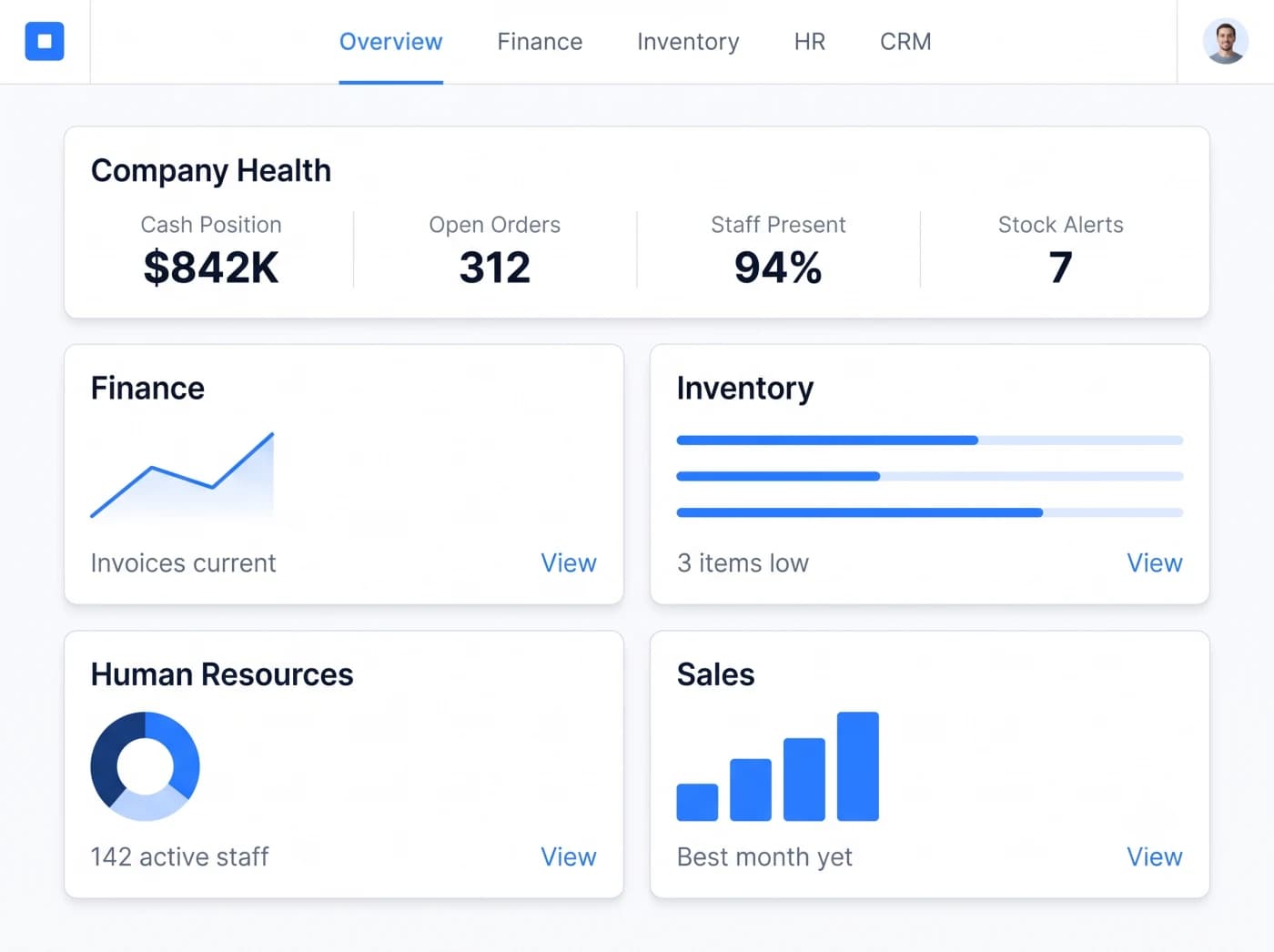
When finance, operations, sales and HR each keep their own spreadsheets and approvals move by email or WhatsApp, nobody sees the whole picture. We build multi-department platforms with shared records, approval workflows, role-based access, audit history and integrations with the ERP, accounting and HR systems you keep. Looking for ERP development specifically? Our custom ERP software page covers it.
What we handle
- Multi-Department Workflow Platforms
- Approval and Escalation Workflows
- Role-Based Access and Audit History
- Integration Layer Across Existing Systems
- Business Intelligence and Reporting
- Document Management Systems
What is enterprise systems development?
Enterprise systems are the software an organization runs on when several departments share the same records and decisions: a purchase request that needs three approvals, a customer that sales, finance and support all touch, a report that today is consolidated by hand from five spreadsheets.
This page is the overview. The detailed pages sit under our enterprise software development hub and are listed in the box beside this text, so you can go straight to the one that matches your project. If you need an ERP itself (finance, inventory, procurement and production in one system), start with custom ERP software.
Whichever route fits, delivery follows the same five steps: a written plan of modules, roles, approvals, reports and integrations, a free pilot of 2 to 3 key modules, then staged rollout department by department. Our published example is a bilingual public-sector platform in Qatar with case management, role-based access, audit trails and data migration.
Delivered remotely from our Islamabad headquarters, with scheduled video meetings in your working hours; on-site visits only when agreed in the contract. See the countries we serve.
Choose the page that matches your project
- Enterprise software development: The main enterprise hub: scope, governance and how large programmes are delivered.
- Custom ERP software: Finance, inventory, procurement and production in one system.
- Multi-entity ERP: One governed ERP across companies, currencies and locations.
- Workflow automation: Approvals, hand-offs and escalations that currently run on email.
- System integrations: Connecting the ERP, accounting, HR and legacy systems you keep.
- Legacy modernization: Replacing or upgrading an old system without losing its business rules.
- Government systems: Case management, applicant portals and audit for public bodies.
- Digital transformation: Moving manual, paper or spreadsheet processes into structured systems.
Enterprise systems development: problems it solves
Common problems
- Finance, HR, operations and sales each keep their own system, so the same record is entered and reconciled several times
- Leadership cannot see cross-department figures without days of manual consolidation
- A licensed ERP forces workarounds for industry-specific steps, and every change is a vendor negotiation
- Approvals run on email and WhatsApp, with no record of who approved what and when
How we approach them
- One governed platform for shared records and approvals, connected to the ERP, accounting and HR systems you keep
- Role-based access per module and action, an audit log of changes, and encryption in transit and at rest as part of our standard security design, with specifics agreed per project
- Phased rollout: core modules first, departments in turn, with the old system running in parallel where needed
- Project code and documentation transfer to you on full payment, as set out in our IP policy
A good fit when
- Several departments or legal entities share records, approvals and reports
- You keep an ERP or accounting system, but the work around it runs on spreadsheets and email
- Audit history and permissions matter for regulation, funding or internal control
Another option may suit you better when
- One department with one workflow: a focused custom software project is smaller
- Your need is finance, inventory and procurement: start at custom ERP software or ERP implementation
- Only the data flow between two systems is missing: see systems and API integration
What's included in enterprise systems development
Linked cards open a dedicated page with its own scope, fit and questions.
Multi-Department Workflow Platforms
One system for work that crosses departments: requests, hand-offs and shared records, so nothing is lost between teams or re-typed from one tool into another.
Approval and Escalation Workflows
Approval chains, delegation and escalation that replace email and WhatsApp threads, with a record of who approved what and when.
Role-Based Access and Audit History
Permissions per module and per action, and an audit log of changes, so each person sees and does only what their role allows.
Integration Layer
Connections to the ERP, accounting, HR and legacy systems you keep, through their APIs or reliable data exchanges, so data flows without duplicate entry.
Business Intelligence and Reporting
Live dashboards and reports drawn from shared data, instead of spreadsheets consolidated by hand at month end.
CRM Platforms
Customer records, sales pipeline and support requests shared across sales, finance and service teams.
HR Management Systems
Hiring, attendance, leave, reviews and staff records in one place, connected to payroll and approvals.
Document Management Systems
Documents with versions, access control, approval routing and long-term records.
ERP Modules
Finance, inventory or procurement modules as part of a wider platform. For a full ERP build, see our custom ERP software page.
Not sure which of these you need? Talk to us on WhatsApp.
Usually in scope
- Shared records, approval and escalation workflows
- Roles, permissions and audit history
- Reporting and dashboards from the shared data
- Integrations and data migration named in the approved plan, and staged rollout
Not included unless agreed
- Changes inside third-party systems we connect to, which depend on their vendors
- Integrations with systems that offer no API, database access or reliable export
- Licences for the third-party products you keep
Benefits of enterprise systems development
Unified Operations
Connect every department under one system. Everyone works from the same trusted information, so nothing gets lost between teams.
Data-Driven Decisions
See live reports across your whole business. Leaders get the clear picture they need to decide faster and smarter.
Process Automation
Let the system handle repetitive manual tasks. You make far fewer mistakes, and your team can focus on work that matters.
Scalable Growth
Built to grow with you. The system keeps running well as your activity, your team, and your data get bigger.
How we deliver enterprise systems development
Custom software built around the way your business works. Five steps, with a free pilot of 2 to 3 key modules before the full build.
Step 1: Understand
We learn how your business works.
Your requirements, workflow, challenges and goals, understood before anything is recommended.
Step 2: Plan
We design the right solution around your workflow.
Modules, workflows, roles, approvals, reports and integrations, agreed before development.
Step 3: Select Technology
Choose the right technical foundation.
Technology options matched to your users, security, budget and growth, not one fixed stack.
- Free pilot
Step 4: Pilot
Test our work before full project development.
Free. You choose 2 to 3 key modules and we build them first, so you can judge our work.
The full project starts only after you approve the pilot.
- Full project
Step 5: Build & Scale
From approved pilot to complete digital system.
Full development, testing, deployment, training and support, built to grow with you.
Technologies We Use for Enterprise Systems
.NET Core or Laravel back ends, React or Next.js front ends, SQL Server or PostgreSQL, and REST APIs with OAuth2 for integrations. Chosen in Select Technology from your hosting rules and existing Microsoft or open-source estate.
Client work we can show
Anonymized case studies from delivered client projects. Client names stay confidential; verifiable references are shared privately during procurement.
Public sector and charitable services · Qatar
Qatar Government Digital Platform
Timeline Digital designed and built a bilingual Arabic and English digital platform for a public-sector program in Qatar, replacing manual, paper-based handling of beneficiary and donor services with one secure online system.
Read the case studyReferences
More client work is under NDA
Much of our enterprise and government work is covered by confidentiality agreements. Ask for references on your first call.
Discuss Your ProjectGuides for this decision
In-depth, practical reading for teams planning this kind of project.
- Guide · 9 min readA Digital Transformation Roadmap for Mid-Sized Organizations: Where to StartA practical way for mid-sized organizations to start digital transformation: inventory current processes, score initiatives by value and effort, fix shared foundations, set governance and measure outcomes against your own baselines.Read the guide
- Guide · 10 min readERP Implementation Roadmap: Which Modules to Implement First, and WhyERP modules should go live in dependency order: master data and core finance first, then purchasing, inventory and sales, with payroll and manufacturing once their inputs are reliable. This guide explains the logic and gives roadmaps for three business types.Read the guide
Enterprise systems development FAQ
People also ask about enterprise systems development. Here are direct answers.
ERP development builds the core business system itself: finance, inventory, procurement, production and HR in one application. Enterprise systems development covers the wider platform around the work that crosses departments: approval workflows, shared customer and case records, role-based access, audit history, reporting and the integration layer that connects your ERP, accounting, HR and legacy systems. Many organizations need both. If your main need is an ERP, our custom ERP software page is the right place to start.
Technology is chosen per project in the Select Technology step. Common choices: the backend is often .NET Core (C#) for complex business logic, high transaction volumes, or environments where the client already runs Microsoft infrastructure. Laravel (PHP) is our choice when the project benefits from faster initial delivery on a smaller team or when the client's hosting environment favors PHP. The frontend is React or Next.js, depending on whether the application is primarily data-entry-heavy or requires server-side rendering for reporting. The database is SQL Server or PostgreSQL; we use Redis as a caching and session layer. For deployment, we use Docker containers on AWS or Azure, with Kubernetes for systems that need horizontal scaling across multiple instances.
Integration approach depends on what the existing system exposes and, where needed, on the vendor's cooperation. If your accounting platform (QuickBooks, Sage, or a local ERP) has a published REST API, we build against it directly with proper OAuth2 authentication and rate-limit handling. If there is no API, we use direct database connectors with read replicas to avoid performance impact on the production database. For legacy systems with only file-based export capability, we build an automated ETL pipeline that polls, transforms, and imports on a scheduled interval. We document every integration in the Technical Architecture Document and version the API contract so future changes do not silently break data flow.
Security is addressed at the schema level, not bolted on after development. Every system we build includes role-based access control (RBAC) with permissions defined per module and per action, not just read/write at the table level. Encryption in transit and at rest is part of our standard security design, with sensitive fields such as salary figures, identification numbers and financial account details given particular attention; the specific methods are agreed per project. Changes to records are written to an audit log recording the user, timestamp, previous value and new value. Our security and data protection page sets out the detail. Authentication uses JWT with short expiry and refresh token rotation. For clients with compliance requirements (GDPR, PDPA, or sector-specific regulations), we design data retention policies and right-to-erasure workflows during the architecture phase to support your obligations; compliance remains your organization's responsibility and is confirmed by your own assessment.
It depends on the number of modules, departments, integrations and how much data has to be migrated, so we do not quote a timeline before we understand the work. After the Understand and Plan steps you get a written plan with phases and target dates for the scope you approve. The free pilot of 2 to 3 key modules comes first, and the delivery plan for the full rollout is confirmed after you approve it. The most common cause of delay in enterprise projects is stakeholder availability during requirements and user acceptance testing, not the build itself.
We follow a five-step migration process: data audit and mapping, transformation rule documentation, a full migration dry-run on staging with validation reports, client sign-off on data quality before go-live, and a final production migration with a rollback plan kept active for an agreed period after cutover. We never migrate directly from source to production. The dry-run usually surfaces records that need manual cleaning or business decisions about legacy anomalies. Catching these before go-live prevents the costly post-launch data corrections that plague projects where migration is treated as an afterthought.
Yes, and we actively recommend it. We structure every enterprise engagement as a modular deployment: the core transactional engine and user management go live first, followed by departmental modules in a sequence agreed during the BRD phase. This means departments start using the system as each module goes live, rather than waiting for a single big-bang go-live. Each module has its own UAT checkpoint and production release. The phased approach also reduces change management risk, since teams adopt the system incrementally rather than switching everything at once.
Yes. We build custom CRM platforms for US companies and international clients, covering sales pipeline management, quoting and proposal workflows, activity tracking, and integrations with email, accounting, and marketing tools. Project source code, designs and documentation transfer to you on full payment, so there are no per-seat license fees for the CRM as your sales team grows. The pilot is free, then we agree the scope, milestones and commercial terms, and any requirement outside the approved scope is reviewed and agreed before additional work begins. Our CRM development page covers the service in more detail.
Other Services You May Need
Custom Software Development
Off-the-shelf software forces your team to adapt to it. We reverse that by building business...
Read this nextWeb Application Development
A web application is business logic running in a browser, not a brochure site. We build customer...
Read this nextWebsite Design and Development
We design modern websites that look great and win customers. Every site is fast, works on phones...
Read this nextWant to talk about your enterprise systems development project?
Leave your name and number. No long form. We'll reply on WhatsApp within 4 business hours to understand what you need.
No spam. We only use your number to reply about your project.
See working software before you commit
Before you commit to the full project, we build 2 to 3 of your key modules as working software, free of charge. Your team tests the pilot, and the full build starts only after you approve it.
See how the free pilot worksUnderstand
We learn your requirements and how your organisation works today.
Select pilot modules
Together we choose 2 to 3 key modules that prove the solution.
Build the working pilot
We build those modules as real, working software, free of charge.
You test it
Your team uses the pilot. The full project starts only after you approve it.
Start a conversation
Tell us how your business works.
Describe what is slowing your team down. We will help you work out what to build, and how a free pilot lets you judge our work before the full project.
Prefer WhatsApp? Start a chatWhat happens next
You send a short brief
The problem, the people involved and any target date. A senior engineer replies within 4 business hours.
We understand your workflow
A first call about how your business works today. An NDA can be signed before you share details.
You test a free pilot
You choose 2 to 3 key modules and we build them first, so you judge real software before the full project.