Custom Software
Custom Software Development
Custom Software Built Around Your Business
Built on a signed-off BRD, delivered in two-week sprints with UAT before every release. We pick .NET Core, Next.js, and Node.js to match your actual load, not a default template.
What we handle
- Custom Web Applications
- Business Management Systems
- CRM and ERP Solutions
- Property Management Systems
- Accounting and Financial Systems
- SaaS Application Development
What is custom software development?
Custom software is built for one organization rather than the average customer of a product category. It starts from how your work actually runs (who creates a record, who approves it, what has to be reported and to whom) and models that directly, so the steps that live today in spreadsheets, email threads and WhatsApp messages move into one system.
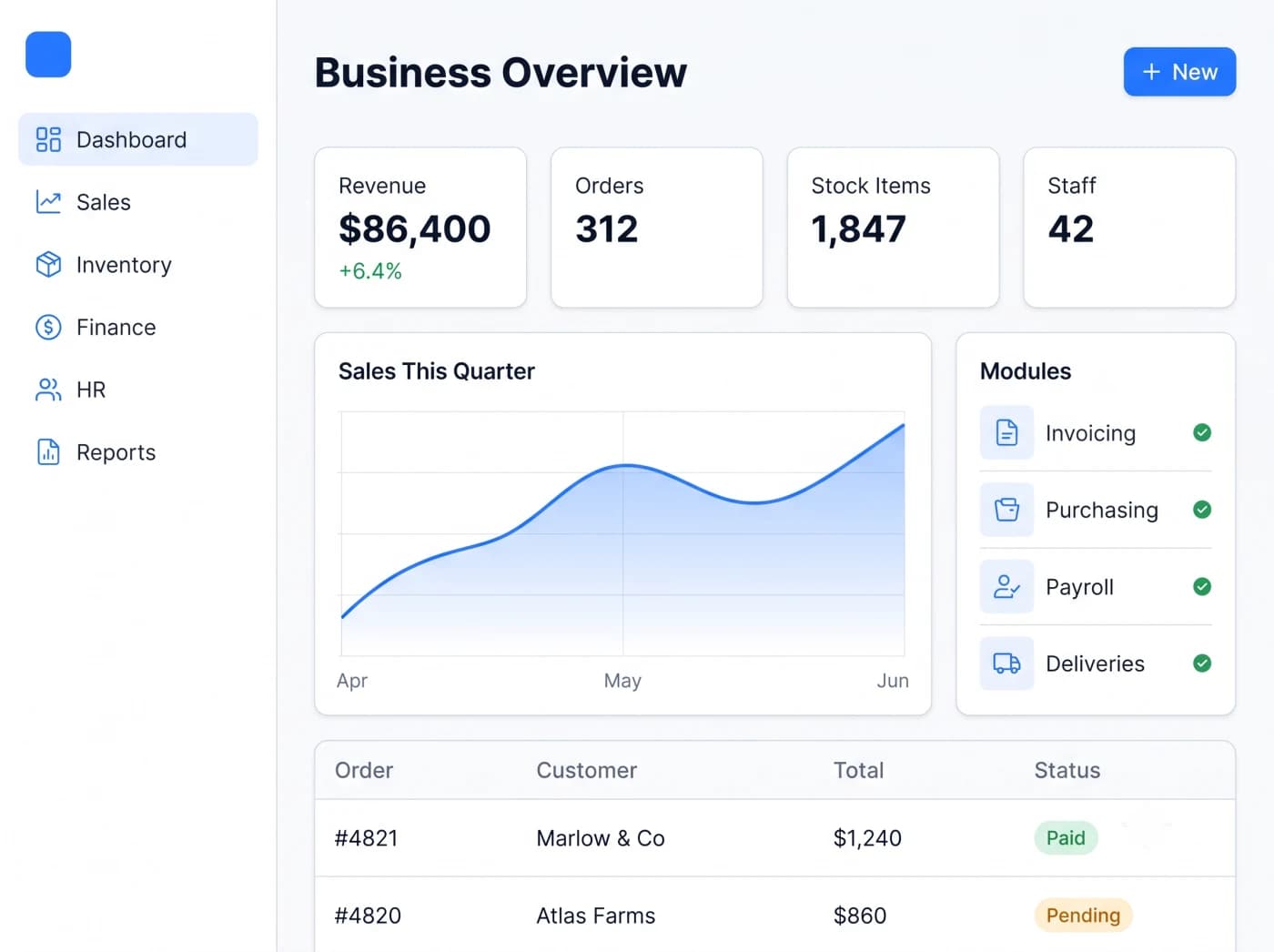
Most projects are not one large application. They are a set of modules on a shared data model: an ERP module for stock or finance, a CRM for the sales pipeline, a client portal, the reports leadership needs, and integrations with the tools you keep. We build them in order of value, starting where manual work or errors cost you most.
Ownership follows our published IP and ownership policy: project source code, designs and documentation transfer to you on full payment, and your data is yours throughout. We keep our generic tooling and know-how, and open-source components stay under their own licences.
Which page fits you? Small and mid-sized businesses: custom business software. UK buyers looking for bespoke software: bespoke software development. A complete ERP: custom ERP software.
Accounting only? See cloud based accounting software, or the version for small businesses.
Delivered remotely from our Islamabad headquarters, with scheduled video meetings in your working hours; on-site visits only when agreed in the contract. See the countries we serve.
Where to go next
- Custom ERP software: When the core need is finance, inventory, procurement or production in one system.
- ERP module development: Adding one or two ERP modules next to systems you keep.
- CRM development: Sales pipeline, quotes and customer records shaped around your process.
- SaaS development: When the software is a subscription product you sell to other businesses.
- Legacy software modernization: Rebuilding or upgrading a system that still works but is hard to change.
- Systems and API integration: Connecting the tools you keep so data stops being re-keyed.
- IP and ownership policy: What transfers to you, when, and what we retain.
- How we work: The five steps, including the free pilot, in full.
Custom software development: problems it solves
Common problems
- Packaged software forces workarounds that take more admin time than the licence saves
- Three to five disconnected tools mean duplicate data entry and reports that never reconcile
- A previous supplier over-promised, and the project stalled before anything useful went live
- An earlier build went live but is undocumented, hard to change and starting to break
How we approach them
- A written plan of modules, roles, approvals, reports and integrations that you approve before development starts
- A free pilot of 2 to 3 key modules, so you judge working software before committing to the full project
- Modules delivered in stages on one data model, with a staging environment where your team tests each release
- Anything outside the approved scope is reviewed and agreed with you before extra work begins
A good fit when
- Your process is specific enough that packaged tools need constant workarounds or side spreadsheets
- Several tools hold the same records, and month-end reporting needs manual reconciliation
- Per-user licences or the data limits of a SaaS plan no longer match how you operate
- The software is part of what you sell, such as a client portal or a SaaS product
Another option may suit you better when
- A packaged product covers your process with light configuration: buy and configure it (see the guide below)
- You need a standard ERP rolled out with modest changes: see ERP implementation services
- An old system still does the job but is hard to change: legacy modernization may be the smaller step
- Two existing tools only need to share data: an integration project may be enough
Buy, configure or build?
Three routes cover most software decisions. The right one depends on how standard your process is, not on which sounds more ambitious.
Buy an off-the-shelf product
Fits when: The process is common across your industry (payroll, email marketing, standard bookkeeping) and the product's way of working is acceptable to your team.
Trade-off: Quickest to start. You follow the vendor's roadmap, pricing changes and data terms, and gaps are filled by hand or with other tools.
Configure a platform
Fits when: Most of the process is standard, but you need your own fields, approval rules, reports or a few integrations on top of an ERP or CRM product.
Trade-off: Keeps the vendor's upgrade path. Heavy customization makes upgrades harder, and per-user licences continue as you grow.
Build custom software
Fits when: The process is how you compete or serve clients, packaged products force repeated workarounds, or the software is itself your product.
Trade-off: Fits the work and you own the project code on full payment. It needs more of your team's time in the Understand and Plan steps, and you carry running costs such as hosting and support.
Many projects mix routes: keep packaged accounting, configure a CRM, and build the module in between. For the ERP version of this choice, read ERP vs custom development or start at custom ERP software.
What's included in custom software development
Linked cards open a dedicated page with its own scope, fit and questions.
ERP Modules
Finance, inventory, HR and production modules on one shared data model.
CRM Systems
Track every lead, deal and customer in one place your team uses.
POS & Business Management
Retail and restaurant systems tied to billing, stock and reporting.
Inventory & Accounting
Stock, purchasing, sales and books in one connected system.
SaaS Products
Subscription platforms built to scale, with billing and dashboards.
Not sure which of these you need? Talk to us on WhatsApp.
Usually in scope
- Workflow mapping and a written plan of modules, roles, approvals, reports and integrations
- Screen designs or a clickable prototype of the key flows
- The free pilot of 2 to 3 key modules, then the approved modules in stages
- Integrations and data migration named in the approved plan
- Testing, deployment, handover documentation and the support period agreed before go-live
Not included unless agreed
- Modules, reports or integrations not in the approved scope (reviewed and agreed before any extra work)
- Integrations with systems that offer no API, database access or reliable export
- Running costs such as hosting, third-party services and store or licence fees, held in your accounts
- Changes inside third-party products, which depend on their vendors
Typical scenarios
Typical situations behind a custom software project. They illustrate the kind of workflow involved; they are not client case studies.
A distributor with stock in several places
The situation: Stock is tracked in a spreadsheet per warehouse, orders arrive by phone and WhatsApp, and invoices are raised in a separate accounting package. Counts drift and month-end reconciliation takes days.
What we would build: Inventory, order and purchasing modules on one data model, an order screen for sales reps, and an integration that posts invoices to the accounting system you keep. Likely pilot modules: stock movements and order entry.
A services firm billing from timesheets
The situation: Consultants log time in one tool, managers approve it by email, and finance rebuilds invoices by hand from exports.
What we would build: Time capture with approval routing, project budgets, invoice drafts generated from approved time, and a client portal for statements. Likely pilot modules: timesheet approval and invoice drafting.
A field service company replacing paper job sheets
The situation: Technicians fill in paper forms, the office re-types them, and customers phone to ask whether the job is done.
What we would build: Job scheduling for the office, a mobile job sheet with photos and signatures that keeps working on weak signal, and automatic status updates to customers. Likely pilot modules: dispatch and the mobile job sheet.
How we deliver custom software development
Custom software built around the way your business works. Five steps, with a free pilot of 2 to 3 key modules before the full build.
Step 1: Understand
We learn how your business works.
Your requirements, workflow, challenges and goals, understood before anything is recommended.
Step 2: Plan
We design the right solution around your workflow.
Modules, workflows, roles, approvals, reports and integrations, agreed before development.
Step 3: Select Technology
Choose the right technical foundation.
Technology options matched to your users, security, budget and growth, not one fixed stack.
- Free pilot
Step 4: Pilot
Test our work before full project development.
Free. You choose 2 to 3 key modules and we build them first, so you can judge our work.
The full project starts only after you approve the pilot.
- Full project
Step 5: Build & Scale
From approved pilot to complete digital system.
Full development, testing, deployment, training and support, built to grow with you.
Technologies We Use for Custom Software
Chosen in the Select Technology step from your users, hosting rules, integrations and who will maintain the system. These are common choices; your existing stack is a valid answer.
Client work we can show
Anonymized case studies from delivered client projects. Client names stay confidential; verifiable references are shared privately during procurement.
Public sector and charitable services · Qatar
Qatar Government Digital Platform
Timeline Digital designed and built a bilingual Arabic and English digital platform for a public-sector program in Qatar, replacing manual, paper-based handling of beneficiary and donor services with one secure online system.
Read the case studyReferences
More client work is under NDA
Much of our enterprise and government work is covered by confidentiality agreements. Ask for references on your first call.
Discuss Your ProjectTimelines and what we need from you
We do not quote a timeline before we understand the work. After the Understand and Plan steps you get a written plan with phases and target dates for the scope you approve. The free pilot of 2 to 3 key modules comes first, and the delivery plan for the full build is confirmed after you approve the pilot. Any requirement outside the approved scope is reviewed and agreed before extra work begins.
A small internal tool is naturally quicker than a multi-module platform with integrations and data migration, and the biggest single factor is usually how quickly decisions and test feedback come back from your side. After launch, support continues under an agreed plan; see maintenance and support.
What you provide
- A decision-maker who approves the plan and the pilot, and a day-to-day contact who knows the workflow
- Time from the people who do the work, during Understand and when testing the pilot and each release
- The spreadsheets, forms and reports the system will replace, and the rules behind them
- Access to existing systems or their exports, and vendor contacts where an integration depends on another supplier
- The data to migrate, and decisions on how it should be cleaned or mapped
- Acceptance testing and sign-off for each release
Want a plan built around your project? Share your requirements through our contact form.
Guides for this decision
In-depth, practical reading for teams planning this kind of project.
- Guide · 11 min readSoftware Requirements Brief: A Template to Write Before You Talk to a DeveloperA software requirements brief is a short document that explains the business problem, the users, the workflow and the priorities before you approach a developer. This guide gives the sections, a copy-paste template and a filled example.Read the guide
- Guide · 10 min readERP Implementation Roadmap: Which Modules to Implement First, and WhyERP modules should go live in dependency order: master data and core finance first, then purchasing, inventory and sales, with payroll and manufacturing once their inputs are reliable. This guide explains the logic and gives roadmaps for three business types.Read the guide
- Guide · 9 min readCustom CRM vs Salesforce, HubSpot or Zoho: When Building Your Own Makes SensePackaged CRMs such as Salesforce, HubSpot and Zoho suit standard sales pipelines; a custom CRM makes sense when your process, integrations, data location or user economics do not fit. This guide gives the signals, a scorecard and the hybrid option.Read the guide
Custom software development FAQ
People also ask about custom software development. Here are direct answers.
Custom software development is the process of designing and building software specifically for one organization's workflows, data model, and user base, as opposed to configuring a commercial product built for a generic audience. It makes sense when off-the-shelf license fees compound over time, when your workflows don't fit standard tools without significant manual workarounds, when you need to own and control your data, or when the software itself is part of your product offering. For businesses handling complex approval chains, multi-entity data, or proprietary processes, custom development gives a system that fits the work instead of forcing workarounds.
It depends on the number of modules, user roles, integrations and how much data has to be migrated, so we do not quote a timeline before we understand the work. After the Understand and Plan steps you get a written plan with phases and target dates for the scope you approve. The free pilot of 2 to 3 key modules comes first, and the delivery plan for the full build is confirmed after you approve the pilot. A small internal tool is naturally quicker than a multi-module platform. Any requirement outside the approved scope is reviewed and agreed before additional work begins, so any change to delivery is agreed in advance.
We follow the same five steps on every project: Understand, Plan, Select Technology, Pilot, and Build & Scale. The Business Requirements Document, signed off by both sides before development starts, records what we are building and why. You then see a free pilot of your key modules before committing, and we agree the scope with you, then define the milestones, delivery plan and commercial terms. Any requirement outside the approved scope is reviewed and agreed before additional work begins, so changes to cost or delivery are transparent and agreed in advance. Development runs in two-week sprints with staging access and a UAT checklist at the close of each cycle, so you review working software every two weeks, not a big-reveal delivery six months later.
Off-the-shelf software is quicker to start with but comes with per-user license fees that compound annually, a feature set designed for an average customer rather than your business, and data that lives on a vendor's infrastructure under their terms. Custom software takes longer to build, but project source code transfers to you on full payment and the system can be built to your approval chains, reporting structure, and integration requirements. There is also a middle route: configuring a packaged ERP or CRM for the parts of your process that are standard. A useful decision rule: if your team relies on spreadsheets and workarounds to fill the gaps in a packaged tool, custom development is worth a closer look. A free pilot of your key modules lets you judge the fit on working software before committing.
Yes. Support is part of the Build & Scale step: after launch we fix bugs, apply security patches and dependency updates, monitor performance, and add small features. The support scope is agreed before go-live, and as your business grows we add new modules and scale the system with you. Hosting is a running cost: it is set up in or transferred to your organization's name, and the arrangement is agreed in the plan.
We take on custom software projects for manufacturing, logistics and freight, real estate and property management, healthcare administration, financial services, professional services firms, retail and wholesale distribution, education management and the public sector. Our published client work is a bilingual public-sector platform in Qatar, and our own products cover retail and restaurant POS, CRM, invoicing, payroll, school and labor management; for other sectors we bring the ERP, CRM, workflow and portal architecture we build every day. The technologies and architecture patterns differ by industry. A healthcare records system has different compliance and audit trail requirements than a logistics dispatch platform, yet the delivery methodology stays consistent. If you operate in a regulated industry, ask us specifically about audit logging, role-based access controls, and data residency options.
Buying packaged software means accepting the vendor roadmap, licensing changes, and data policies that come with it. Hiring a custom software development company gives you a team that studies your workflows first, then builds only what your operation needs. Project source code transfers to you on full payment, you control where your data lives, and you extend the system as the business changes. For the processes that set you apart from competitors, that control usually outweighs the quicker start of a packaged product.
Ask for four things before signing. First, a written plan that defines deliverables, milestones, and acceptance criteria, not a vague pitch. Second, ownership terms confirming that the project source code, designs and documentation transfer to you on full payment, and what the supplier retains. Third, a portfolio of systems similar to yours in scale or industry. Fourth, case studies you can review, ideally with reference clients you can contact. A company confident in its delivery record will provide all four without hesitation.
A mutual NDA can be signed before you share project details. The contract sets out ownership in line with our published IP policy: project source code, designs and documentation transfer to you on full payment, and your data is yours throughout. We keep our generic tooling and know-how; where a shared utility ships inside your codebase you may use and modify it within that system. Open-source components stay under their own licences, and you receive a list of them. If a project ends early, the milestones you have paid for are handed over. Governing law is agreed in the contract.
Custom Software Guides and Resources
How We Work
Understand, Plan, Select Technology, Pilot, Build & Scale: the five steps every project follows, with a free pilot.
Read this nextHire Software Developers
Add senior engineers to your team: dedicated developers you interview and approve yourself.
Read this nextBest Custom Software Development Companies
A buyer guide to evaluating custom software development partners for US, UK and EU projects.
Read this nextERP vs Custom Development
When an off-the-shelf ERP makes sense, and when custom development pays off.
Read this nextCustom Business Software Company
How we build business management systems, CRMs and internal tools for growing companies.
Read this nextCustom Software Development in Pakistan
Why global businesses build with our Islamabad-based senior engineering team.
Read this nextOther Services You May Need
Web Application Development
A web application is business logic running in a browser, not a brochure site. We build customer...
Read this nextMobile App Development
Timeline Digital designs and builds iOS and Android apps using Flutter for cross-platform...
Read this nextEnterprise Systems Development
Timeline Digital builds enterprise systems for multi-department operations: shared data, approval...
Read this nextWant to talk about your custom software development project?
Leave your name and number. No long form. We'll reply on WhatsApp within 4 business hours to understand what you need.
No spam. We only use your number to reply about your project.
See working software before you commit
Before you commit to the full project, we build 2 to 3 of your key modules as working software, free of charge. Your team tests the pilot, and the full build starts only after you approve it.
See how the free pilot worksUnderstand
We learn your requirements and how your organisation works today.
Select pilot modules
Together we choose 2 to 3 key modules that prove the solution.
Build the working pilot
We build those modules as real, working software, free of charge.
You test it
Your team uses the pilot. The full project starts only after you approve it.
Start a conversation
Tell us how your business works.
Describe what is slowing your team down. We will help you work out what to build, and how a free pilot lets you judge our work before the full project.
Prefer WhatsApp? Start a chatWhat happens next
You send a short brief
The problem, the people involved and any target date. A senior engineer replies within 4 business hours.
We understand your workflow
A first call about how your business works today. An NDA can be signed before you share details.
You test a free pilot
You choose 2 to 3 key modules and we build them first, so you judge real software before the full project.