Mobile Apps
Mobile App Development
Mobile Apps That People Actually Use
Cross-platform iOS and Android apps built with Flutter, native Swift or Kotlin where hardware demands it, and a .NET or NestJS backend. We design in Figma and submit to both stores for you.
What we handle
- Android App Development
- iOS App Development
- Cross-Platform Apps
- Business Apps
- Ecommerce Apps
- App Maintenance and Updates
What is mobile app development?
A business app is rarely just the app. It needs an API and database behind it, an admin panel for the team that manages users and content, push notifications, and developer accounts with Apple and Google in your organization's name. Planning those pieces together is what keeps an app maintainable after launch.
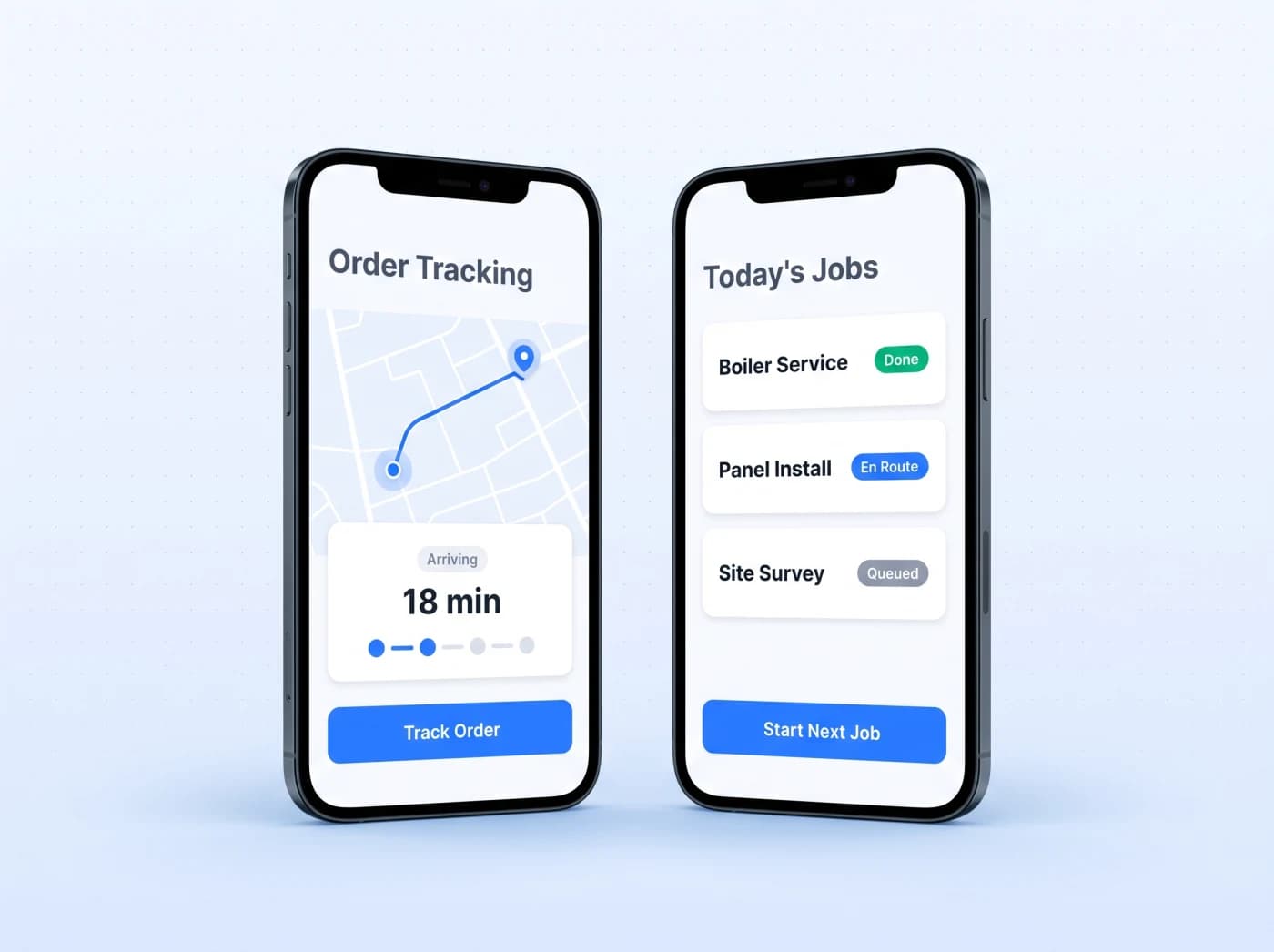
Most requests fall into two groups: customer apps for booking, ordering, tracking and support, and field and staff apps for inspections, job sheets and deliveries, often connected to an ERP or CRM. Field apps usually have to keep working with weak or no signal and sync later, which shapes the data design from day one.
We choose between Flutter and native Swift or Kotlin after reviewing the features: Flutter for most business apps, native where Bluetooth peripherals, health sensors or low-level camera and AR work need it. See cross-platform app development for the trade-offs.
Delivered remotely from our Islamabad headquarters, with scheduled video meetings in your working hours; on-site visits only when agreed in the contract. See the countries we serve.
Mobile app development: problems it solves
Common problems
- Separate iOS and Android codebases add a second build and test cycle, and features drift apart over time
- The app crashes or loses data when field users work in areas with poor signal
- Store review rejects a submission over missing privacy declarations or policy issues
- The existing backend cannot handle the request volume a mobile app generates
How we approach them
- Flutter where it fits: one codebase, shared business logic and one QA cycle for both platforms
- Offline-first design for field apps, with local storage, a background sync queue and conflict rules
- Store policy and privacy declarations checked before each submission, so review issues are caught early
- An API backend load-tested against expected use before launch, hosted on the cloud you choose
A good fit when
- People use it often and on the move, and benefit from notifications, the camera, location or offline use
- Field or shift staff need a tool that works with poor signal and syncs later
- Customers in your sector already expect to book, order or track through an app
Another option may suit you better when
- Use is occasional and mostly at a desk: a responsive web application avoids store reviews and installs
- You want to test demand first: a progressive web app or a small pilot can answer that before a full app
- The app would only repeat content that is already on your website
What's included in mobile app development
Linked cards open a dedicated page with its own scope, fit and questions.
Android Apps
Native Android apps for customers, staff and operations.
iOS Apps
iPhone and iPad apps with clean UX and real business value.
Cross-Platform Apps
One codebase for both Android and iOS, one team, faster releases.
Customer Apps
Apps for booking, ordering, tracking and support.
Field & Staff Apps
Mobile tools for field teams, inspections and service work.
Connected Apps
Mobile apps wired into your ERP and CRM for real-time access.
Not sure which of these you need? Talk to us on WhatsApp.
Usually in scope
- UX design of the agreed screens for iPhone and Android
- The app, its API and database, and an admin panel where the plan includes one
- Sign-in, push notifications and the integrations named in the plan
- Testing through TestFlight and Google Play internal testing, then store submission
Not included unless agreed
- Apple and Google developer account fees (the accounts are opened in your organization's name)
- Devices or platforms not named in the plan, such as watches, tablets or in-car systems
- Marketing the app after launch
- Support beyond the agreed period, which is set out in a support plan
Benefits of mobile app development
Both Platforms
One app for iPhone and Android users, usually from a single Flutter codebase, so neither group waits for features.
Enhanced Engagement
Apps keep people more engaged than a mobile website. They send alerts, work without internet, and feel personal.
Revenue Growth
Earn money in ways that fit your app. Sell items inside it, offer memberships, run ads, or sell products. We help you keep customers coming back.
Brand Presence
An installed app sits on your customer's home screen, a step closer than a bookmark or a search.
How we deliver mobile app development
Custom software built around the way your business works. Five steps, with a free pilot of 2 to 3 key modules before the full build.
Step 1: Understand
We learn how your business works.
Your requirements, workflow, challenges and goals, understood before anything is recommended.
Step 2: Plan
We design the right solution around your workflow.
Modules, workflows, roles, approvals, reports and integrations, agreed before development.
Step 3: Select Technology
Choose the right technical foundation.
Technology options matched to your users, security, budget and growth, not one fixed stack.
- Free pilot
Step 4: Pilot
Test our work before full project development.
Free. You choose 2 to 3 key modules and we build them first, so you can judge our work.
The full project starts only after you approve the pilot.
- Full project
Step 5: Build & Scale
From approved pilot to complete digital system.
Full development, testing, deployment, training and support, built to grow with you.
Technologies We Use for Mobile Apps
Flutter for most apps; Swift and Kotlin for hardware-heavy modules; ASP.NET Core or NestJS for the API and Next.js for admin panels. Confirmed in Select Technology.
Client work we can show
Anonymized case studies from delivered client projects. Client names stay confidential; verifiable references are shared privately during procurement.
Public sector and charitable services · Qatar
Qatar Government Digital Platform
Timeline Digital designed and built a bilingual Arabic and English digital platform for a public-sector program in Qatar, replacing manual, paper-based handling of beneficiary and donor services with one secure online system.
Read the case studyReferences
More client work is under NDA
Much of our enterprise and government work is covered by confidentiality agreements. Ask for references on your first call.
Discuss Your ProjectTimelines and what we need from you
We do not quote a timeline before we understand the work. After the Understand and Plan steps you get a written plan with phases and target dates for the scope you approve. The free pilot of 2 to 3 key modules comes first, and the delivery plan for the full build is confirmed after you approve the pilot. Any requirement outside the approved scope is reviewed and agreed before extra work begins.
Store review is outside our control: Apple and Google set their own review times, so release dates allow for it.
What you provide
- Apple and Google developer accounts in your organization's name, or approval for us to open them for you
- A list of the devices and operating system versions your users have
- Content, brand assets and your privacy policy
- Testers who install each build and confirm sign-off
Want a plan built around your project? Share your requirements through our contact form.
Guides for this decision
In-depth, practical reading for teams planning this kind of project.
- Guide · 11 min readOffline-First Field Service Apps: Sync, Conflicts and Device ManagementAn offline-first field app saves every action on the device first and syncs it later, so work never stops when the signal does. This guide covers sync design, conflict rules, attachments, device management, private distribution and testing.Read the guide
- Guide · 11 min readSoftware Requirements Brief: A Template to Write Before You Talk to a DeveloperA software requirements brief is a short document that explains the business problem, the users, the workflow and the priorities before you approach a developer. This guide gives the sections, a copy-paste template and a filled example.Read the guide
Mobile app development FAQ
People also ask about mobile app development. Here are direct answers.
Flutter compiles a single Dart codebase into native ARM code for both iOS and Android. The result is one project to maintain, one QA cycle to run, and usually less engineering effort than two separate native builds. Performance is near-identical to native for the vast majority of business applications, with smooth animation, fast startup, and full access to device APIs. Flutter is our usual recommendation for business apps, confirmed after we review your feature requirements. The exception is apps requiring deep integration with proprietary hardware SDKs, such as specialized medical sensors or Bluetooth peripherals with platform-specific drivers, where Swift or Kotlin is the more practical choice.
We recommend a native build in Swift (iOS) or Kotlin (Android) when the app needs capabilities that Flutter's platform channels cannot cleanly abstract: background health sensor streaming via Apple HealthKit, Bluetooth Low Energy peripherals with complex custom profiles, CarPlay or Android Auto integration, or platform-specific AR using ARKit or ARCore at a low level. For these cases, we build the affected module natively and, where both platforms are needed, maintain two separate native projects. We are transparent about the trade-off upfront: native dual builds take noticeably more engineering time than an equivalent Flutter project.
It depends on the number of screens and user roles, the backend and integrations, offline needs and any hardware access, so we do not quote a timeline before we understand the work. After the Understand and Plan steps you get a written plan with phases and target dates for the scope you approve. The free pilot of 2 to 3 key modules comes first, and the delivery plan for the full build is confirmed after you approve it. Apple and Google set their own store review times, so release dates allow for review.
Yes, fully. For the App Store, we configure App Store Connect, prepare screenshots at the iPhone sizes Apple requires, plus iPad if applicable, write the app description and keyword field, complete the privacy manifest, and submit for review. For Google Play, we configure the Play Console, prepare the feature graphic and screenshots, write the store listing, complete the data safety form and content rating questionnaire, and release to the production track. If Apple or Google raises a review issue, we respond and resubmit. Store submission is part of our delivery, not a separate service.
Most of our mobile apps connect to an ASP.NET Core or NestJS backend that exposes a versioned REST API over HTTPS. Authentication is handled with JWT tokens, and sensitive data is stored in PostgreSQL or SQL Server, with personal data fields encrypted where the plan calls for it. We also build a companion web panel in Next.js for operations or admin teams who need to manage data without going through the mobile app. Push notifications are delivered via APNs (Apple) and FCM (Google). If you already have an existing backend or a third-party API, we integrate against it rather than rebuilding.
Yes. We build iOS and Android apps for UK companies, delivered remotely, usually from one Flutter codebase that ships to both stores, built to be hosted in the UK or EU where required and designed to support your GDPR obligations (compliance remains your organization's responsibility and is confirmed by your own assessment). Most projects include a matching admin panel so your team can manage bookings, users and reports in one place. Our UK custom software development page covers the wider UK offer.
We design for these requirements from the start rather than adding them afterwards. Where GDPR applies, data collection is limited to its purpose, consent is part of onboarding and users can have their data deleted. Where HIPAA applies, health data can be encrypted on the device with Keychain or Keystore, connections can use certificate pinning, and data access can be logged. Card data is not stored in the app: payment SDKs such as Stripe or Braintree handle tokenization, which keeps PCI DSS scope small. We design to support your obligations; compliance remains your organization's responsibility and is confirmed by your own assessment.
Other Services You May Need
Custom Software Development
Off-the-shelf software forces your team to adapt to it. We reverse that by building business...
Read this nextWeb Application Development
A web application is business logic running in a browser, not a brochure site. We build customer...
Read this nextEnterprise Systems Development
Timeline Digital builds enterprise systems for multi-department operations: shared data, approval...
Read this nextWant to talk about your mobile app development project?
Leave your name and number. No long form. We'll reply on WhatsApp within 4 business hours to understand what you need.
No spam. We only use your number to reply about your project.
Made in Islamabad, Pakistan
Mobile App Development for Pakistani Businesses
Timeline Digital builds Android and iOS apps for businesses and startups across Pakistan. We build with Flutter for one codebase on both platforms, add offline support for weak signal areas, and build the key screens first as a pilot, with support in Urdu and English from our Islamabad team.
Chat on WhatsApp in Urdu or EnglishOne app for Android and iOS
We use Flutter to build for both platforms from one codebase, which keeps your app consistent and simpler to maintain.
Works on weak connections
Apps for field staff, riders, and agents work offline and sync when the signal returns, which suits real conditions across Pakistan.
Local payments and Urdu
We add JazzCash, EasyPaisa, and card payments, and can build Urdu screens for staff or customers.
A pilot, then code ownership
We build the most important screens first as a pilot for you to test, and the source code and app store accounts are yours on full payment.
Common questions from Pakistan
Do you build for both Android and iPhone?
Yes. We build for Android and iOS, usually with Flutter so both platforms come from one codebase and stay consistent. We also handle app store submission and the source code and store accounts are yours on full payment.
Can the app work without internet?
Yes. For field teams, riders, and agents across Pakistan, we build offline support so the app keeps working without a signal and syncs when the connection returns.
Can the app take JazzCash or EasyPaisa payments?
Yes. We integrate local payment options such as JazzCash and EasyPaisa, along with card gateways, so your Pakistani users can pay the way they prefer.
See working software before you commit
Before you commit to the full project, we build 2 to 3 of your key modules as working software, free of charge. Your team tests the pilot, and the full build starts only after you approve it.
See how the free pilot worksUnderstand
We learn your requirements and how your organisation works today.
Select pilot modules
Together we choose 2 to 3 key modules that prove the solution.
Build the working pilot
We build those modules as real, working software, free of charge.
You test it
Your team uses the pilot. The full project starts only after you approve it.
Start a conversation
Tell us how your business works.
Describe what is slowing your team down. We will help you work out what to build, and how a free pilot lets you judge our work before the full project.
Prefer WhatsApp? Start a chatWhat happens next
You send a short brief
The problem, the people involved and any target date. A senior engineer replies within 4 business hours.
We understand your workflow
A first call about how your business works today. An NDA can be signed before you share details.
You test a free pilot
You choose 2 to 3 key modules and we build them first, so you judge real software before the full project.