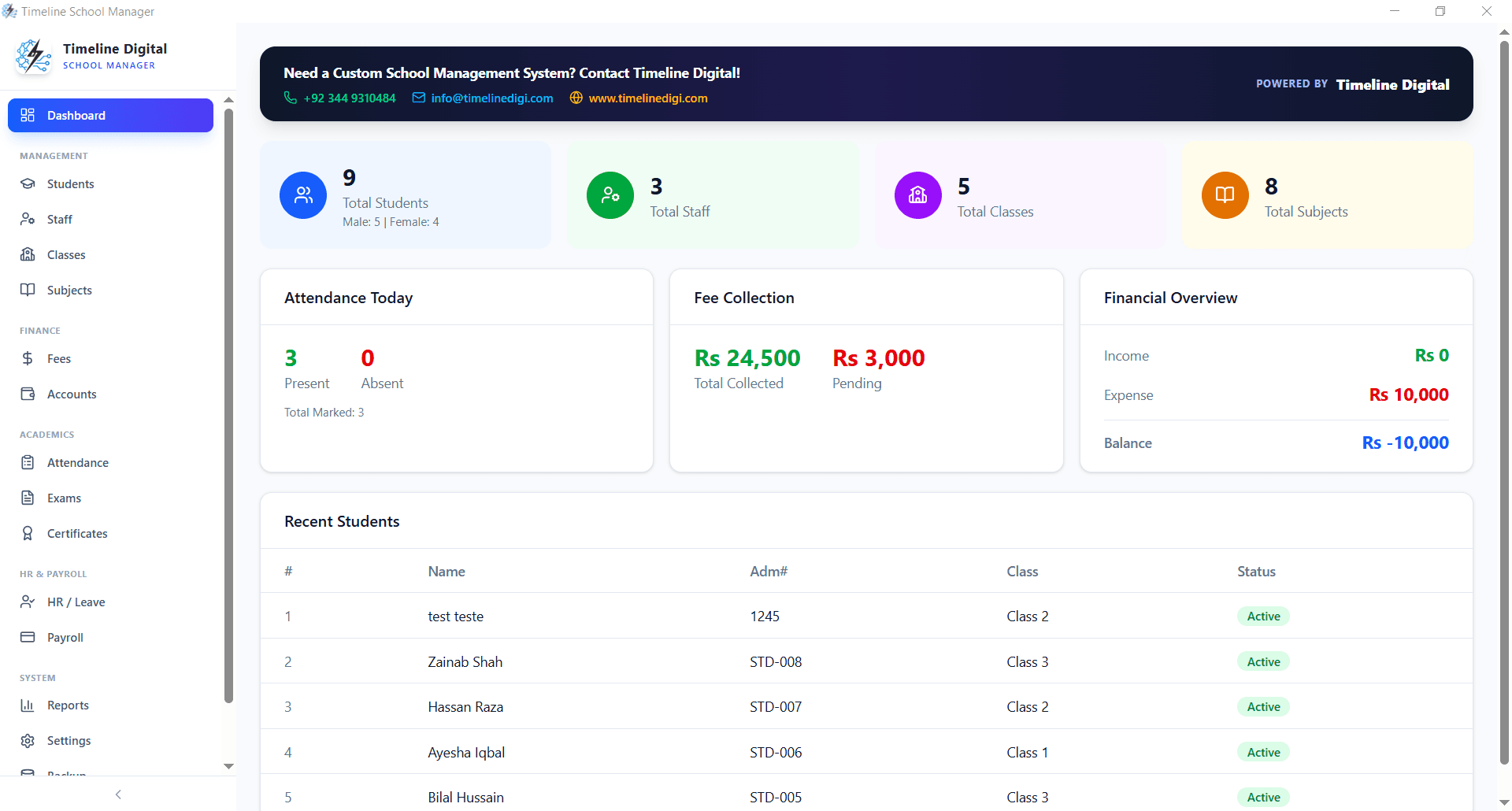
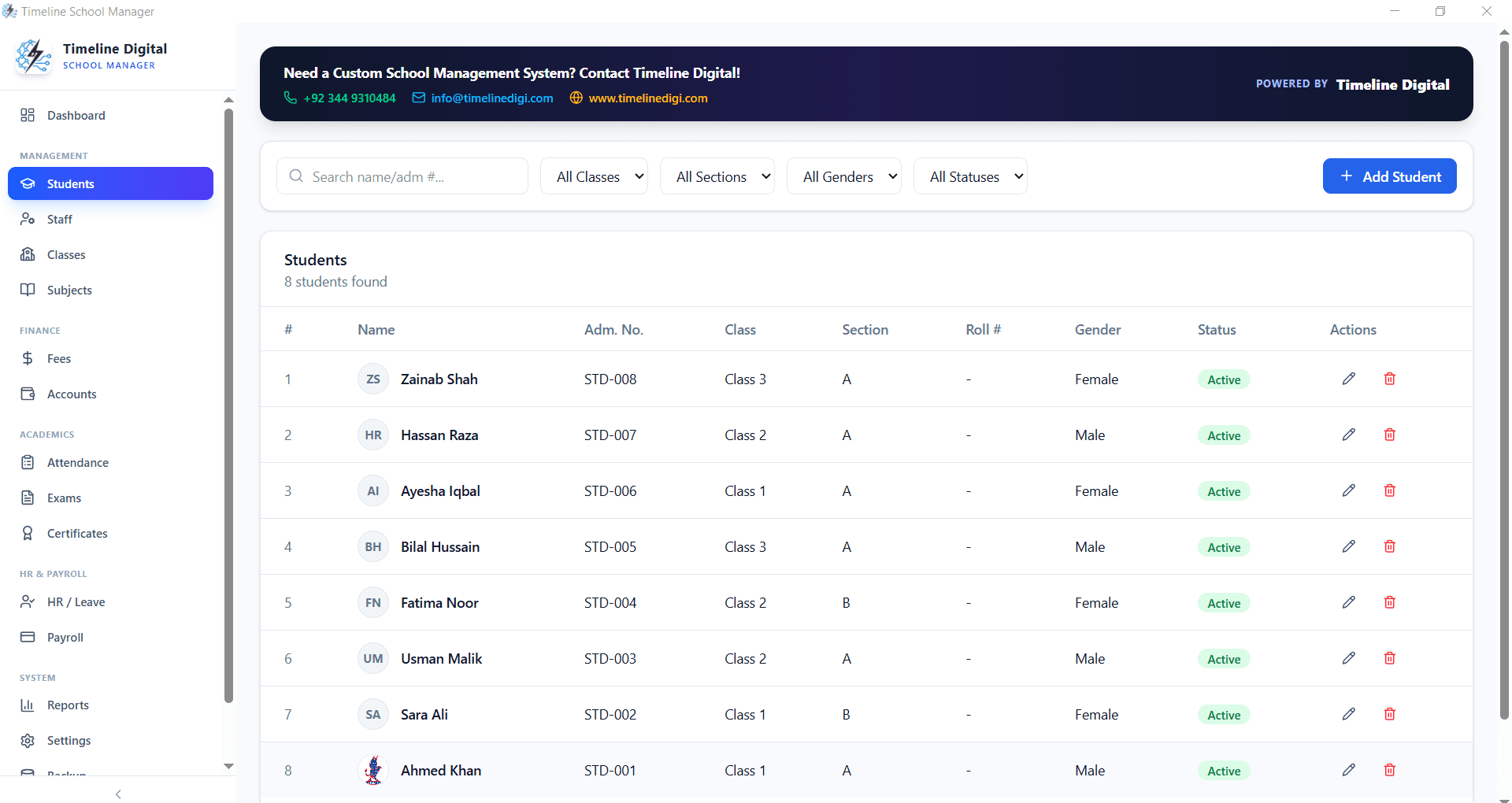
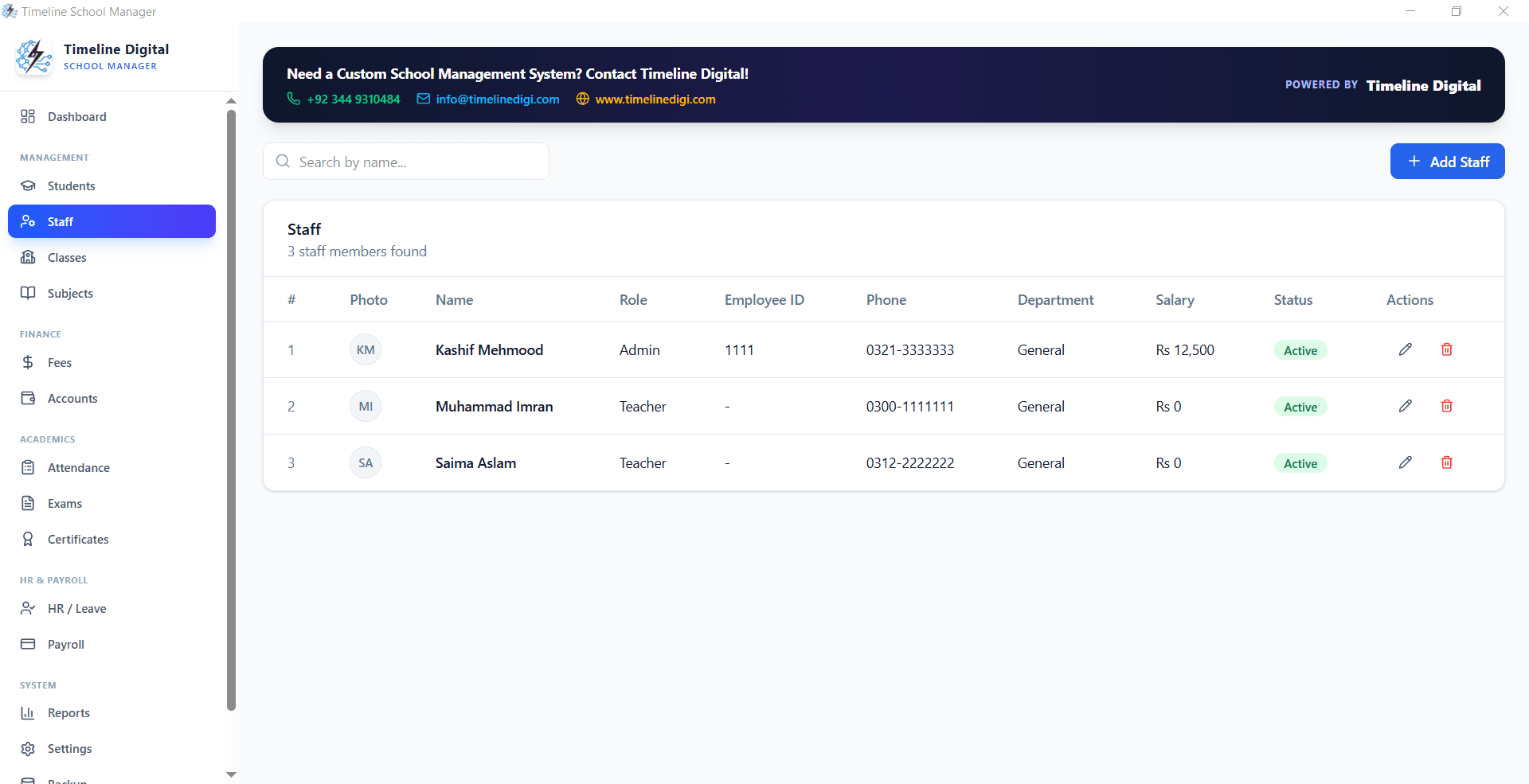
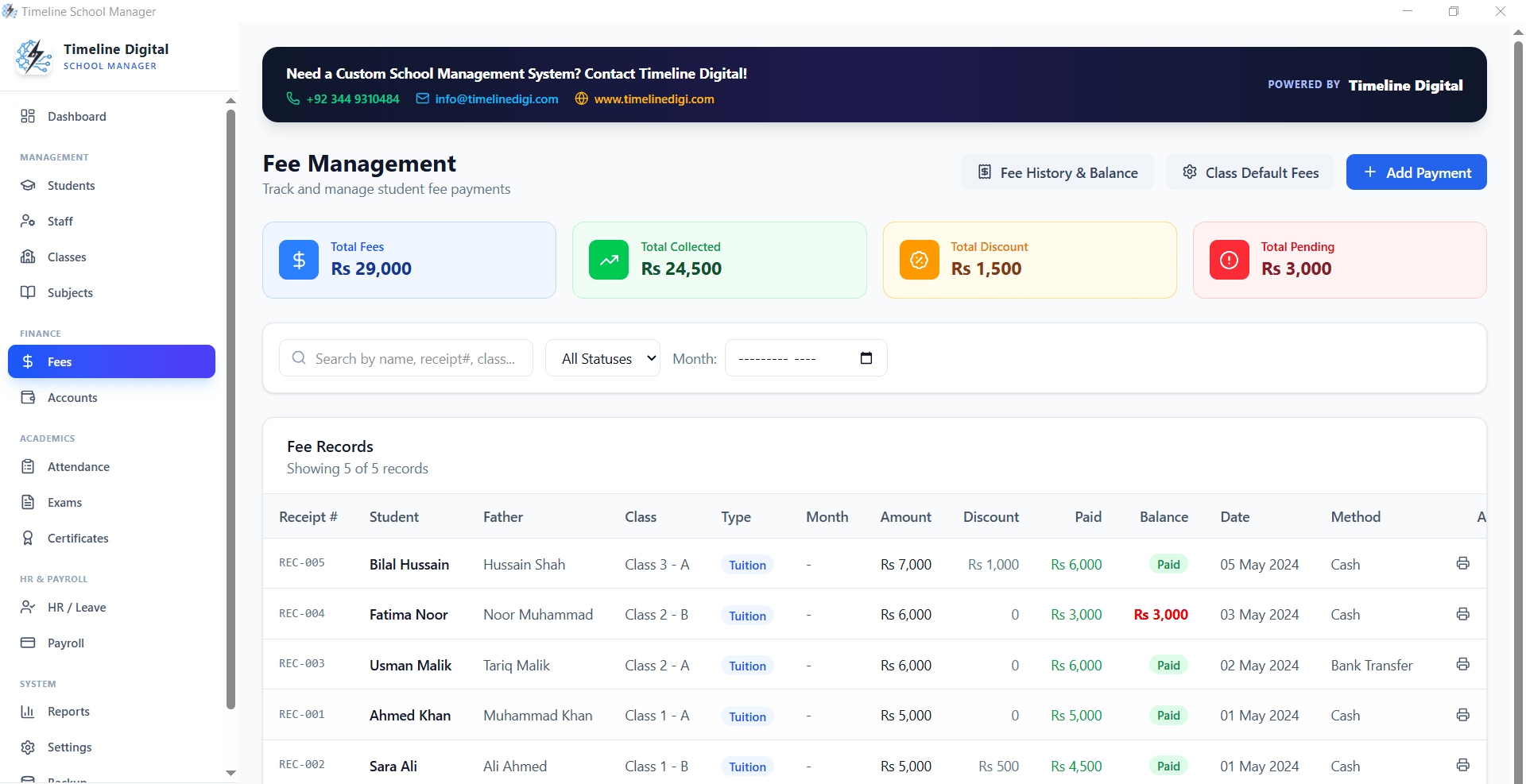
Timeline School Manager is a powerful, offline-first school management system built by Timeline Digital. Manage students, staff, attendance, fees, exams, payroll, certificates, and finances, all from one place, completely free, forever.
No internet required. No monthly fees. No per-student charges. Just download, install on your Windows PC, and run your entire school from day one.
A school management system is an application that digitizes and centralizes the daily administrative operations of a school. Instead of maintaining paper registers, separate spreadsheets, and manual fee books, a school management system puts everything in one place: student records, staff information, attendance logs, fee collection, exam results, payroll, and financial accounts.
For school principals, administrators, and accountants, this means less paperwork, fewer errors, faster reporting, and more time focused on education rather than administration.
One-sentence definition (featured snippet)
A school management system is an application that helps schools manage students, staff, attendance, fees, exams, and reports from one centralized platform.
Why schools switch from paper to digital systems
Manual processes take hours to complete, create data errors, and make it impossible to get a quick overview of school operations. The right school management system solves all of that instantly.
Timeline School Manager, Built for Real Schools
Timeline School Manager is a comprehensive, offline-first school management desktop application developed by Timeline Digital. Currently at version 2.4.0, it is designed specifically for small to medium-sized schools that need a reliable, professional system without depending on the internet or paying expensive monthly subscriptions.
Whether you run a primary school, secondary school, private academy, coaching center, or madrasa, this free school management system covers every department of your institution in a single unified application.
One-time install, use it for lifetime. Absolutely free
All data stays on your own computer, completely private
No per-student, per-teacher, or per-module charges ever
Timeline School Manager includes every module your school needs, all included in the free version. No paid upgrades. No premium tiers.
Student & Staff Management
Fees & Accounts Tracking
Attendance System
Exam & Results Management
Staff Attendance & Payroll
Certificates & Reports
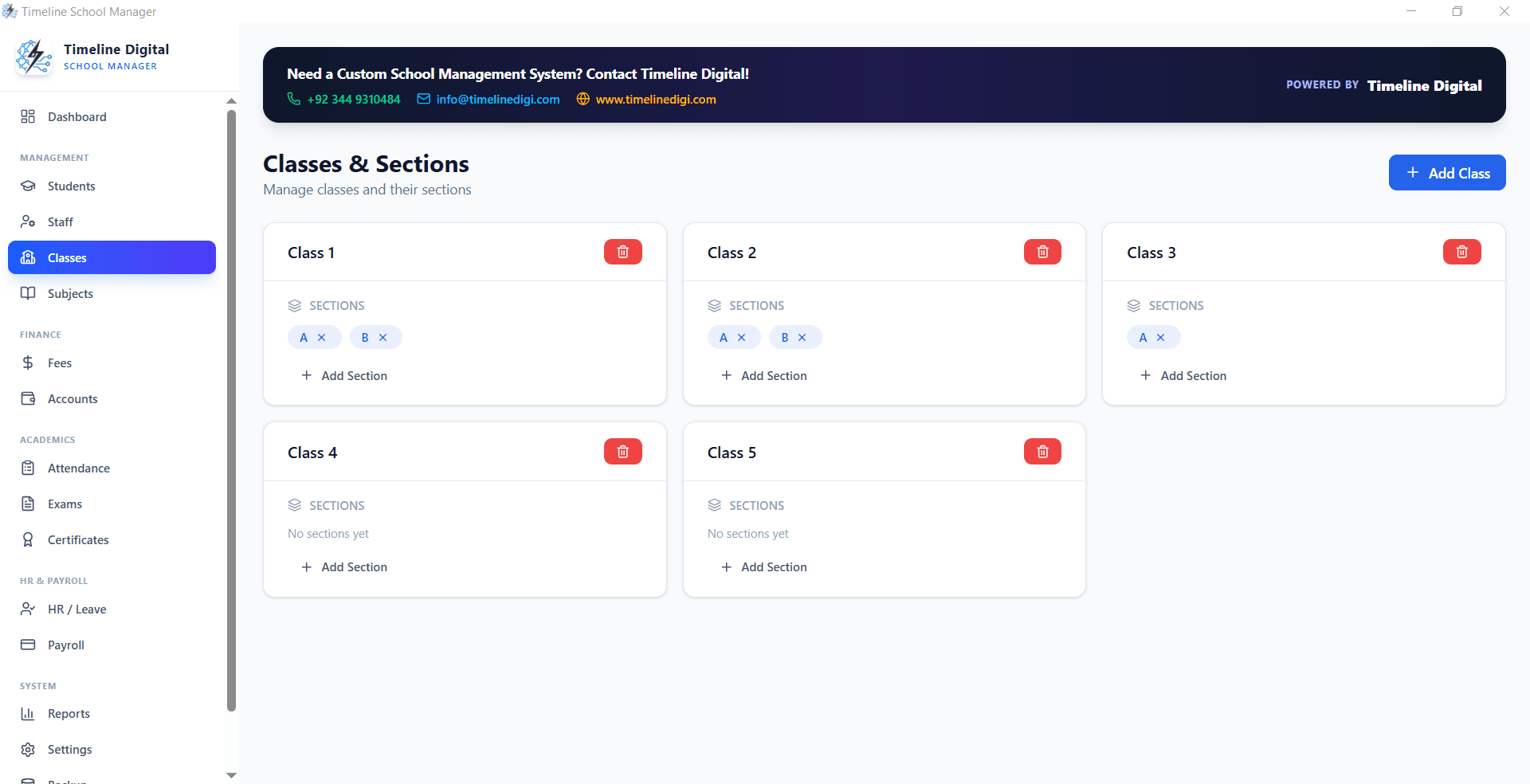
Multi-Class & Section Support
Offline / Local SQLite Storage
Print-Ready Reports & Receipts
Secure Password Protection
Inside the Free School Management System
Each module is built for real school workflows. Here is what each section of the system does.
Student Management
Maintain complete student profiles including admission details, parents' contact information, class assignment, fee status, and academic history in a single organized database.
Staff Management
Manage all teaching and non-teaching staff records, designations, salary details, joining dates, qualifications, and contact information with quick search and filter options.
Fees & Accounts Tracking
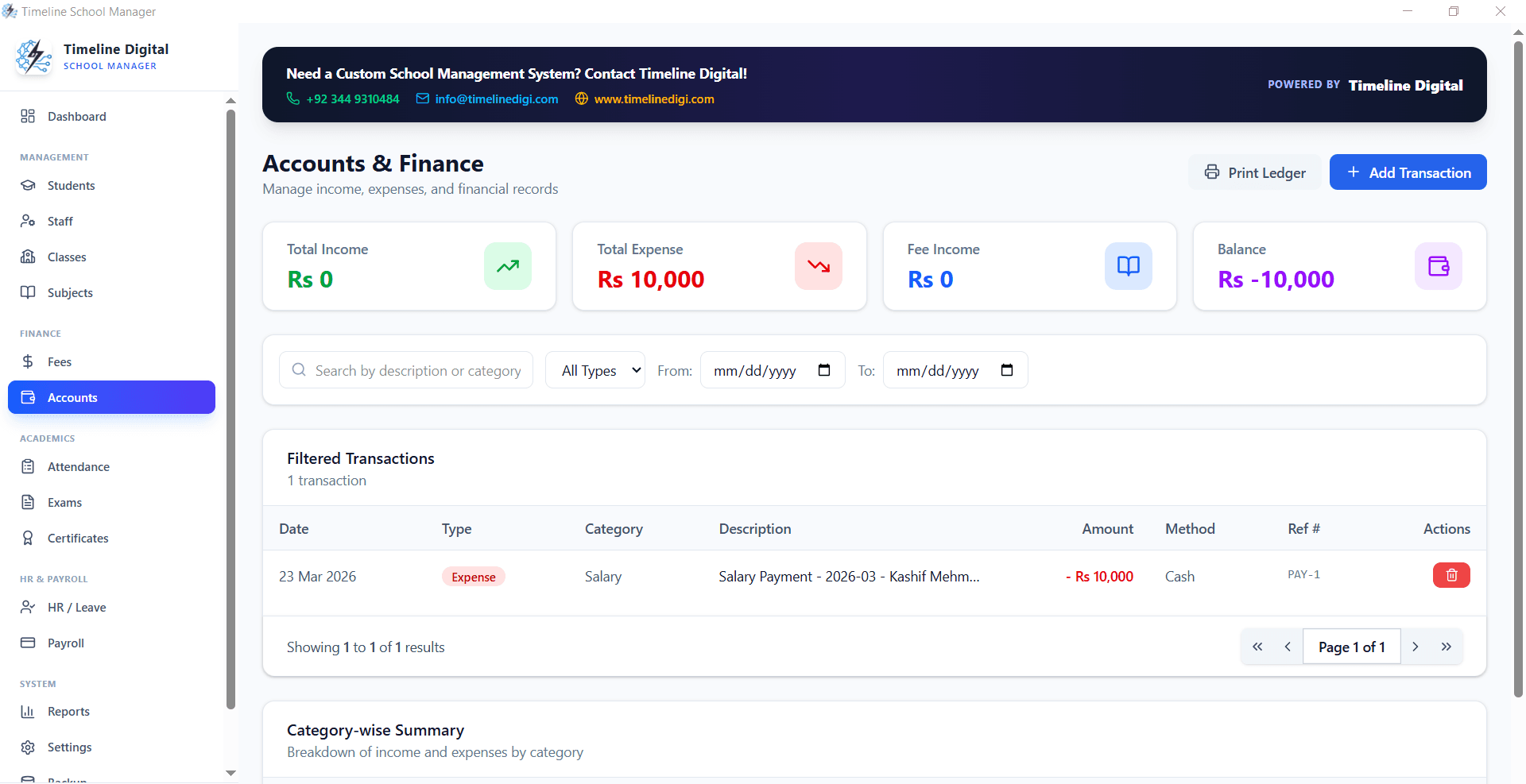
Collect and record student fee payments, generate fee receipts, track dues, apply discounts, and monitor monthly fee collection, all with a full accounts ledger.
Class & Section Management
Define unlimited classes and sections, assign subject teachers, manage timetables, and keep class-wise enrollment counts for accurate planning and reporting.
Subject Management
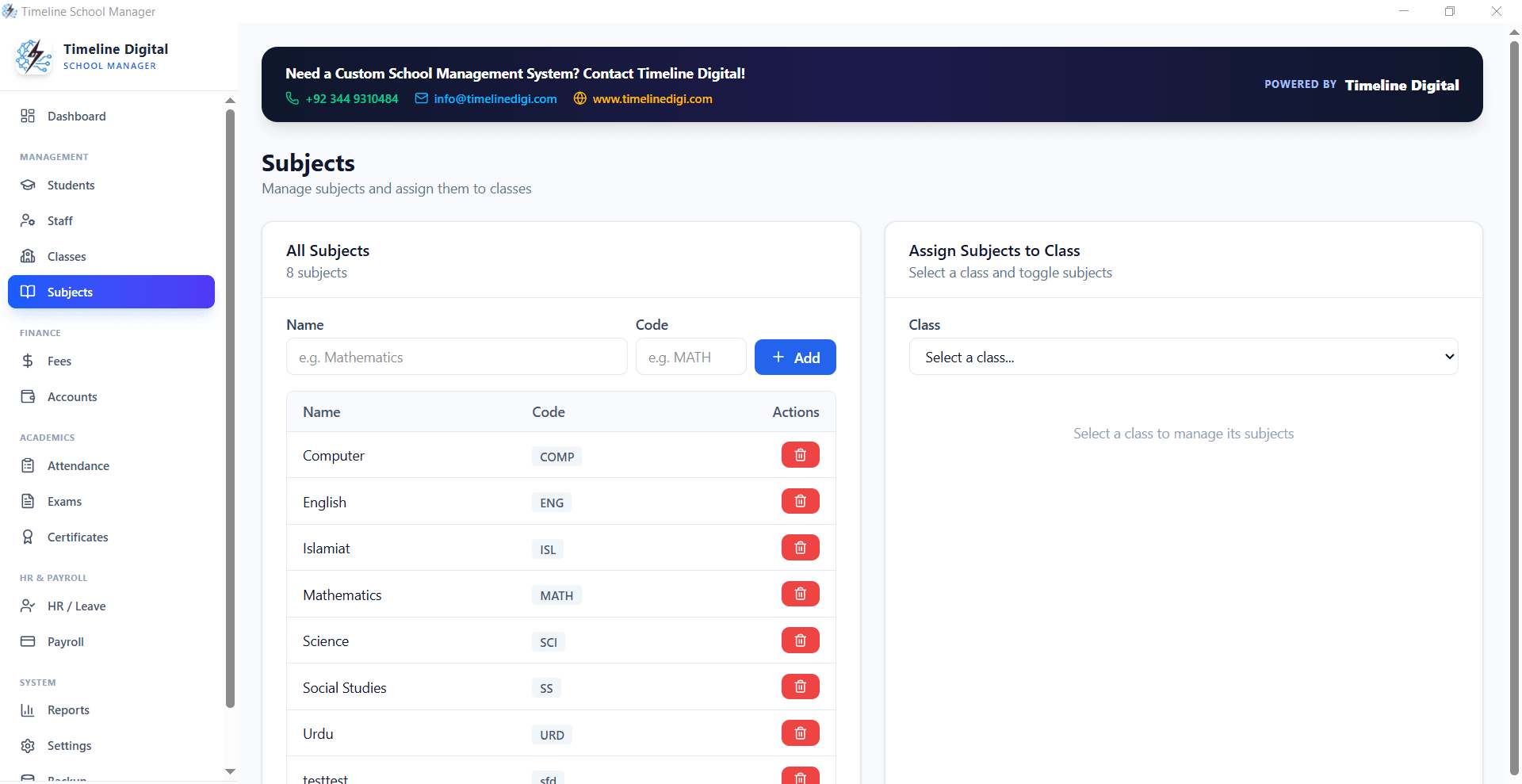
Create and manage subjects per class, assign subject teachers, set exam schemes, and configure grading rules. Supports both elective and compulsory subjects.
Financial Accounts
Track school income, expenses, vendor payments, and overall financial health with a clean accounts module that gives principals a real-time budget overview.
Attendance, Exams & Payroll. All in One School System
Beyond student records and fees, Timeline School Manager covers the operational backbone every school depends on.
Attendance System
Take daily student attendance class by class and mark individual students as present, absent, or on leave. The system automatically computes monthly attendance summaries and flags low-attendance students. Teacher attendance is tracked separately with its own daily log.
Exam & Results Management
Configure term exams and annual exams per class, enter marks per subject, and let the system calculate totals, percentages, grades, and positions automatically. Print individual result cards and class-level result sheets with a single click. No spreadsheets needed.
Staff Payroll
Calculate monthly salaries for all staff members based on configured pay scales, allowances, and deductions. Generate payroll slips for each employee and maintain a full salary payment history. Staff attendance data feeds directly into payroll so late marks and absences are deducted automatically.
Certificates & Testimonials
Print school-branded leaving certificates, character certificates, bonafide certificates, and testimonials directly from student records. All certificate fields auto-populate from the student profile, reducing data entry time to seconds.
Print-Ready Reports
Every report in Timeline School Manager, from fee defaulter lists to monthly attendance sheets to exam result summaries, is formatted for direct printing. No extra formatting in Word or Excel. Just click Print and you are done.
Security & Access Control
Protect your school data with admin-level password protection. Only authorized staff can access the system. Because all data is stored locally and never sent to any cloud server, your student and financial records remain fully private at all times.
Why an Offline School Management System Matters
Most schools, especially in rural and low-connectivity areas worldwide, face unreliable internet connections. Cloud-based school management systems become completely unusable when the connection drops, causing disruption during fee collection, exam entry, or attendance marking.
Timeline School Manager eliminates that risk entirely. Because it runs entirely offline on a local Windows PC with SQLite database storage, your school operations are never interrupted by power cuts, slow internet, or provider outages.
Works in areas with no or slow internet
No dependency on external servers or cloud providers
Data never leaves your school premises
Daily operations continue even during internet outages
No monthly cost even if your internet plan expires
Faster performance than web-based school systems
Which Schools Should Use This Free School Management System?
Timeline School Manager is built to work for any educational institution that needs a simple, powerful, cost-free school management solution.
Primary & Secondary Schools
Manage classes from Grade 1 to Grade 12 with full fee tracking, attendance, and result cards for every student.
Private Academies
Run a complete academy operation: enroll students, collect fees, manage teachers, and print certificates without paying monthly SaaS bills.
Madrasas & Religious Institutes
Works equally well for religious schools with custom class names, subject structures, and Arabic-friendly reporting.
Coaching Centers
Track batch enrollments, collect fees per subject or batch, manage tutors, and run exams for coaching center students.
Low-Resource Environments
Because it is fully offline and runs on a single Windows PC, it is perfect for schools in rural areas with limited internet connectivity.
Schools Migrating from Paper
Import or enter existing student and staff data once, then run all daily operations digitally from day one, no IT team required.
Free Lifetime License | No Credit Card Required
Timeline School Manager is 100% Free
Most school management systems charge per student, per teacher, or per month. Timeline Digital has a different philosophy: every school deserves professional digital tools regardless of budget. That is why Timeline School Manager Free Offline Edition is offered at absolutely zero cost, for individual schools of any size, forever.
Download starts instantly. If you need installation help, message us on WhatsApp and we will guide you.
Timeline School Manager vs. Paid School Management Systems
See how our free offline system compares to typical cloud-based paid school system options.
Feature
Typical Paid System
Timeline School Manager (Free)
Cost
Monthly/yearly subscription
100% Free, for lifetime
Internet Required
Yes, cloud-based
No, fully offline
Data Privacy
Stored on vendor servers
Stored on your own PC only
Student Records
Included
Included
Fee Management
Included (paid tier)
Included, free
Attendance Tracking
Included
Included
Exam & Results
Sometimes an add-on
Included, free
Payroll
Often paid add-on
Included, free
Certificates
Often missing or extra
Included, free
Print Reports
Included
Included
OS Support
Web browser / any OS
Windows 10 / 11
Setup Required
Account registration
Simple local install
We reply within the hour
Want us to set up Timeline School Manager for your school?
Leave your name and number. We'll set it up, add the modules you need (fees, attendance, exams, transport, and more), move your existing student and staff data across, support multiple campuses, and train your staff. Tell us what your school needs and we'll help.
No spam. We only use your number to reply about your project.
Frequently Asked Questions | School Management System
Common questions about Timeline School Manager and how it works.
What is a school management system?
A school management system is an application that helps schools manage students, staff, attendance, fees, exams, payroll, timetables, and reports from one central platform, replacing manual paperwork and spreadsheets.
Is Timeline School Manager really free forever?
Yes. Timeline School Manager Free Offline Edition is completely free with no subscription, no license cost, and no hidden fees, for lifetime use. Download it once and use it forever at zero cost.
Does Timeline School Manager work without the internet?
Yes. Timeline School Manager is an offline-first desktop application. All data is stored locally on your computer using SQLite. You do not need an active internet connection to run it.
What operating systems does Timeline School Manager support?
Timeline School Manager is a Windows desktop application. It runs on Windows 10 and Windows 11 and can be installed on any school computer without requiring a server or cloud setup.
Can I manage multiple classes and sections with this system?
Yes. Timeline School Manager supports multi-class and multi-section management. You can define classes, assign sections, enroll students, manage subject timetables, and run exams per class and section.
Can I print fee receipts and reports directly from the system?
Yes. The system includes print-ready reports for fee receipts, attendance sheets, exam result cards, certificates, payroll slips, and financial summaries. Everything prints directly without needing external tools.
Is my school data secure in this offline system?
Yes. All data is stored locally on your own machine, nothing is sent online. The system also includes password protection to prevent unauthorized access.
Who is Timeline School Manager designed for?
Timeline School Manager is designed for small to medium-sized schools, academies, madrasas, coaching centers, and educational institutes that need a reliable, easy-to-use system without depending on the internet or paying ongoing fees.
What version is currently available?
The current release is Timeline School Manager Setup 2.4.0 (Free Offline Edition), developed by Timeline Digital.
How do I get support for Timeline School Manager?
You can contact Timeline Digital through the contact page on this website. Our team provides support via email and WhatsApp for setup, configuration, and any technical questions.
Free School Management System. Version 2.4.0
Start Managing Your School the Right Way. For Free
Join schools worldwide that use Timeline School Manager to run their daily operations without internet dependency and without paying a single dollar or pound in system fees. Download your free copy today and take complete control of your school administration.
Available for Windows 10 and Windows 11 · Developed by Timeline Digital · Version 2.4.0
About Timeline Digital
Timeline Digital is a custom application development company based in Islamabad, Pakistan. We build professional web applications, mobile apps, enterprise systems, and desktop applications for businesses and schools worldwide. Timeline School Manager is our contribution to the education sector . a full-featured, free school management system that any school can use regardless of its budget.
Beyond free digital products, Timeline Digital also develops custom school management systems tailored specifically to the workflow of individual institutions. With cloud sync, multi-branch support, parent portals, SMS notifications, and more. If your school has grown beyond what a standard offline application can offer, contact us to discuss a custom solution.
Timeline School Manager is used by schools, academies and madrasas across Pakistan, including Islamabad, Lahore, Karachi, Rawalpindi and Peshawar. It handles admissions, fees, attendance, exams and payroll offline, prints fee receipts in PKR, and costs Rs 0 forever.
Fees and receipts in PKR
Print fee receipts and reports in Pakistani Rupees, with school name, student name, class and fee head, for monthly and term billing.
Works during load-shedding
Offline-first by design, because power and internet are not always reliable. The office keeps working when the connection drops.
Madrasa and academy ready
Supports Hifz and Dars-e-Nizama style classes and coaching academies, not just standard school grades.
Rs 0, no per-student fee
Free forever with no per-student monthly charge, unlike cloud school systems that bill PKR 1,000 to 3,500 per student per month.
Support in Urdu
Setup help for administrators on WhatsApp at +92 344 9310484, in Urdu or English.
Common questions from Pakistan
Is Timeline School Manager available in Pakistan and does it support Urdu?
Yes. It is used by schools across Pakistan and is built by Timeline Digital in Islamabad. The interface is in English, but setup help and support are available in Urdu on WhatsApp at +92 344 9310484. Fees and receipts can be printed in PKR.
How does it compare to paid school software in Pakistan that charges monthly in PKR?
Many cloud school systems in Pakistan charge a monthly fee per student, often PKR 1,000 to 3,500. Timeline School Manager is free forever with no per-student fee and runs offline on your own PC. The tradeoff is that it is a desktop app rather than a multi-campus cloud portal.
Does it work during load-shedding or when the internet is down in Pakistan?
Yes. It is a fully offline Windows app, so admissions, fee collection, attendance and reports keep working when the power or internet is unstable. All data stays on the school computer.
Can Pakistani madrasas and Islamic institutes use it for Hifz and Dars-e-Nizama classes?
Yes. You can name classes and sections to match Hifz, Nazira and Dars-e-Nizama groups, and track admissions, fees, attendance and results for them like any other class. Coaching academies can use it the same way.