Financial Management
General ledger, AP/AR, budgeting, multi-currency, tax automation, and real-time financial dashboards.
Stop forcing your operations into rigid, off-the-shelf templates. We engineer bespoke ERP software that consolidates finance, HR, inventory, sales, and supply chain into a single platform. Designed around your workflows, not someone else's assumptions.
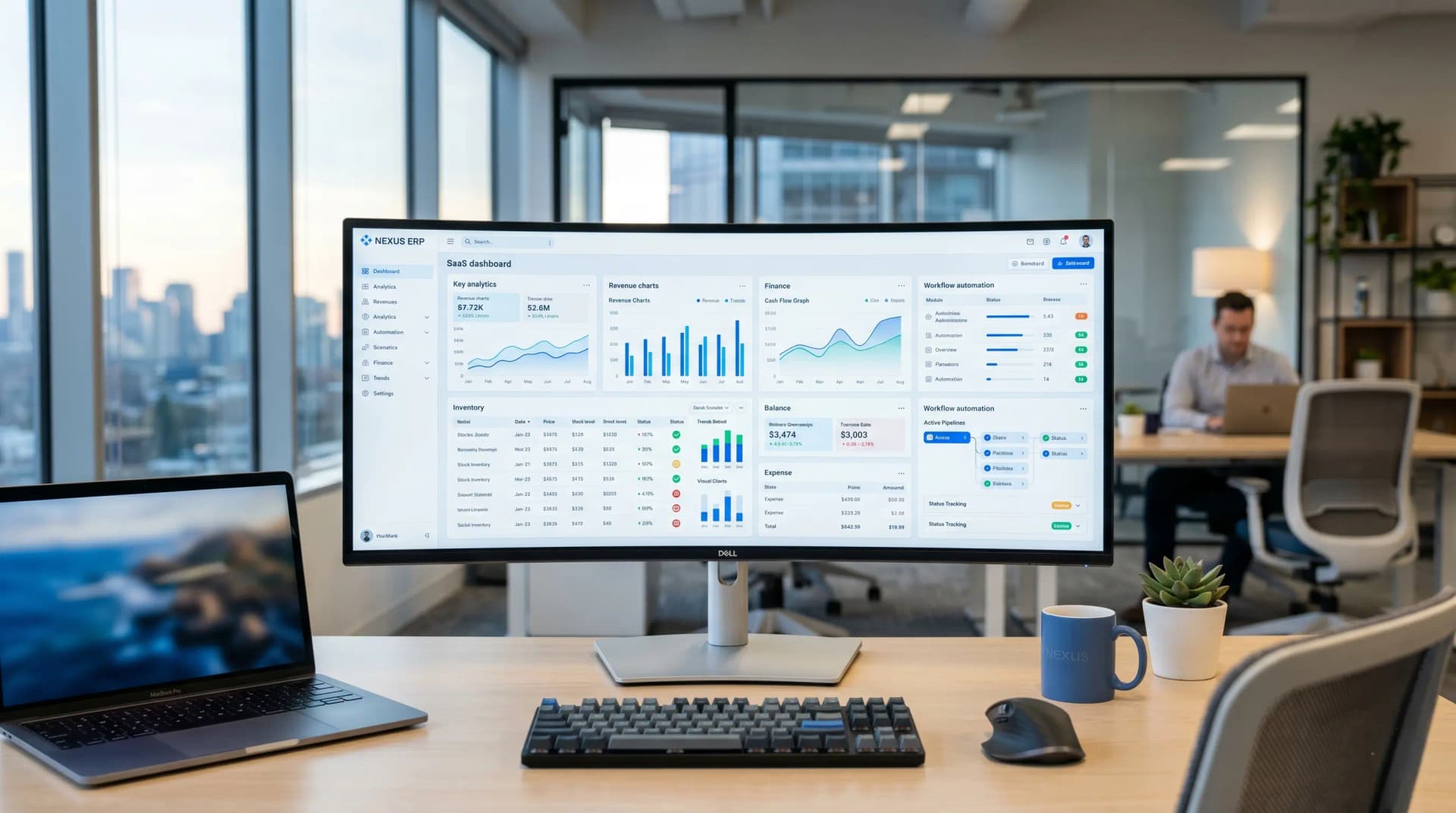
Custom ERP software is a bespoke enterprise resource planning platform built around your specific business processes. You own the code, control the data, and scale without licensing fees. Unlike off-the-shelf ERPs that force workflow compromises.
Enterprise Resource Planning software acts as the digital nervous system of modern organizations. Consolidating finance, human resources, inventory, sales, and supply chain into a single ecosystem with real-time data sharing and advanced analytics.
Custom ERP software is architected from the ground up to mirror your exact workflows, approval processes, and data requirements. Unlike SAP, Oracle, or Microsoft Dynamics 365, it does not force you to adapt your processes to fit a vendor's framework. Your proprietary operations are embedded directly into the system, creating competitive advantage that generic platforms cannot replicate.
You own 100% of the intellectual property and source code. No recurring licensing fees. No per-user subscription penalties. Absolute control over data residency, security, and infrastructure.
Evaluating options? See our CRM & ERP solutions or broader custom software development services.
Off-the-shelf systems promise faster deployment but mask long-term costs and strategic limitations. Custom ERP reverses that trade-off.
| Metric | Off-the-Shelf | Custom ERP |
|---|---|---|
| Workflow fit | Forces you to adapt to rigid software logic | Engineered around your exact processes |
| Feature scope | Bloated with unused modules; lacks niche capabilities | Lean architecture; every module has a purpose |
| Scaling cost | Per-seat fees escalate as you grow | Zero licensing penalties at any user count |
| Data ownership | Vendor-hosted; limited security control | You own code, data, and infrastructure |
| Competitive edge | Same toolset as every competitor | Proprietary system competitors cannot replicate |
The financial case for custom ERP becomes clear when you analyze total cost of ownership over a 5-year horizon. No escalating seat fees, no third-party middleware costs, and full IP ownership.
Every module is built for a specific organizational requirement. No bloat, no unused features.
General ledger, AP/AR, budgeting, multi-currency, tax automation, and real-time financial dashboards.
Recruitment, onboarding, payroll, attendance, performance reviews, and workforce analytics.
Multi-location stock tracking, reorder automation, barcode/RFID integration, and space optimization.
Procurement automation, vendor management, demand forecasting, logistics coordination, and traceability.
Lead management, pipeline tracking, quotations, order processing, and unified customer intelligence.
Bill of materials, production scheduling, quality control, shop floor data, and predictive maintenance.
AI-powered dashboards, custom report builders, KPI tracking, and natural language querying.
Approval chains, notifications, document routing, task orchestration, and rule-based process automation.
Need something specific? Tell us what you need and we will scope it.
Your ERP should be an active participant in operations. Not a passive data store. We embed AI, blockchain, and real-time analytics directly into the platform.
Non-technical users generate complex visualizations via natural language. No SQL required.
Automated password resets, access requests, incident logging via Slack, Jira, and Teams.
ML models forecast demand, equipment failures, and cash flow patterns before impact.
Immutable transaction records via smart contracts for finance, pharma, and supply chain.
Real-time enterprise-wide metrics for proactive, data-driven decisions across all departments.
Responsive architecture accessible from any device and location for hybrid workforces.
Generic ERP leaves critical functional gaps. We build tailored modules for each industry vertical.
IoT-integrated ERP with predictive maintenance, multi-location inventory, and production scheduling.
ML algorithms analyze machine performance data to forecast failures, reducing unplanned downtime.
Project management with CAD/BIM integration, subcontractor coordination, and safety compliance.
The construction ERP market is projected to reach $28 billion by 2030.
HIPAA-compliant ERP unifying EHR with admin, HR, and financial workflows.
Streamlined patient registration, automated revenue cycle management, and insurance claims processing.
Omnichannel inventory sync, dynamic pricing, and demand forecasting across all sales channels.
Instant synchronization of inventory, pricing, and customer profiles across all points of sale.
Blockchain-integrated ERP with compliance reporting and immutable financial records.
Smart contracts ensure transactions are permanently recorded and resistant to tampering.
Fleet management, route optimization, warehouse operations, and real-time shipment tracking.
Automated procurement workflows with dynamic inventory tracking across multiple locations.
Resource allocation, project profitability tracking, time and billing automation.
Real-time visibility into project profitability and team utilization rates.
Batch management, quality control, regulatory compliance, and full supply chain traceability.
Blockchain-backed audit trails for every batch, material transfer, and quality checkpoint.
ERP failures stem from organizational challenges, not faulty code. We mitigate every major risk before development begins.
Intensive discovery forcing total alignment between software capabilities and executive strategy before development begins.
Internal champions, transparent communication, and continuous training programs from pre-launch through post-deployment.
Forensic dataset audits, rigorous cleaning protocols, small-batch trial migrations in sandboxed environments with rollback plans.
Scenario-based UAT validating real-world workflows. Defect tracking linked directly to business requirements.
A transparent six-phase process from discovery through continuous post-launch support.
Day 1
Map your operational landscape, identify bottlenecks, and define strategic objectives.
Weeks 1 to 2
Document every workflow, data model, integration point, and compliance requirement.
Weeks 2 to 4
Intuitive interfaces designed for high adoption. Every screen reviewed by your team.
Weeks 4 to 20
Regular development cycles with working software demos. Full real-time visibility throughout.
Weeks 18 to 22
QA, penetration testing, OWASP review, and scenario-based user acceptance testing.
Post-launch
Deployment, training, proactive maintenance, security patching, and ongoing upgrades.
You see working software often, with short, regular updates. Full visibility into the build process throughout development.
End-to-end development, staff augmentation, or dedicated offshore teams. We agree the full scope up front.
AI-powered talent matching onboards AI/ML, DevOps, and blockchain specialists in 3 days average.
Not a transactional vendor. A strategic digital transformation partner.
Custom ERP software delivered across USA, UK, Canada, Australia, and UAE.
Full-stack, AI/ML, DevOps, QA, and project management under one roof.
From focused tools to enterprise platforms serving 500K+ users.
No licensing. No vendor lock-in. Every asset belongs to you.
GDPR, HIPAA, SOC 2, and OWASP baked into architecture from day one.
100% refund if you are unsatisfied with the quality of the build.
Real enterprise systems delivering measurable improvements at scale.
Challenge: Zero real-time visibility across 200+ vehicles.
Solution: Custom ERP with route optimization, fleet tracking, billing, and warehouse management.
35% faster deliveries · 28% cost reduction · 99.9% uptime
Tech: Python, React, PostgreSQL, AWS
View case studyChallenge: 500K+ patient records across disconnected systems.
Solution: HIPAA-compliant ERP unifying EHR, scheduling, telemedicine, and billing.
60% fewer no-shows · Full HIPAA compliance · 500K+ users
Tech: Next.js, NestJS, PostgreSQL, AWS
View case studyChallenge: $2M+ monthly orders without unified operations.
Solution: Omnichannel ERP with multi-vendor marketplace and real-time inventory sync.
45% conversion lift · $2M+ GMV · Sub-second loads
Tech: Next.js, Stripe, Redis, Elasticsearch
View case studyOur proprietary Invoicely platform is a cross-platform financial utility running on Windows, Mac, Linux, iOS, and Android. Businesses use it daily for GST/VAT invoices, proforma invoices, quotations, credit/debit notes, and delivery challans.
The same engineering standards. High-speed data retrieval, cryptographic security, and intuitive UX. Power every custom ERP we build. Invoicely is publicly accessible proof of our ability to ship production-grade financial software at scale.
5 Platforms
Win, Mac, Linux, iOS, Android
GST/VAT
Automated tax compliance
AES-256
Enterprise-grade encryption
We pick the right technology for your enterprise. Not what is trending.
Costs, timelines, industries, integration, ROI, and implementation.
Custom ERP software is an enterprise resource planning system built specifically for your organization. Unlike SAP, Oracle, or Dynamics, it mirrors your exact workflows and data requirements. You own 100% of the source code and pay zero recurring licensing fees.
It depends entirely on your scope. The number and complexity of modules, the integrations you need, data migration, and compliance requirements all shape the work. After a free discovery call we map exactly what you need and send a clear written proposal with a defined scope. Book a free consultation and we will talk it through. No obligation.
It depends on the scope. A focused module is far quicker than a comprehensive multi-module ERP with AI and blockchain. We agree the plan up front, work in regular cycles, and you see working software often with short, regular updates so there are no surprises along the way.
Off-the-shelf ERPs force you to adapt to their rigid architecture, creating bottlenecks and workarounds. Custom ERP fits your exact processes, eliminates licensing fees, gives you full data ownership, and creates competitive differentiation generic platforms cannot offer.
Manufacturing, construction, healthcare, retail, finance, logistics, pharmaceuticals, and professional services. Any organization whose processes do not fit generic ERP templates gains significant advantages.
Yes. Custom ERP is designed to integrate with your existing stack. Accounting systems, CRM, e-commerce, IoT devices, APIs, legacy databases, Slack, and Teams. We engineer high-availability API layers that move data automatically, with no manual re-entry.
Absolutely. Cloud-native architecture scales horizontally and vertically. Adding thousands of users incurs zero licensing penalties. New modules and integrations are added incrementally as your business evolves.
25 to 45% reduction in operational costs, 30 to 50% efficiency improvements, and elimination of compounding SaaS licensing fees. Most clients achieve full ROI within 18 to 30 months.
Forensic audits of existing datasets, rigorous cleaning and validation, small-batch trial migrations in sandbox environments, and tested rollback plans with redundant backups.
Yes. Continuous maintenance, security patching, performance monitoring, feature enhancements, 24/7 incident response, and training for new team members.
Free strategic consulting to map your technology roadmap and define your digital transformation strategy. No obligation.