The installment price is the cash price plus a monthly markup for the months you wait: Installment Price = Cash Price × (1 + Monthly Rate × Months). Then divide the balance after down payment by the number of months to get the installment amount — and always subtract expected defaults before calling anything "profit."
Price installments wrong and you either scare customers away or work for free. This guide gives you the three formulas, worked examples at 3%, 4%, and 5% monthly rates, and the default math that most shop owners skip — the part that quietly decides whether your installment business makes money.
Installment Price = Cash Price × (1 + Monthly Rate × Months)
The "monthly rate" is your reward for waiting and your cover for risk. It is your decision, shaped by competition, item type and how risky your customers are; the examples below use 3%, 4% and 5% per month purely as illustrations.
Worked examples — phone with a cash price of 180,000, 6-month plan:
| Monthly rate | Formula | Installment price | Total markup |
|---|
| 3% | 180,000 × (1 + 0.03 × 6) | 212,400 | 32,400 |
| 4% | 180,000 × (1 + 0.04 × 6) | 223,200 | 43,200 |
| 5% | 180,000 × (1 + 0.05 × 6) | 234,000 | 54,000 |
Notice how one percentage point changes the markup by more than 10,000 on a single phone. If your competitors sell the same phone on installments for 220,000, you know instantly you're competing in the 3.5–4% range. Price above that only if you offer something they don't — a longer term, a lower down payment, or a better reputation.
Rule of thumb: riskier customer or longer term → higher rate. A 12-month plan at 3% doubles your waiting time compared to 6 months, so many shops use 3% for short plans and 4–5% for long ones.
Monthly = (Installment Price − Down Payment) ÷ Months
Customers don't decide on the total price. They decide on the monthly number. Your job is to make that number feel easy.
Example at 4%: 223,200 total − 43,200 down (about 20%) = 180,000 ÷ 6 = 30,000/month. That's a clean, sayable number: "43,000 down, then just 30,000 a month for six months."
How does the down payment change everything?
The down payment does three jobs at once: it lowers the monthly amount, it reduces the money you have at risk, and it filters out customers who were never going to pay. Here's the same 223,200 phone (4%, 6 months) at different down payments:
| Down payment | Amount financed | Monthly | Your money at risk |
|---|
| 10% (22,320) | 200,880 | ~33,480 | High |
| 20% (43,200)* | 180,000 | 30,000 | Moderate |
| 30% (66,960) | 156,240 | ~26,040 | Lower |
| 40% (89,280) | 133,920 | ~22,320 | Low |
*Rounded for a clean monthly number.
Two things jump out. First, moving from 10% to 30% down cuts your exposure by roughly a quarter while dropping the monthly by about 7,000 — the customer feels the benefit too. Second, a customer who genuinely cannot produce 20% down is telling you something about their next six months. A common rule of thumb is a 20% floor, with 30–40% for new or unproven customers.
In Timeline Free Installment Manager, the down payment is automatically recorded as the first payment when you create the plan, so your receivable numbers are correct from day one.
Real Profit = (Installment Price − Cash Price) − (Default Rate × Amount Financed)
Your markup is not your profit. Some customers will stop paying, and that expected loss must come out of the markup before you count anything.
Example (4%, 20% down): markup is 43,200; amount financed is 180,000. At a 3% default rate, expected loss ≈ 5,400 → real profit ≈ 37,800 per phone.
Now watch what happens when collections get sloppy (illustrative default rates):
| Default rate | Expected loss (on 180,000) | Real profit | % of markup kept |
|---|
| 2% | 3,600 | 39,600 | 92% |
| 3% | 5,400 | 37,800 | 88% |
| 5% | 9,000 | 34,200 | 79% |
| 10% | 18,000 | 25,200 | 58% |
| 15% | 27,000 | 16,200 | 38% |
| 20% | 36,000 | 7,200 | 17% |
At a 20% default rate, a deal that looked like 43,200 of markup earns almost nothing — and that's before your time chasing payments. This table is the single most important thing in installment pricing: collections, not pricing, decide profit. A shop at 3% monthly with 2% defaults beats a shop at 5% monthly with 15% defaults, every time. Our recovery tips guide covers how to keep that default number low.
If you don't know your default rate, you can't use this formula — which is exactly why tracking matters. Timeline's dashboard shows Total Receivable vs Total Received, and its 11 reports (including Next 30 Days Recovery and Customer Statement) turn your default rate from a guess into a number.
Is an installment markup the same as interest?
Not in how shops present it, but often yes in how the law measures it. A flat monthly rate charged on the original cash price works like simple interest, and because the balance falls as the customer pays, the effective annual rate is close to double the flat annual rate. Some laws treat any extra charge for paying over time as a finance charge that must be disclosed as an APR (US Truth in Lending rules and UK consumer-credit rules are examples), and whether a fixed-price credit sale fits Islamic principles is a question for a qualified scholar. Take local advice on how you present your prices.
Timeline Free Installment Manager, made by Timeline Digital, a custom software development company founded in 2013 in Islamabad, Pakistan, does not calculate interest, APR or the markup. You work out the total installment price with the formulas here and enter it; the app subtracts the down payment, splits the rest into equal installments (the last one absorbs any rounding) and tracks every payment.
How should you present the price to customers?
Never lead with the total. Lead with the monthly amount, then the down payment, and mention the total only when asked or when writing the agreement.
- Weak: "The installment price is 223,200."
- Strong: "43,000 down and it's yours today — then just 30,000 a month for six months."
Both describe the same deal. The second one sells it. A few more presentation rules:
- Compare against the cash price openly. "Cash is 180,000; on installments it's 30,000 a month." Hiding the cash price breeds distrust; showing it makes the convenience cost feel fair.
- Print the schedule during the conversation. A dated, printed schedule with exact amounts feels professional and final. Timeline shows a live preview of the full schedule as you build the plan, so the customer sees every date before signing.
- Offer two options, not five. "6 months at 30,000 or 9 months at 21,500" is a choice. Five options is a headache, and headaches walk out of shops.
Why do clean, round numbers collect better?
Rounding isn't decoration — it changes behavior. A customer owing 30,000 on the 5th of every month remembers it, budgets it, and can hand it to a family member to deliver. A customer owing 29,617 has to check the paper every month, and every check is a chance to delay.
Practical rounding rules:
- Round the monthly amount to a clean figure (nearest 500 or 1,000; nearest $5 or £5 in the West), then adjust the down payment or the final installment to make the totals match.
- Round up, not down — the extra goes to you, and the customer never notices the difference between 29,617 and 30,000.
- Keep every installment identical except possibly the last. "Six payments of 30,000" is a sentence; a schedule where every month differs is a dispute waiting to happen.
The 212,400 result from the 3% example becomes "39,000 down, then 29,000/month × 6 = 213,000" — cleaner for everyone and 600 better for you.
Quick reference table (6-month plans, ~25% total markup, 20% down)
| Cash price | Installment price | Down (20%) | Monthly |
|---|
| 50,000 | 62,500 | 12,500 | ~8,333 |
| 100,000 | 125,000 | 25,000 | ~16,667 |
| 180,000 | 225,000 | 45,000 | 30,000 |
| 300,000 | 375,000 | 75,000 | 50,000 |
Adjust the markup column to your local rate; the structure stays the same.
When should you refuse the sale?
The most profitable decision in this business is sometimes "no." Refuse — or restructure with a much larger down payment — when:
- The customer bargains hard on the down payment but accepts any monthly amount. That pattern usually means they're focused on walking out with the item, not on paying for it.
- No guarantor from a different household will sign. If their own circle won't vouch for them, don't volunteer to.
- The numbers fail the income test. If the monthly installment looks like more than roughly a quarter of their stated household income (a rule of thumb, not a standard), the plan is likely to break early.
- They already have an overdue account — with you or, if you can find out, with a nearby shop. Selling again to a late payer converts one bad debt into two.
- The item is easy to resell and easy to hide (high-end phones especially) and the buyer is new to you with weak references. That combination is where most total losses come from.
A refused sale costs you the markup on one deal. A default costs you the full financed amount. Using the example above: one total default on 180,000 financed wipes out the real profit of four to five good deals. Say no politely, offer a higher-down-payment version, and let them come back when they're ready. See Start an Installment Business for how to set these rules before your first sale.
Track the real numbers automatically
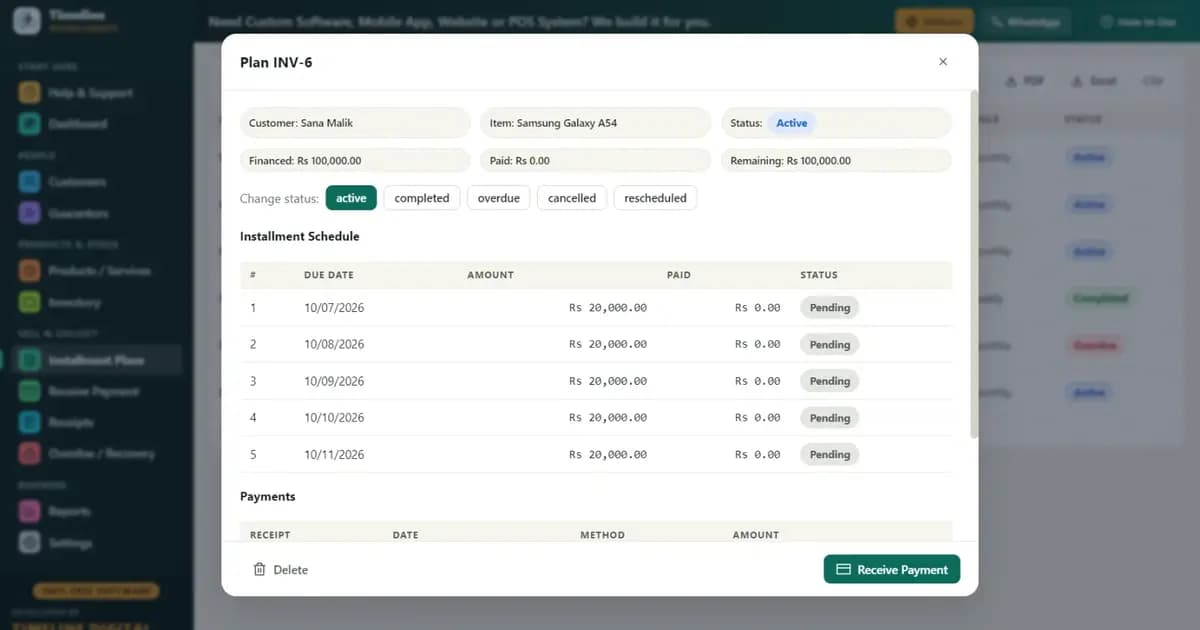
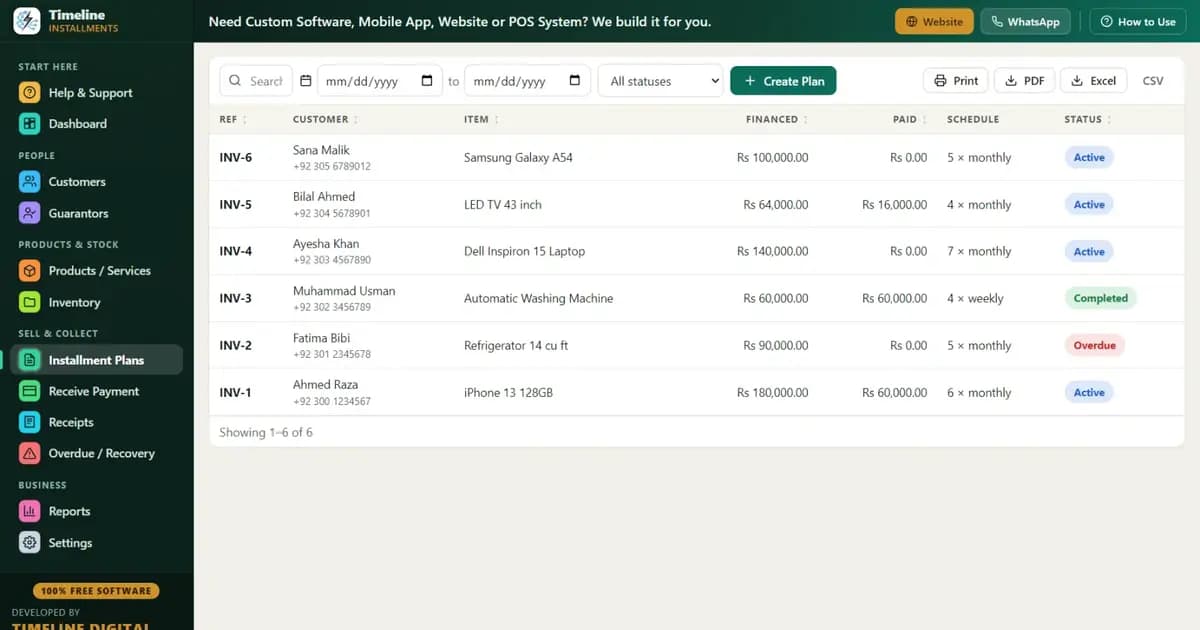
Formulas set the price; software proves the profit. Timeline Free Installment Manager — 100% free forever, fully offline, no account needed — auto-builds every daily, weekly, or monthly schedule with a live preview, records the down payment as the first payment, applies partial payments to the oldest installment first, and prints branded receipts showing "Installments Paid X of Y" and the remaining balance. Its dashboard and reports show your Total Receivable vs Total Received, so your default rate stops being a guess and starts being a number you can manage.
Price it once, track it forever
Set your rate, your down-payment floor, and your refusal rules — then let software handle the arithmetic. Download Timeline Free Installment Manager (free, offline, Windows 10/11, ~90 MB; the installer is not code-signed, so Windows SmartScreen may ask once) and build your first plan with Sample Data in five minutes. Selling phones? The mobile shop installment software page shows the same workflow at a phone counter, and installment software for Pakistan covers qist pricing in rupees.
Related: Start an Installment Business · Recovery Tips · Installment Agreement Format