A good installment agreement is one page long, signed by three people (buyer, guarantor, seller), and attached to a printed payment schedule. That single sheet of paper turns "he promised to pay" into a document you can show to a family elder, a mediator, or a court — and it makes most customers pay on time simply because they signed it.
A verbal deal is a future dispute. Every installment sale needs a written agreement, no matter how well you know the customer. This guide gives you the exact format, explains every clause in plain words, and shows you how to file it so you can find it a year later.
The agreement (copy & adapt)
INSTALLMENT SALE AGREEMENT — No. ____ Date: ____
Seller: [Shop name, address, phone]
Buyer: [Name, ID/CNIC #, phone, address] (attach ID copy + photo)
Guarantor: [Name, ID #, phone, relation] — "I guarantee full payment if the buyer defaults." Signature: ____
Item: [Product, model, serial/IMEI] · Condition: New/Used
Price & terms: Total installment price: ____ · Down payment: ____ · Balance: ____ · [N] installments of ____ each, due on the [day] of every [week/month], starting [date] (schedule attached).
Clauses:
1. Ownership remains with the seller until full payment (retention of title).
2. Late payments incur [none / fixed ____ / ____% of remaining] after [X] days.
3. Missed installments beyond [X] days allow the seller to demand full balance and/or repossess the item.
4. Item condition accepted at delivery; warranty per manufacturer only.
5. Payments valid only with the seller's printed receipt.
Signatures: Buyer ____ · Guarantor ____ · Seller ____ (+ thumbprint where customary)
Print two copies. Buyer keeps one, you keep one. Now let's walk through why every line is there.
What does each part of the agreement actually do?
Agreement number and date. The number links the paper to your records. When a customer calls about "my phone plan," you find agreement No. 47 in seconds instead of digging through a drawer. The date starts the clock on every deadline in the contract.
Seller details. Your shop name, address, and phone. This proves who the contract is with — important if you ever sell the shop or a family member handles a dispute for you.
Buyer details with ID number. The name alone is not enough. Two men named Ahmed Khan can live on the same street. The ID number (more on country differences below) is the one thing that identifies exactly one person. Always attach a photocopy of the ID and, ideally, a photo of the buyer holding the item on delivery day.
Item description with serial or IMEI. "One mobile phone" is useless in a dispute. "Samsung A55, IMEI 3548...991, new, box sealed" identifies the exact unit. If the buyer later claims you sold a used phone, the serial number and the "Condition: New" line settle it. For vehicles, write the engine and chassis numbers. For furniture, write the model and a short description.
Price and terms. Four numbers must appear and must add up: total installment price, down payment, balance, and the per-installment amount times the number of installments. If these numbers disagree, the whole agreement becomes arguable. This is why the schedule should be printed by software, not calculated by hand — one math slip and the customer's version of events wins.
Clause 1 — retention of title. In plain words: the item belongs to you until the last installment is paid. Without this clause, the moment you hand over the phone, it may legally be the buyer's property, and taking it back after a default becomes much harder. With it, you are recovering your own goods, not seizing the buyer's.
Clause 2 — late fee. State the exact fee and the grace period. "Late fee applies" means nothing; "500 fixed after 5 days late" means everything. A written late fee also gives you something to waive — forgiving a late fee for a good customer builds loyalty and costs you nothing.
Clause 3 — acceleration and repossession. This is your emergency exit. If the buyer stops paying, this clause lets you demand the whole remaining balance at once, or take the item back. Without it, you can only chase one missed installment at a time while the item loses value every month.
Clause 4 — condition accepted at delivery. Stops the classic month-three excuse: "the screen was already scratched, so I'm not paying." The buyer confirmed the condition on day one, in writing. Warranty claims go to the manufacturer, not to your payment schedule.
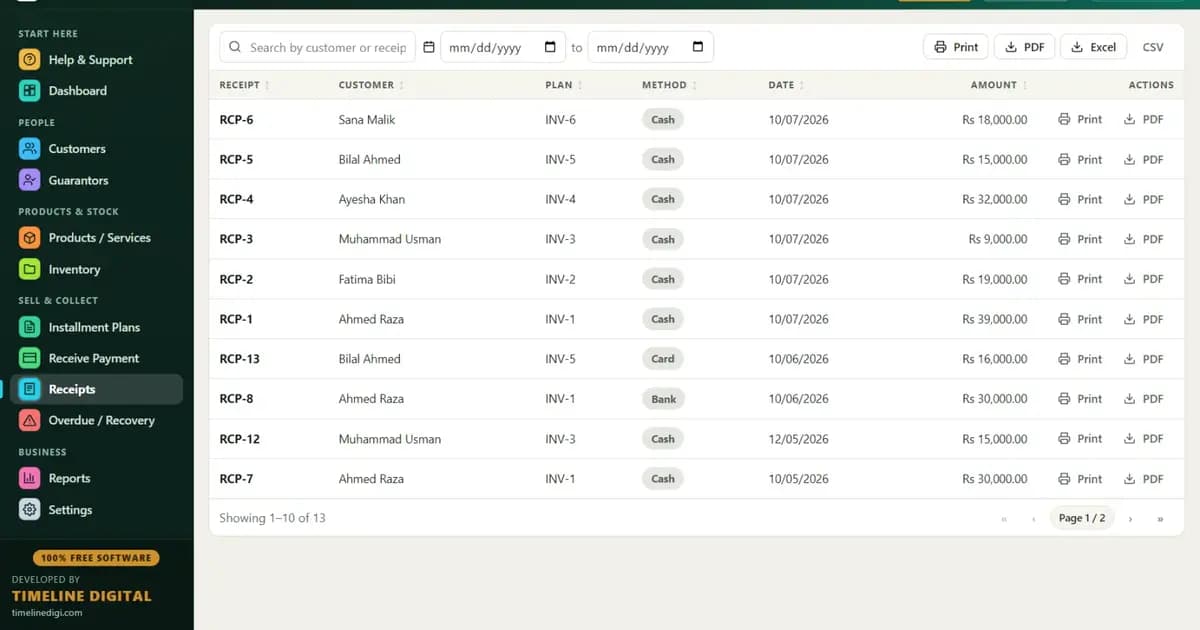
Clause 5 — printed receipt only. This protects both sides. The buyer knows a payment doesn't count unless a receipt exists; you know nobody can claim "I gave cash to your brother last Tuesday." Every payment, every time, gets a printed receipt.
Why is the guarantor section the most important part?
Ask any shop owner who has run installments for years: the guarantor is worth more than the late fee, the ID copy, and the acceleration clause combined. Here's why.
When a buyer stops answering your calls, the guarantor still answers theirs. One call — "your cousin's phone plan is 40 days late, and you signed as guarantor" — recovers more overdue accounts than any legal letter. Most buyers pay quickly once the guarantor knows, because nobody wants to embarrass the person who vouched for them.
Rules for a guarantor that actually works:
- The guarantor must be a different household than the buyer. A wife guaranteeing a husband adds nothing — if the household has no money, neither does the guarantor.
- Take the guarantor's ID copy and phone number, exactly like the buyer's.
- The guarantor must sign in your presence and read the one-line promise: "I guarantee full payment if the buyer defaults." Reading it out loud makes it real.
- Prefer a guarantor with something to lose locally — a shop, a job, a house in the area.
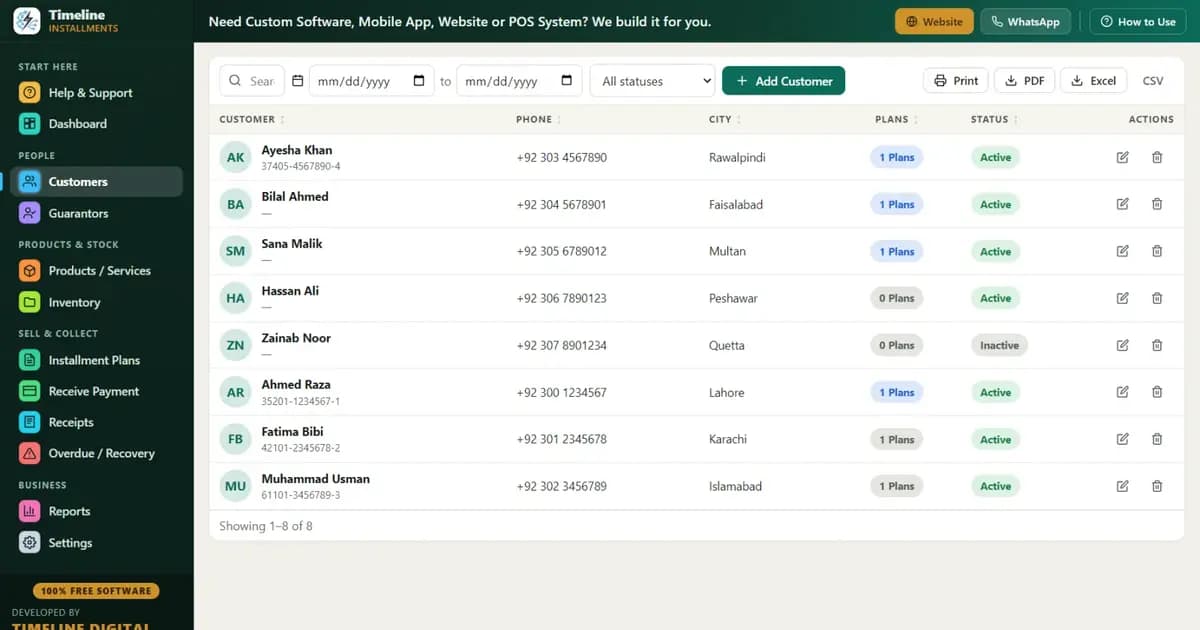
In Timeline Free Installment Manager, guarantors are saved with their ID and contact details and linked directly to the plan. When a plan appears on the Overdue screen, the guarantor's contact is shown right next to the customer's phone number — so the follow-up call takes ten seconds to start, not ten minutes of searching.
What ID should you record in your country?
| Country | ID to record | Notes |
|---|---|---|
| Pakistan | CNIC (13-digit number) | Photocopy both sides; check the photo matches the buyer. Standard for qist agreements. |
| India | Aadhaar (or PAN) | Aadhaar identifies the person; verify the name and photo. Many shops record both Aadhaar and phone number linked to it. |
| USA | Driver's license (or state ID) | Record license number and state. For larger tickets, some shops also note the last 4 of the SSN — never store the full SSN. |
| UK | Driving licence or passport | Record the number and confirm the address matches a recent utility bill. |
| Bangladesh | NID (National ID) | Photocopy and verify the photo, same routine as CNIC. |
Whatever the country, the routine is identical: see the original, keep a copy, write the number on the agreement. A phone number changes; a national ID doesn't. If you sell in Pakistan or India, see our country pages for local setup: installment software for Pakistan and EMI software for India.
What makes an agreement enforceable in practice?
Forget courtroom drama — in real shop life, "enforceable" mostly means the paper is so clear that nobody bothers to fight it. Here's what makes the difference:
- Both parties signed, and a witness or guarantor signed too. An unsigned template is decoration.
- The numbers add up. Down payment + all installments = total price, to the rupee/dollar. Software-printed schedules never make this mistake; hand-written ones often do.
- The item is identified by serial/IMEI, so there is no argument about which item.
- You actually followed the contract yourself. If your clause says "receipt required" and you took three payments without receipts, the contract is half-dead. Consistency is what judges, elders, and mediators look at.
- Copies exist. The buyer has one, you have one, and your file has the ID copies stapled to it. A contract only you have seen is a weak contract.
- Local formalities where customary. In some areas a thumbprint alongside the signature is expected; in others a stamp paper is preferred for high-value items like motorcycles. Ask a local lawyer once, then repeat the same format every time.
One honest note: this article is practical guidance, not legal advice. For vehicles or very high-value goods, spend one hour with a local lawyer to check your template against local law. It costs a little once and protects every sale after.
What's the printing and filing routine?
A great agreement that you can't find is the same as no agreement. Use this five-minute routine on every sale:
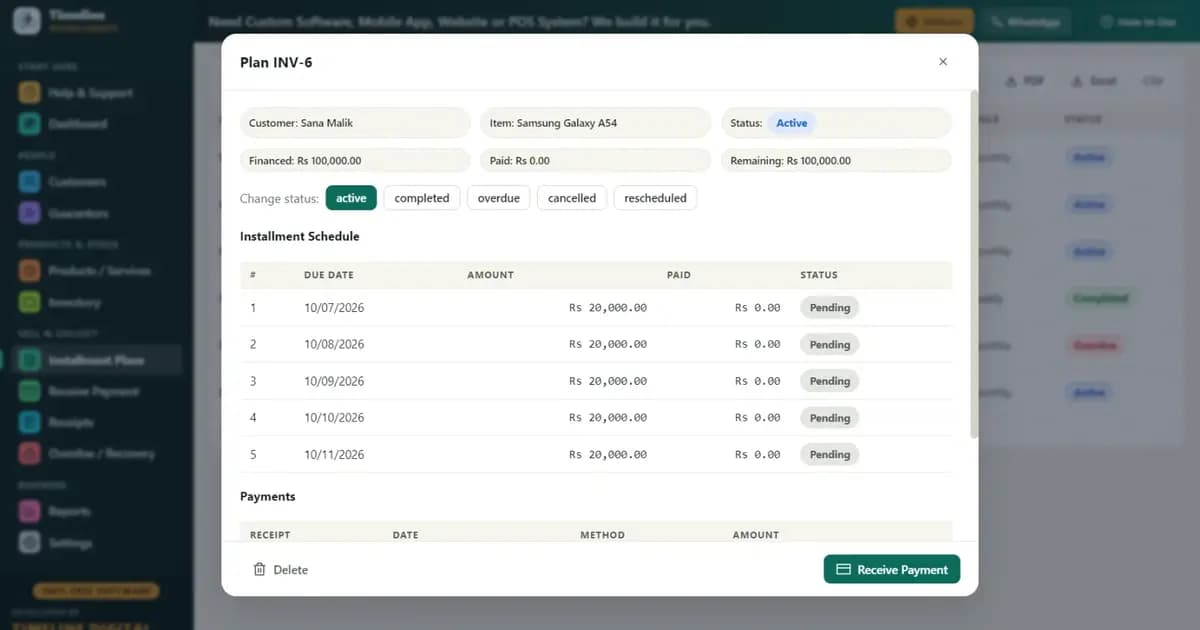
- Create the plan in software first. Enter the customer (with ID), guarantor, item, prices, and dates. Timeline generates the full dated schedule instantly with a live preview, and the down payment is auto-recorded as the first payment.
- Print the schedule and staple it to the agreement — it is the "schedule attached" from the terms section.
- Fill and sign the agreement — buyer, guarantor, seller. Two copies.
- Photocopy the IDs (buyer + guarantor) and staple them to your copy.
- File by agreement number in a simple ring binder or folder, newest at the front. Write the agreement number inside the software plan notes so paper and software point at each other.
Every later payment gets a printed receipt — Timeline prints branded receipts (with your logo, "Installments Paid X of Y," the remaining balance, and signature lines) on any Windows printer, including Microsoft Print to PDF if you'd rather WhatsApp a PDF copy to the customer. That receipt trail is Clause 5 running on autopilot.
Never write the schedule by hand
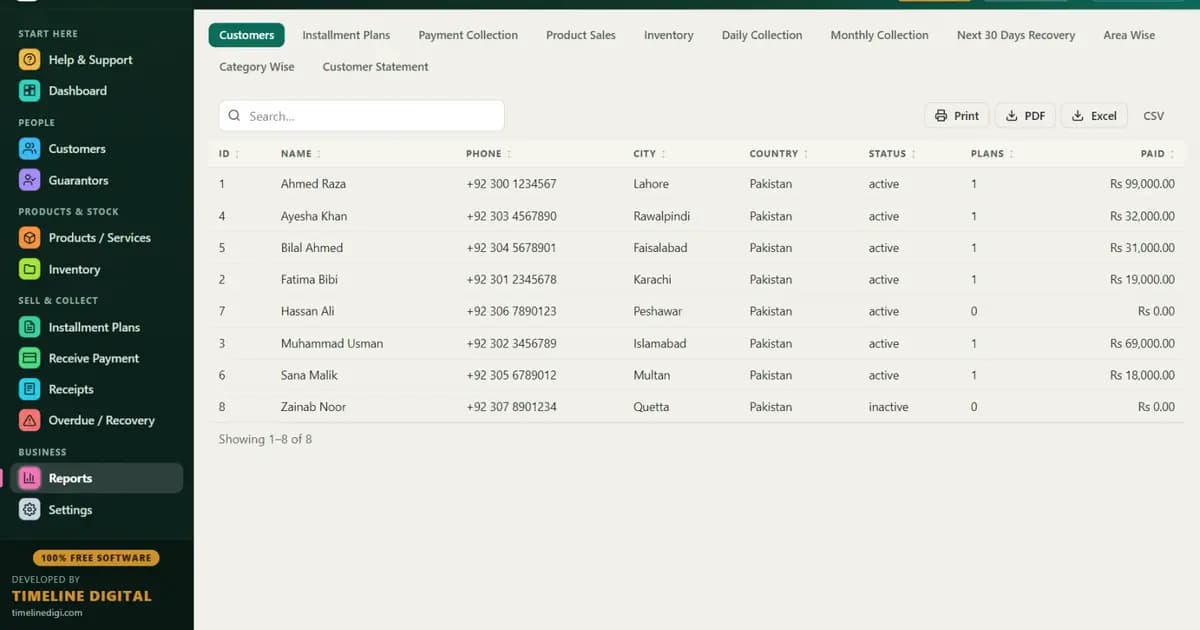
Hand-written schedules cause math disputes — a smudged digit or a skipped date becomes a real argument six months later. Timeline Free Installment Manager is 100% free forever, works fully offline on Windows 10/11, needs no account, and builds daily, weekly, or monthly schedules automatically. Partial payments apply to the oldest installment first, discounts can settle installments cleanly, and a Customer Statement report prints the entire payment history whenever a customer asks "how much is left?" You can even practice on Sample Data before touching real accounts.
Get the schedule and receipts handled for free
The template above covers the paper side. For the numbers side — schedules, receipts, balances, overdue tracking with guarantor contacts — download Timeline Free Installment Manager. It's free forever, offline, and takes about 90 MB on Windows 10/11. Try it with Sample Data first, then print your first real agreement pack today.
Related: 9 Recovery Tips · How to Calculate Installment Price & Profit · Start an Installment Business