BNPL providers give you instant approvals and take the default risk off your hands — but they charge merchant fees typically around 2–8% and keep the customer relationship. In-house installments let you keep the full margin and the relationship, but you carry the default risk and must run proper record-keeping.
Neither option is "better." They fit different stores, different customers, and different ticket sizes. This guide gives US and UK small retailers an honest side-by-side, a decision table by business type, and the exact routine for running in-house plans properly if you go that way.
What does BNPL actually give you — and cost you?
Buy Now, Pay Later services (Klarna, Afterpay, Affirm, Clearpay and similar) sit between you and the customer. The customer applies at checkout, the provider approves or declines in seconds, you get paid upfront (minus fees), and the provider collects from the customer.
The genuine upsides:
- Instant approval, zero effort. No ID copies, no guarantors, no judgment calls. The provider's algorithm decides in seconds.
- You're paid upfront. Typically within days, and if the customer never pays another cent, that's the provider's problem, not yours.
- No collections work. No reminder calls, no overdue tracking, no awkward conversations.
- Checkout conversion. Some shoppers simply expect a BNPL button, especially online, and its presence can lift average order value.
The genuine costs:
- Merchant fees, typically around 2–8% per transaction depending on provider, plan length, and your volume — often plus a small fixed fee. On thin-margin goods, that can be most of your profit. A $500 sale at a 6% fee hands over $30; if your margin was $60, BNPL just took half.
- The customer belongs to them. The payment relationship, the app, the repeat-purchase prompts — all live with the provider. You become the place the item came from, not the business the customer owes and trusts.
- Eligibility limits. Providers approve who they choose. Thin-credit-file customers, some of your most loyal regulars among them, may be declined at your own counter — and you have no say.
- Ticket and category limits. Very small tickets aren't worth the fixed fee; large tickets may exceed the provider's cap; some categories aren't supported at all.
- You still eat returns and disputes under most agreements, and provider terms can change with notice.
What does in-house financing give you — and demand from you?
In-house installments are the oldest financing model in retail: you sell the item, take a down payment, and the customer pays you directly over weeks or months.
The genuine upsides:
- You keep the full margin — plus the installment markup. No percentage skimmed off every sale. The convenience premium you charge for paying over time goes to you, not to a fintech.
- You approve whoever you trust. The regular who's shopped with you for eight years but has a thin credit file? You can say yes when the algorithm says no. That's a competitive weapon chain stores can't copy.
- The relationship stays yours. Every payment is a customer visit or call — a chance to sell accessories, hear about their cousin who needs a washing machine, and build the loyalty that keeps a small store alive.
- You own the data. Who pays on time, who buys what, which area performs — it's your asset, not a provider's.
The genuine demands:
- You carry the default risk. If the customer stops paying, that's your inventory and your money. Down payments, guarantors, and pricing that accounts for defaults are how you manage it (see How to Calculate Installment Price & Profit).
- You need real record-keeping. Schedules, receipts, balances, overdue tracking. A notebook doesn't survive fifty active plans; you need software or the model collapses into disputes.
- You do the collections. Reminder calls and follow-ups take discipline (our recovery tips cover the routine).
- Cash comes in slowly. You're paid over months, not upfront, so you need enough working capital to restock while money is still out.
Decision table: which fits your business?
| Your situation | Better fit | Why |
|---|---|---|
| Online store, mostly one-time buyers | BNPL | No relationship to protect; conversion lift matters most; collections at distance are impractical |
| Neighborhood store with regulars (furniture, appliances, jewelry) | In-house | You know the customers; the markup and loyalty are worth the work |
| Thin margins (under ~10%) | In-house, carefully | A 2–8% BNPL fee can erase the margin; but in-house only works with strict down payments |
| High margins, high volume, no spare staff time | BNPL | Fee is affordable; your time is the scarce resource |
| Big-ticket local sales (vehicles, solar, high-end furniture) | In-house | Often above BNPL caps; agreement + guarantor model is standard here |
| Customers often declined by BNPL / thin credit files | In-house | You can approve people you know; that's the whole advantage |
| Just starting, no capital cushion | BNPL first | Upfront payment protects cash flow while you build reserves |
| Established, with working capital | Both | BNPL at online checkout, in-house at the counter for trusted regulars |
That last row is the quiet answer for many stores: it's not either/or. Offer BNPL to strangers and in-house terms to people you'd greet by name.
How do you run in-house financing properly?
In-house plans fail when they're run casually. Run them like a system and the default risk becomes manageable:
- Always take a down payment — 20% minimum. It filters out non-payers and cuts your exposure. Customers with real intent don't struggle to find 20%.
- Always sign a one-page agreement with ID recorded (driver's license in the US, driving licence or passport in the UK) and, for larger tickets, a guarantor from a different household. Use our copy-ready agreement format.
- Price in the default risk. Your installment price should include a markup that covers waiting time and expected losses — the formulas are in our pricing guide.
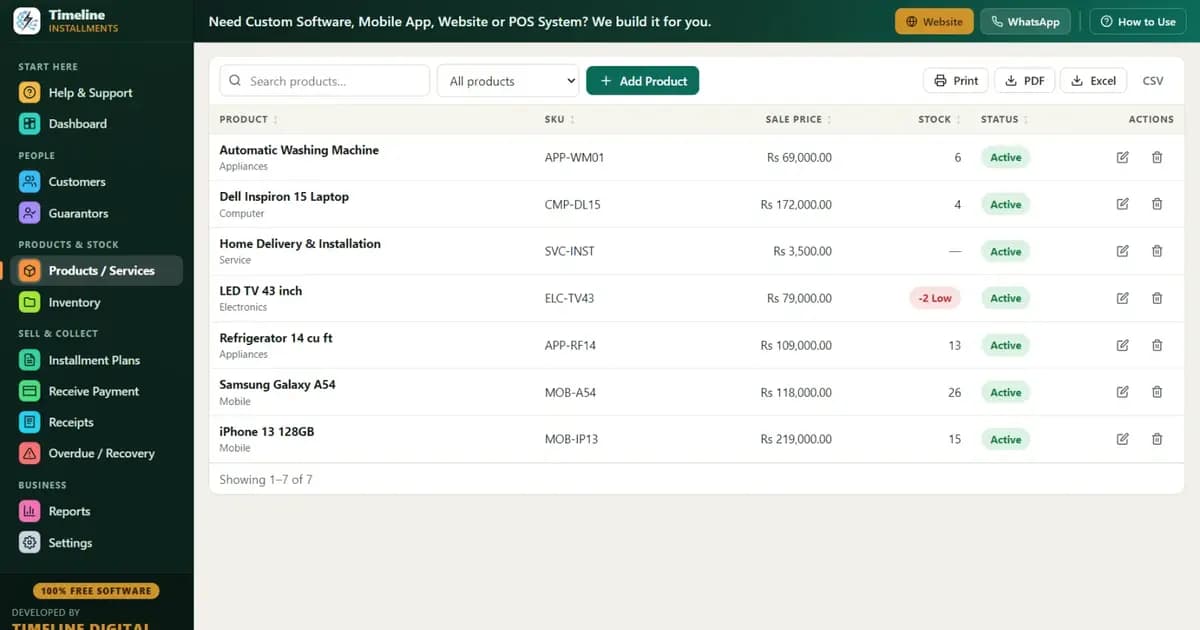
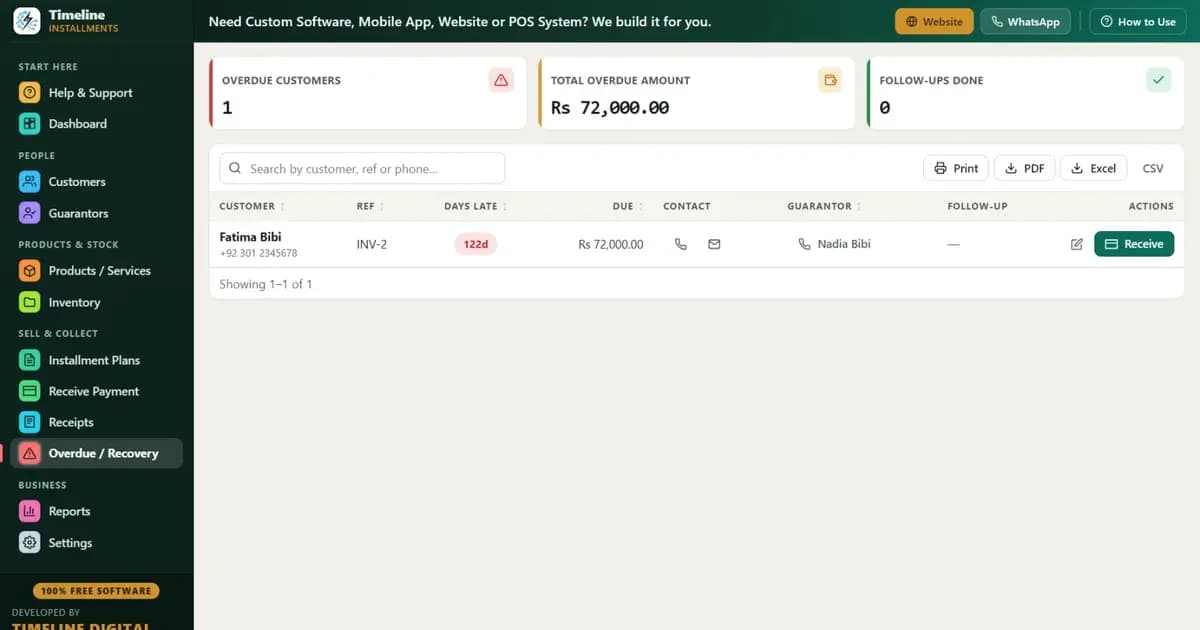
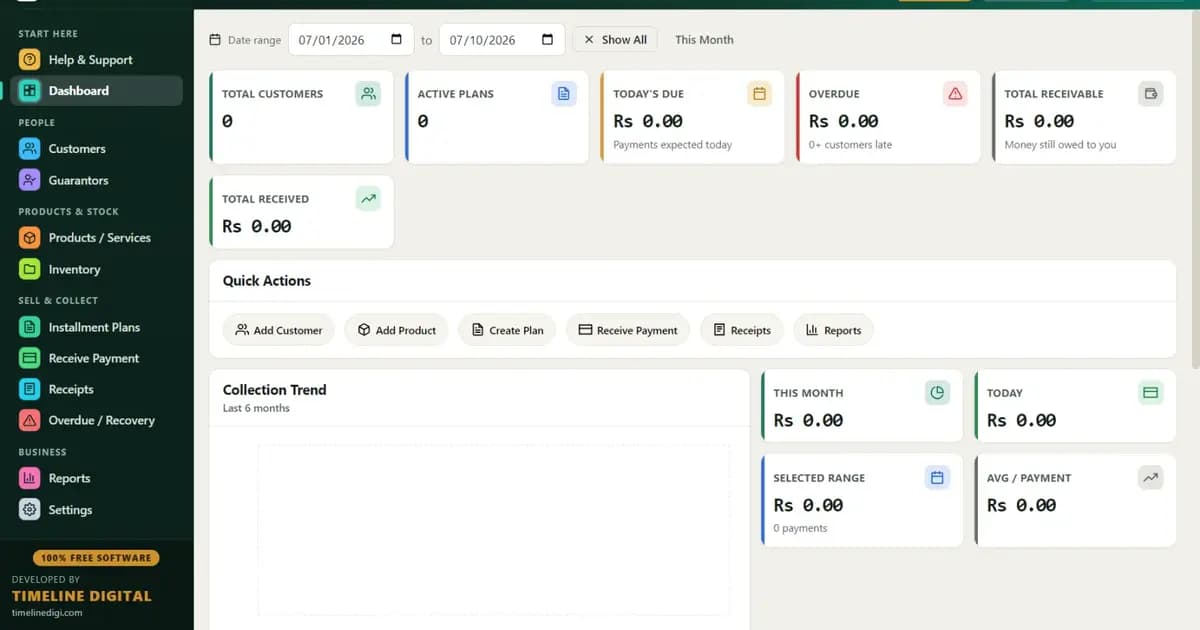
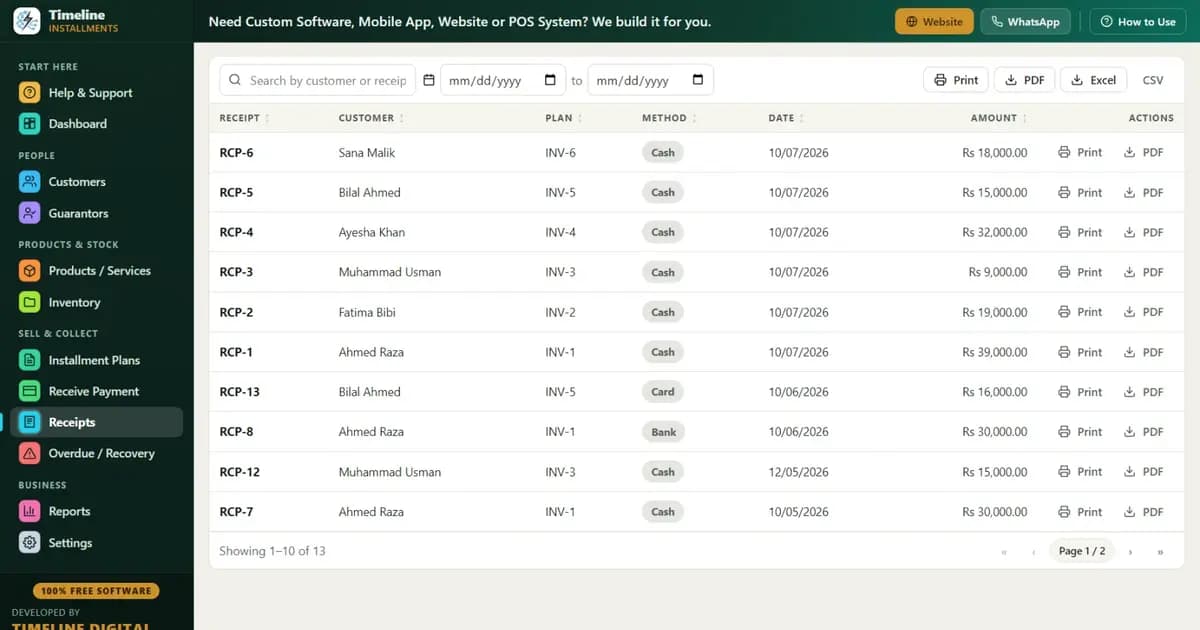
- Track everything in software, not a notebook. Timeline Free Installment Manager is 100% free forever (the developer, Timeline Digital, earns from custom software instead), runs fully offline on Windows 10/11 with no account, and handles the whole workflow: auto-generated weekly or monthly schedules with a live preview, down payment auto-recorded as the first payment, branded printed or PDF receipts showing "Installments Paid X of Y" and the remaining balance, customers stored with ID and linked guarantors, an Overdue screen showing days late with customer and guarantor contacts, and 11 reports including Next 30 Days Recovery and Customer Statement — all exportable to Print/PDF/Excel/CSV. Currency is automatic by country ($, £ and 150+ others).
- Call on day one of lateness, politely. Early, friendly reminders are what keep default rates low — not aggression, and not waiting a month "to be nice."
- Back up your records. Timeline has one-click Backup & Restore with reminders; your plan records are your receivables, so treat the backup like cash in the till.
Run this way, in-house financing is essentially the modern version of layaway with delivery upfront — see our layaway and in-house financing software page for the full setup.
A note on compliance (read this part)
Consumer credit is regulated, and the rules are your responsibility as the merchant — this article is practical guidance, not legal advice. In the US, requirements vary by state and can include disclosure rules (and, if you charge interest across enough transactions, Truth in Lending–style obligations); in the UK, the FCA regulates consumer credit, and whether your in-house arrangement needs authorization depends on its structure — interest-free, short-term plans are treated differently from interest-bearing ones. Before launching, spend an hour with a local attorney or solicitor to confirm how your plan structure is classified where you trade. It's a one-time cost that protects every sale afterward.
Keep the margin and the relationship
If your store has regulars, in-house installments are the profit BNPL was skimming. Download Timeline Free Installment Manager — free forever, fully offline, no account — and run your first practice plan in Sample Data mode today.
Related: Layaway & In-House Financing Software · Installment Agreement Format · Calculate Installment Price & Profit