The short answer: match the payment schedule to how your customer earns. Daily-wage earners pay best on daily or weekly plans, salaried customers pay best on monthly plans, and the wrong match is one of the biggest hidden causes of defaults.
Choosing between daily, weekly, and monthly installments isn't a small detail — it changes your cash flow, your default rate, and how much staff time you spend collecting. This guide compares all three with real numbers, shows which industries use which, and gives you a simple decision framework you can apply to your next sale.
What's the difference in cash-flow math?
Take the same deal — 60,000 financed after down payment, to be repaid over roughly 3 months — and split it three ways:
| Schedule | Payment amount | Number of payments | Money back in 30 days | Collection events per plan |
|---|---|---|---|---|
| Daily | 667/day | 90 | ~20,000 | 90 |
| Weekly | 4,615/week | 13 | ~18,500 | 13 |
| Monthly | 20,000/month | 3 | 20,000 | 3 |
The totals are the same, but the shape of the money is completely different:
- Daily gives you a steady drip. Cash arrives every day, which is great for restocking a fast-moving shop, but every payment is tiny and every day is a collection event.
- Weekly gives you a rhythm. Thirteen decent-sized payments, and if one is missed you know within seven days — not thirty.
- Monthly gives you lumps. Big payments, few collection events, but a missed payment means a whole month of silence before the schedule tells you something is wrong.
That last point is the one most shop owners underestimate: frequency is an early-warning system. On a daily plan you know by Tuesday that a customer is in trouble. On a monthly plan you find out five weeks in — after the customer has already spent the money somewhere else.
How does frequency affect default behavior?
Customers don't default because they're dishonest; most default because a big payment arrives on a day they don't have the money. Frequency controls how big each payment is and how well it matches the customer's income pattern:
- Small payments are psychologically easy. Handing over 667 from today's earnings feels painless. Saving up 20,000 over a month requires discipline that many daily earners simply don't have a system for — the money leaks away in daily life.
- Habit beats memory. A daily or weekly payment becomes a routine, like buying bread. A monthly payment relies on the customer remembering one date — and one forgotten date starts a late spiral.
- Missed payments are smaller problems. A missed daily payment of 667 can be doubled up tomorrow. A missed monthly 20,000 usually can't be doubled next month, so it snowballs.
The flip side: high-frequency plans give a customer 90 chances to miss instead of 3, so your tracking must be tight. A missed daily payment that nobody notices trains the customer that missing is fine.
What does each schedule cost you in staff time?
This is where daily collection gets expensive. Every payment is a visit, a call, or a shop-counter transaction, plus a receipt and a record entry.
| Schedule | Collection events per plan (3 months) | Realistic time per event | Staff time per plan |
|---|---|---|---|
| Daily | 90 | 5–10 min (field visit) | 7–15 hours |
| Weekly | 13 | 5–10 min | 1–2 hours |
| Monthly | 3 | 5–10 min | 15–30 min |
Daily collection only works when a collector visits many customers in the same area on one route — that's the whole model of committee/micro-finance-style daily lines. One collector, one street, forty customers, two hours. If your daily customers are scattered across town, the collection cost eats the markup.
Weekly is the sweet spot for many small shops: frequent enough to catch trouble early, infrequent enough that one person can handle collections alongside other work. Monthly is the cheapest to run — which is why it dominates for salaried customers — but it demands the strongest agreements, guarantors, and reminder discipline because each payment is large and each gap is long.
Which industries use which schedule?
| Schedule | Typical businesses | Why it fits |
|---|---|---|
| Daily | Micro-finance-style credit lines, market vendors, daily-wage neighborhoods, small kirana/general-store credit | Customers earn daily; collector runs a fixed area route; tiny payments match tiny incomes |
| Weekly | Appliances and furniture (the classic UK "pay weekly" model), clothing, household goods, motorcycles in some markets | Weekly wages are common; payment is meaningful but manageable; trouble surfaces fast |
| Monthly | Mobile phones, laptops, vehicles, solar systems, higher-value furniture | Customers are salaried and paid monthly; low collection cost; standard EMI expectation |
If you run a mixed shop, you don't have to pick one. A furniture store can sell a sofa on weekly payments to a market trader and a bedroom set on monthly EMI to a salaried teacher — the item is the same, the customer's income pattern is what changes.
A simple decision framework
Ask three questions about each customer:
- How do they get paid? Daily earnings → daily or weekly. Weekly wages → weekly. Monthly salary → monthly. This one question does most of the work.
- Can you afford to collect at that frequency? Daily plans need a route with density — many customers close together — or a customer who passes your shop anyway. If collection means a special trip across town for 667, say weekly instead.
- How big is each payment? Keep any single payment comfortably below what the customer earns between payments. A weekly payment above a week's spare income will fail no matter how honest the customer is.
When two answers conflict, follow the income pattern and adjust the term. A daily earner buying a 60,000 item doesn't need a daily plan for 3 months — they might do better on a weekly plan over 5 months with a smaller weekly amount.
Worked example 1 — daily. A vegetable-cart vendor buys a 24,000 item, pays 4,000 down. Balance 20,000 over 100 days = 200/day, collected on the collector's morning route. He earns 800–1,200 daily; 200 is painless.
Worked example 2 — weekly. A tailor with weekly income buys a 45,000 sewing machine, pays 9,000 down. Balance 36,000 over 18 weeks = 2,000/week, paid every Saturday when she's paid for the week's work.
Worked example 3 — monthly. A salaried clerk buys a 180,000 phone priced at 225,000 on installment, pays 45,000 down. Balance 180,000 over 6 months = 30,000/month, due the 5th — three days after salary day. (For how to set that price, see How to Calculate Installment Price & Profit.)
Notice the pattern in all three: the due date is anchored to the day money arrives, not to the day of the sale.
How does the software generate each schedule type?
Building a 100-line daily schedule by hand is where mistakes — and disputes — come from. Timeline Free Installment Manager generates daily, weekly, and monthly schedules automatically:
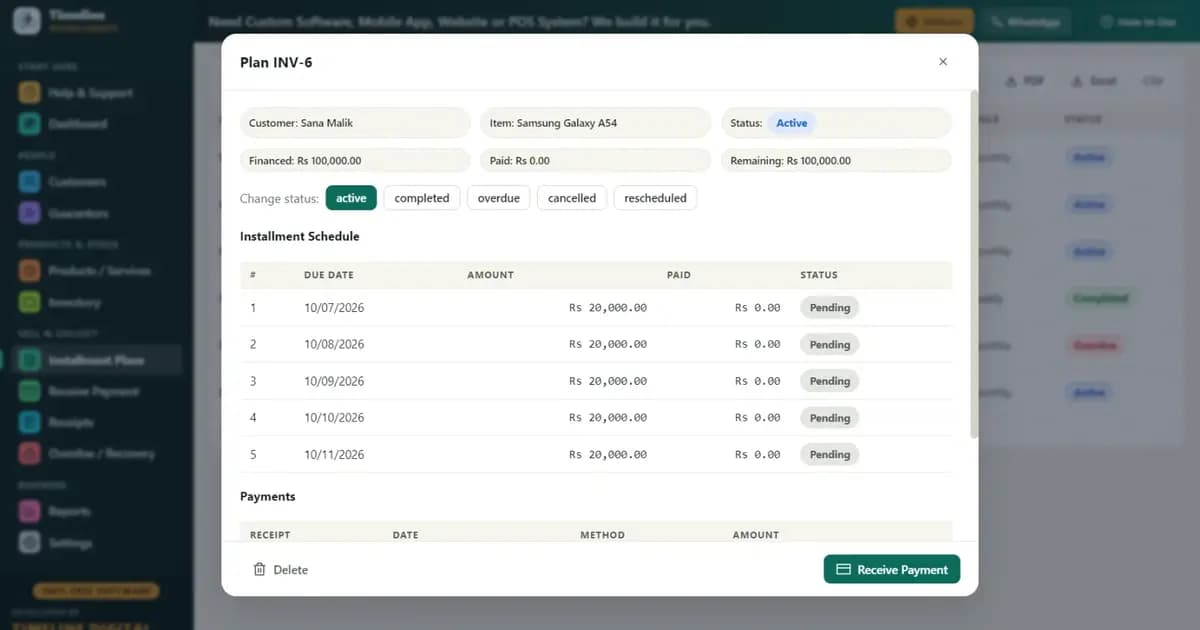
- Pick the frequency, number of installments, amount, and start date, and a live preview shows every dated installment before you save — so you and the customer can look at the actual calendar together.
- The down payment is auto-recorded as the first payment, so the balance is right from minute one.
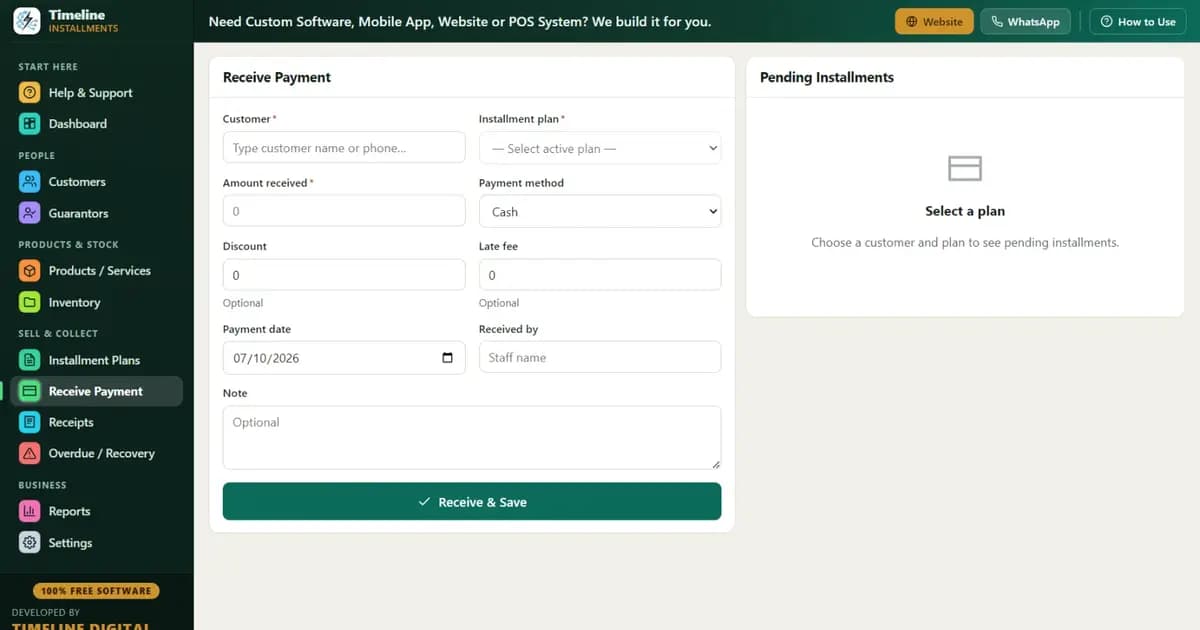
- Partial payments apply to the oldest installment first — essential on daily and weekly plans where customers often hand over uneven amounts ("here's 500 for today and yesterday").
- Every payment prints a branded receipt showing "Installments Paid X of Y" and the remaining balance — on any Windows printer, including Microsoft Print to PDF.
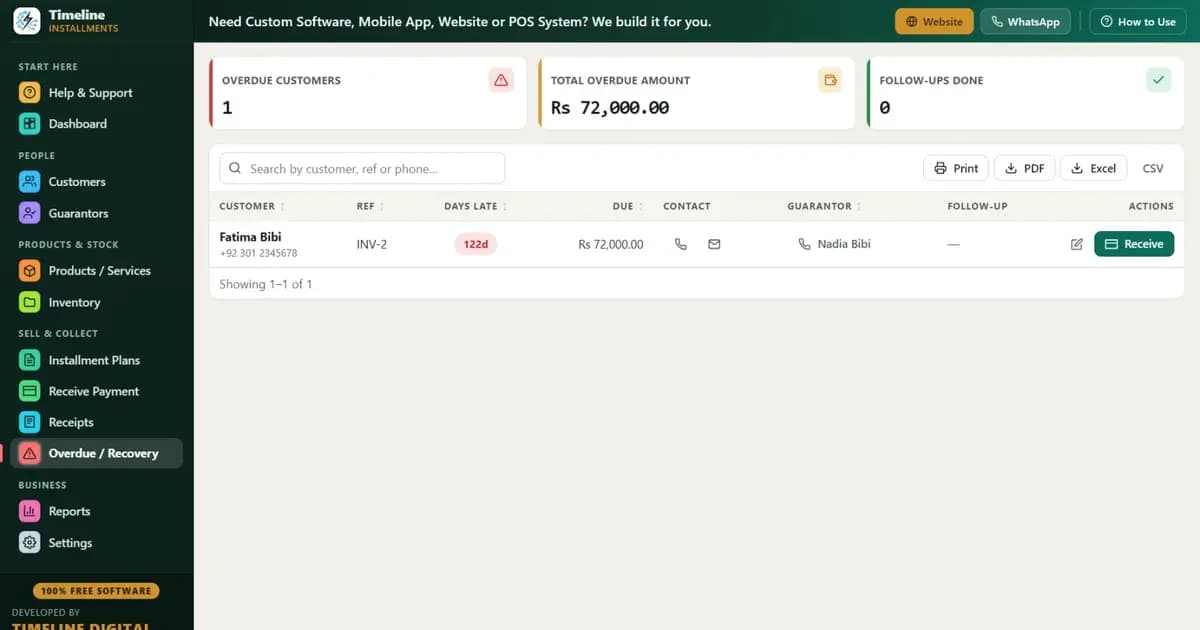
- The Daily Collection report lists everything due and collected that day (perfect for a collector's route), and the Overdue screen shows days late with the customer's phone and the guarantor's contact next to each account.
- The Next 30 Days Recovery report tells you exactly how much cash is scheduled to arrive — which matters most on monthly plans where cash comes in lumps.
Everything runs fully offline on Windows 10/11 with no account, and the currency sets itself from your country (Rs, ₹, $, £, ৳ and 150+ more), so daily lines in Karachi and pay-weekly furniture in Leeds use the same free tool.
Try all three schedules in five minutes
Not sure which frequency fits your shop? Download Timeline Free Installment Manager — free forever, offline, no account — switch on Sample Data mode, and build one daily, one weekly, and one monthly plan. The live preview shows exactly what each schedule looks like before you ever risk a real sale.
Related: Start an Installment Business · Recovery Tips · Installment Agreement Format