Straight answers to the questions buyers ask before they download.
What is a labor management system?
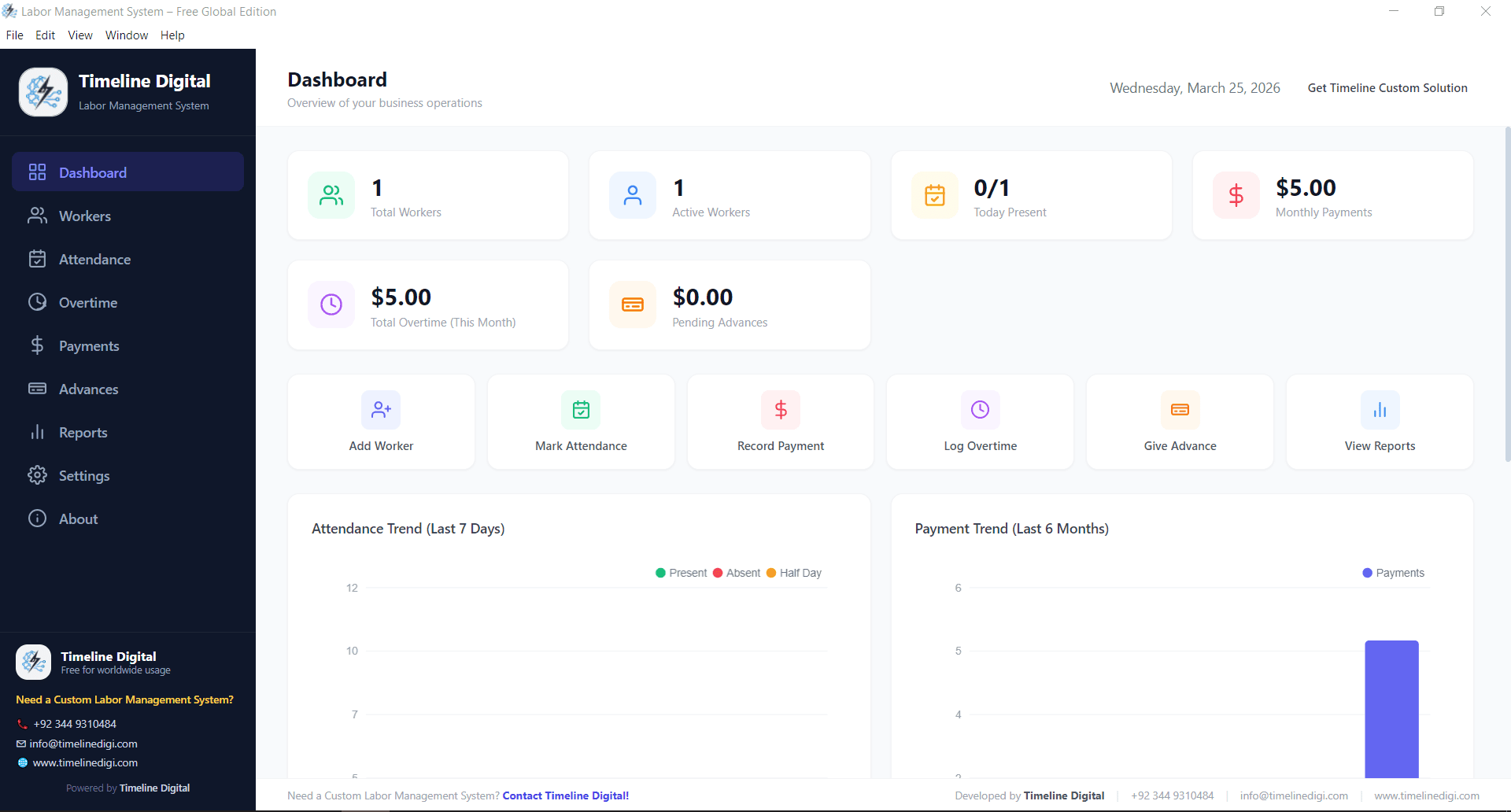
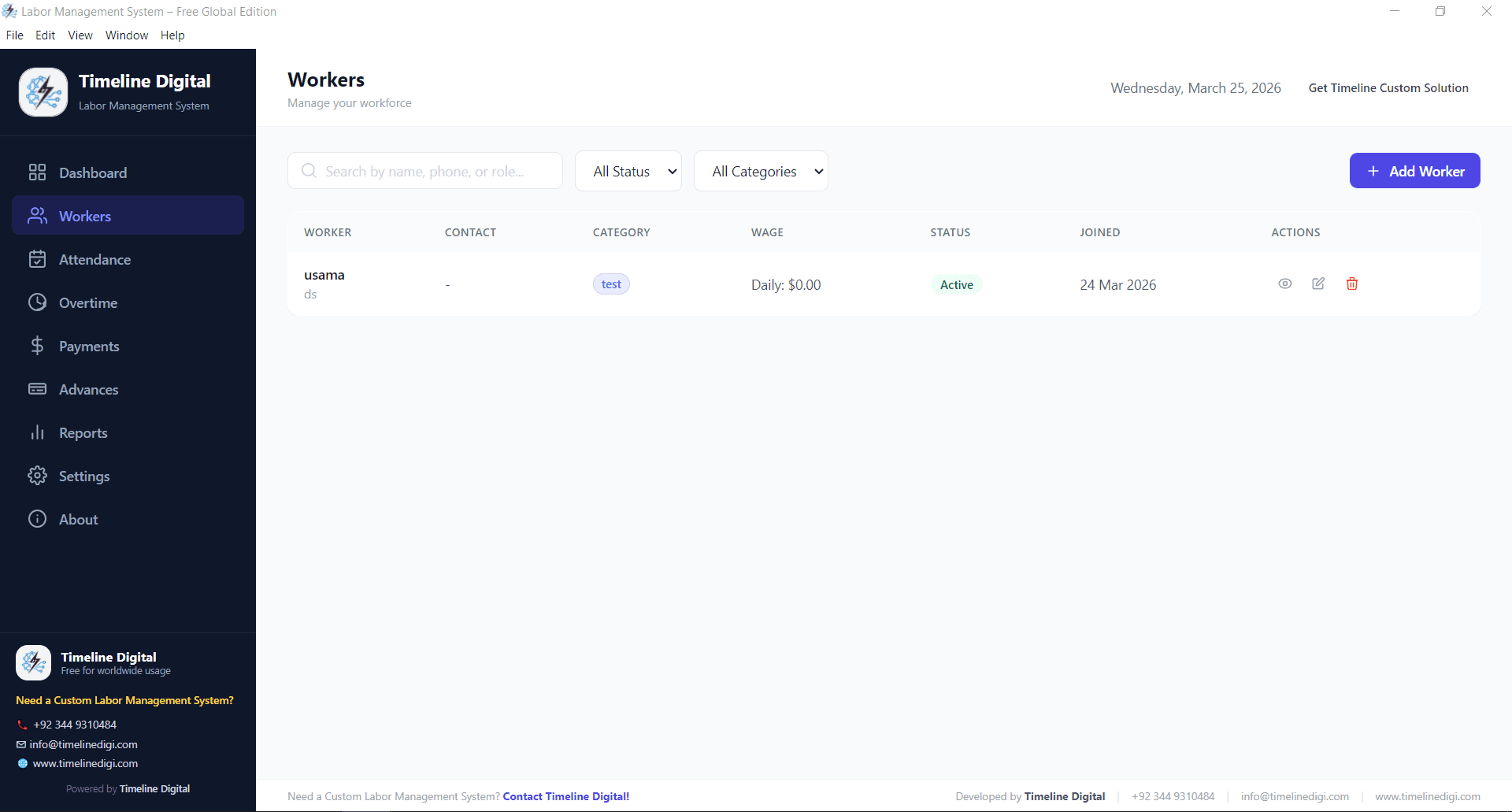
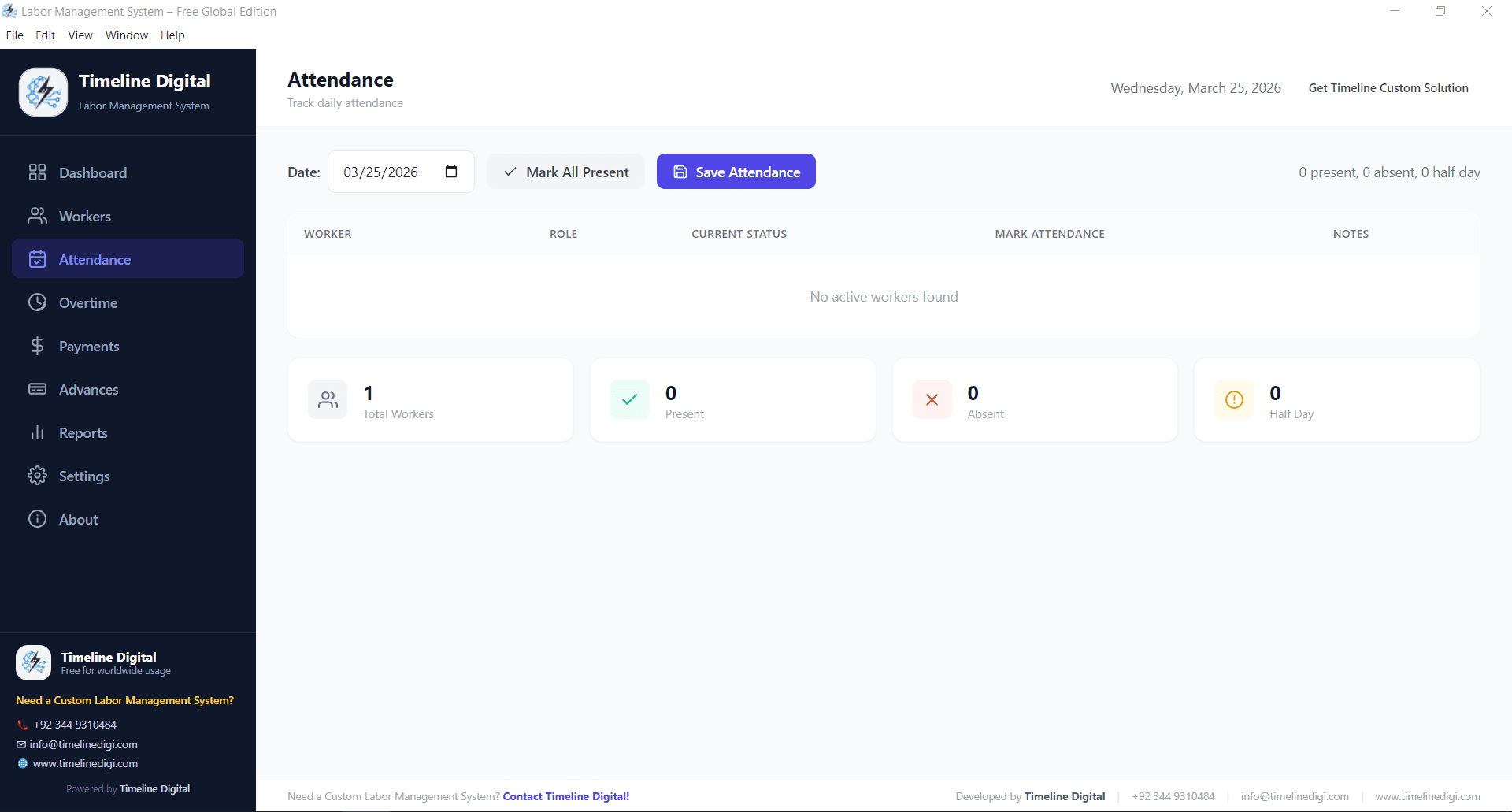
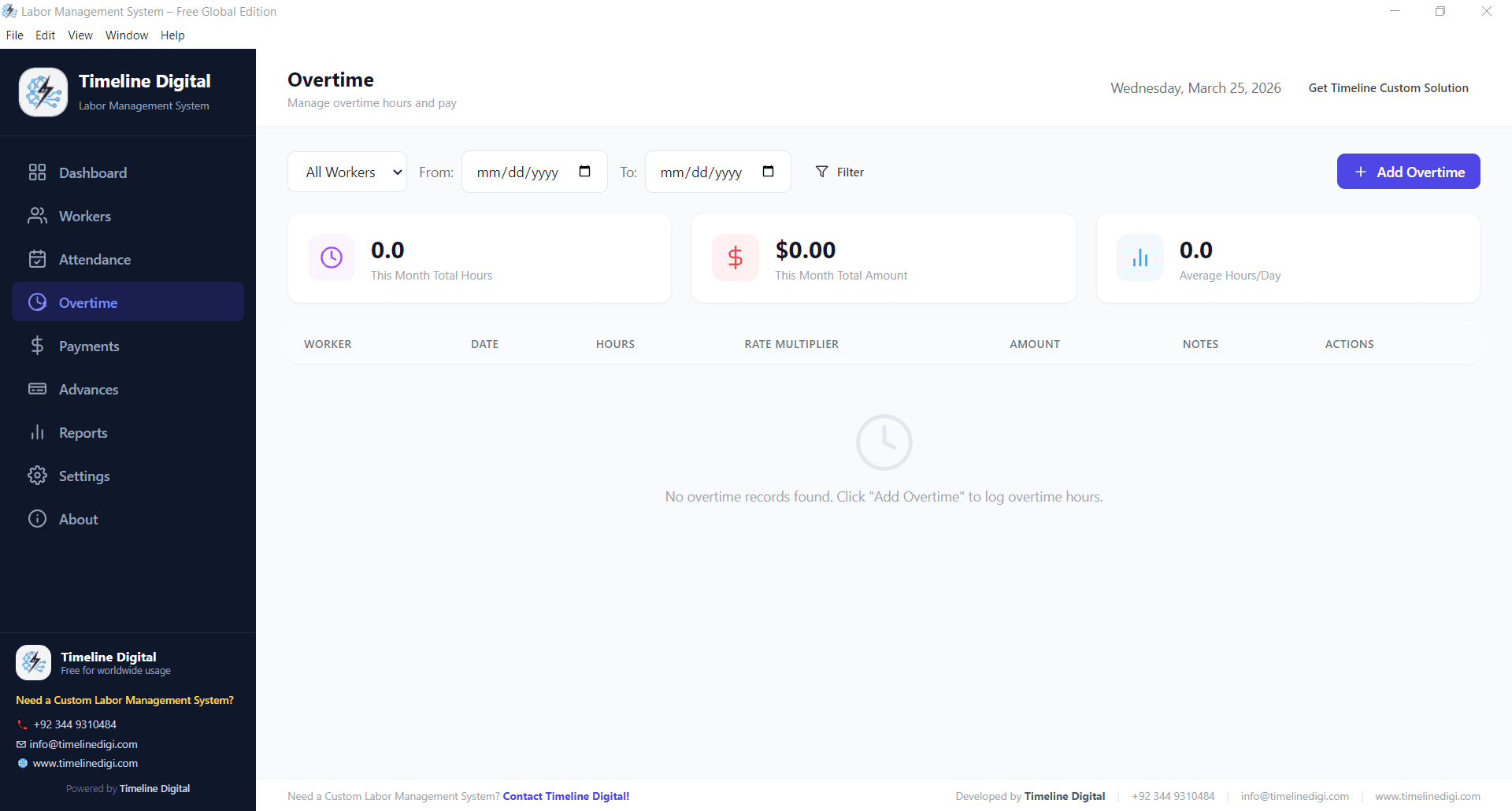
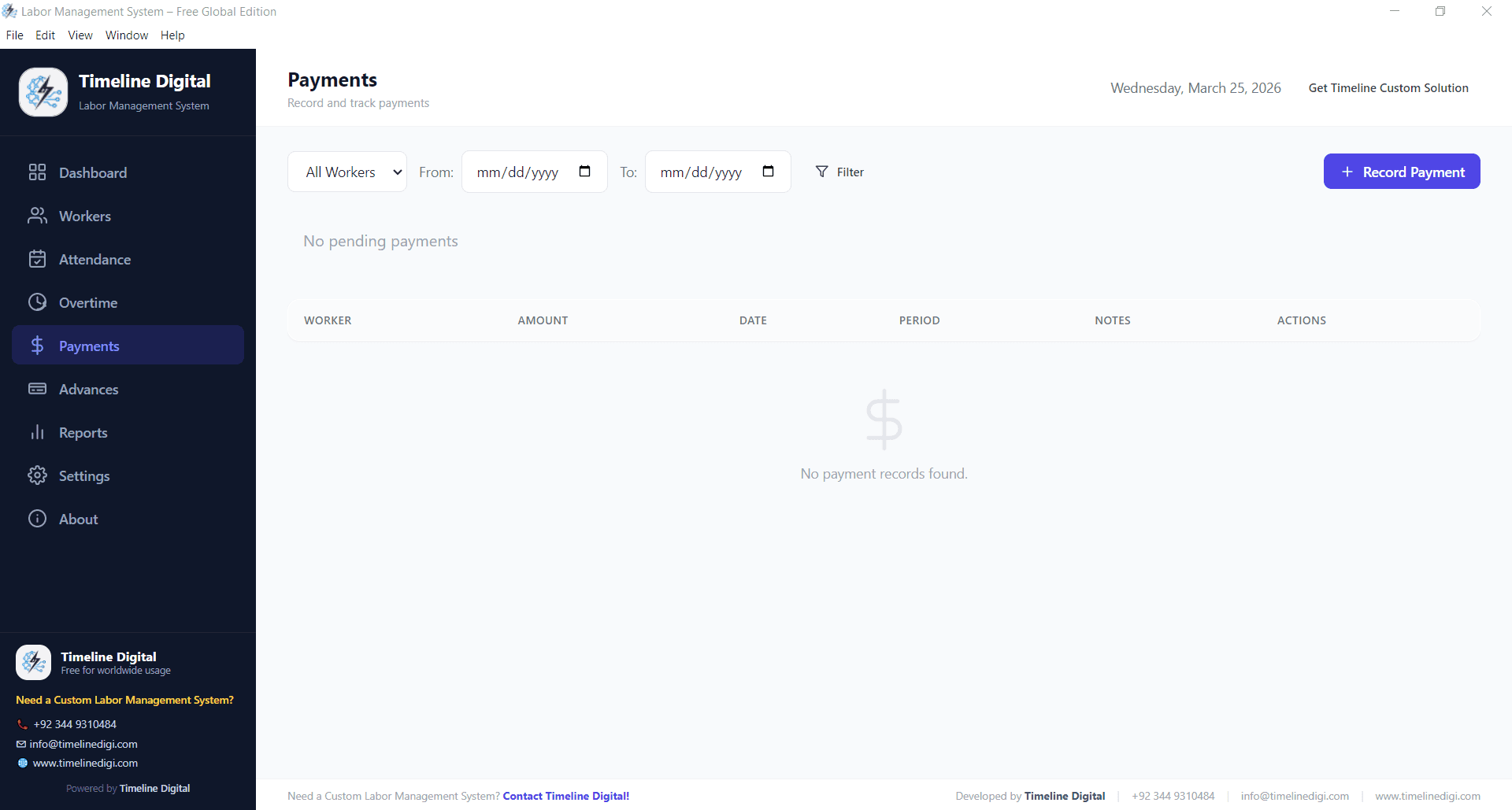
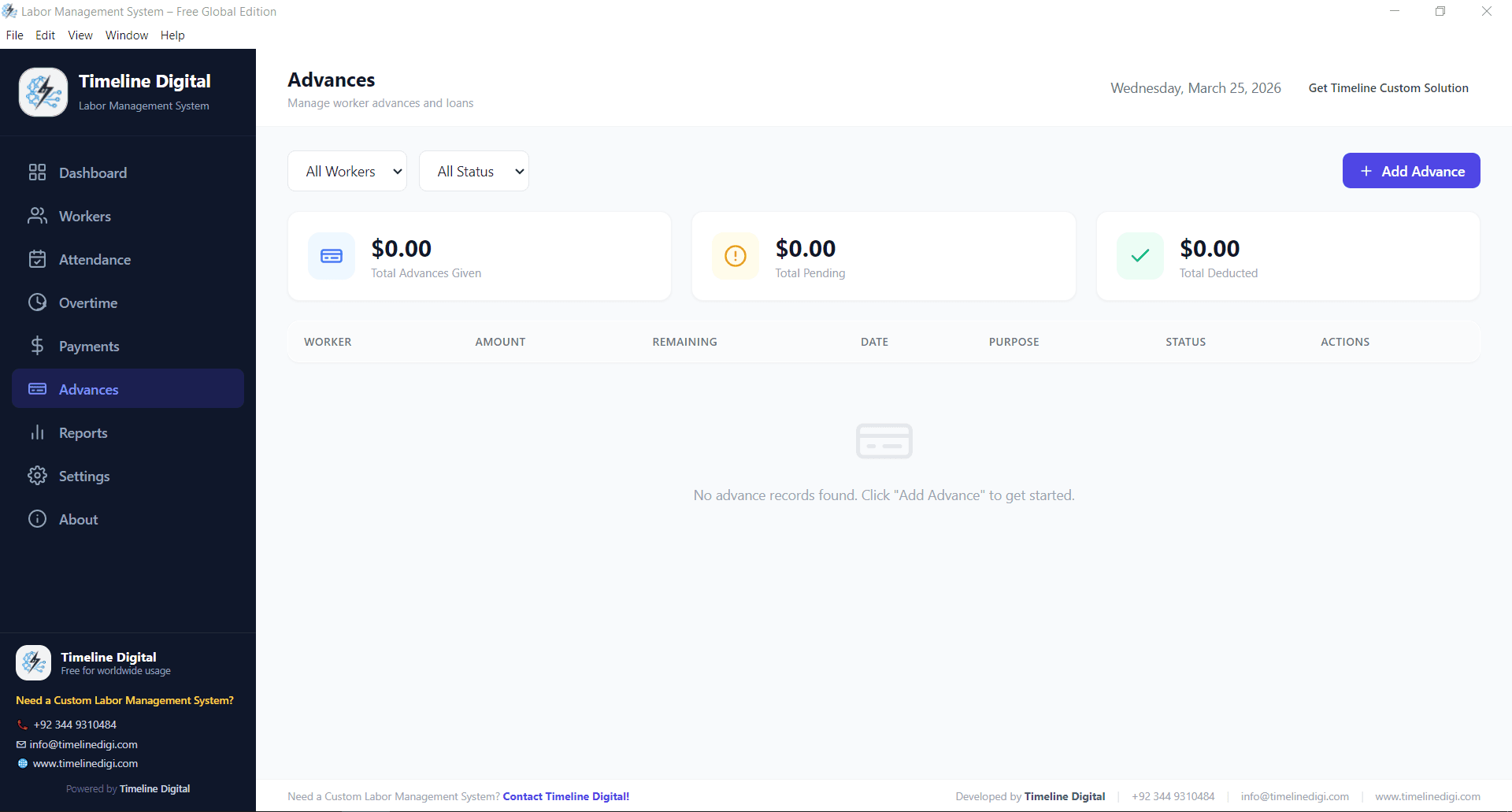
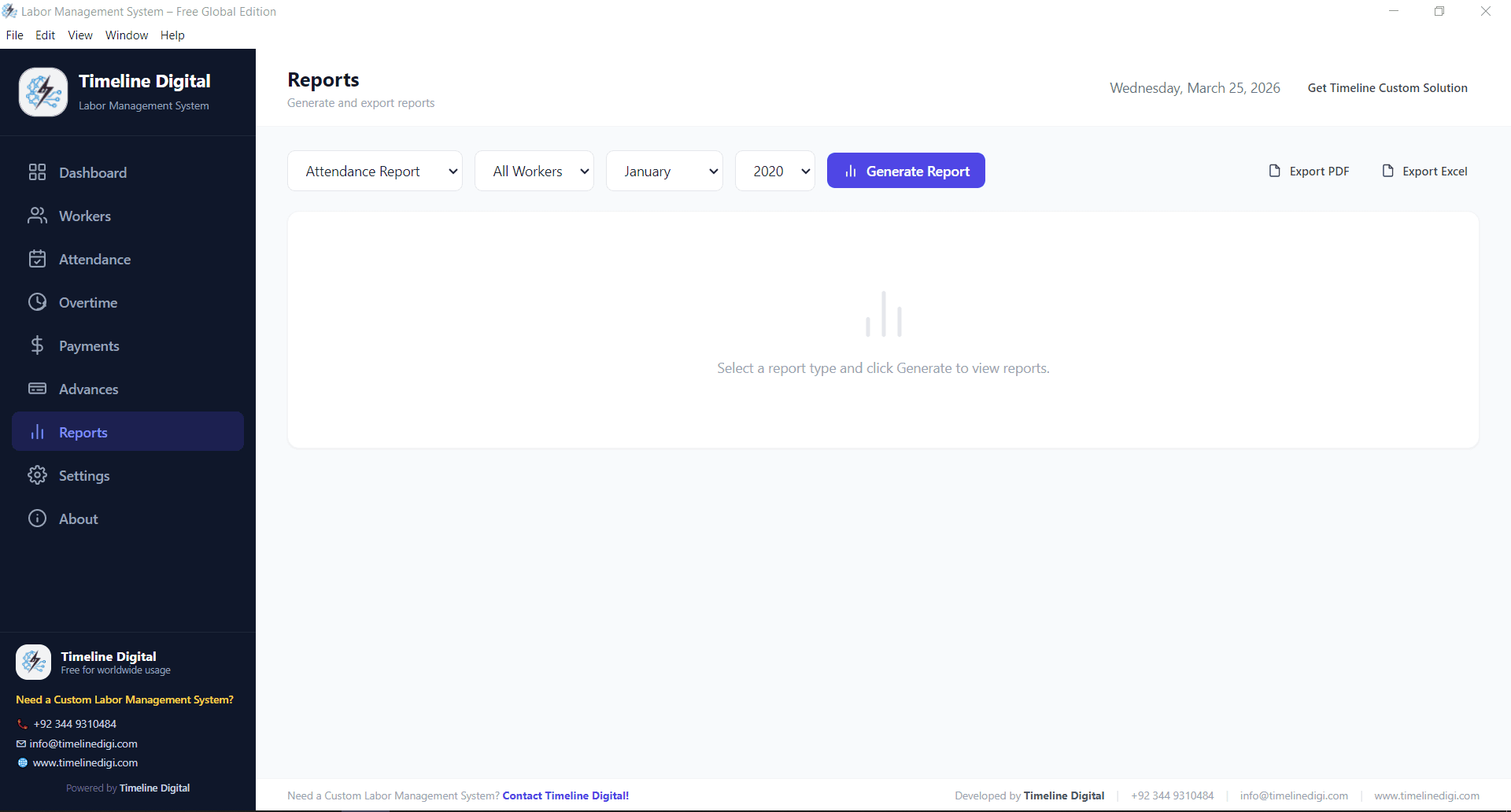
A labor management system (LMS) is software that helps businesses track workers, record daily attendance, manage overtime hours, process payments, handle salary advances, and generate workforce reports from a single application. It replaces paper registers and spreadsheets with accurate, automated workflows and is used across construction, warehousing, manufacturing, retail, hospitality, and facility-management industries.
Is the Labor Management System really free?
Yes, it is 100% free. There is no subscription, no trial period, no hidden cost, and no feature limitation. Timeline Digital provides this software as a free resource for businesses worldwide. Including the USA, UK, Canada, Australia, Germany, UAE, and Pakistan. Download it once and use it for a lifetime.
Does the Labor Management System work offline?
Yes. This is a desktop application that runs entirely on your computer without needing an internet connection. All data is stored locally on your machine, which means you can use it anytime, anywhere. Even on construction sites, remote factories, or warehouses with no reliable network.
Labor management vs HRIS or payroll software?
A labor management system covers day-to-day workforce operations: attendance tracking, worker profiles, overtime logging, advance management, and payment calculations. An HRIS (Human Resources Information System) focuses on employee records, benefits, recruitment, and policy administration. Payroll software focuses on salary calculation, tax filings, and compliance. The LMS handles the daily operations cycle that feeds the HRIS and payroll; most SMBs only need the LMS layer.
Labor management vs WMS, what is the difference?
A WMS tracks inventory, picking, receiving, and stock movement. A labor management system (LMS) tracks the people performing that work. Their hours, attendance, productivity, overtime, and pay. Large warehouses typically run both: the WMS manages goods, the LMS manages workers. In this product, the LMS works standalone and can sit alongside any WMS without forcing a migration.
Is the software safe to install?
Absolutely. The software is developed by Timeline Digital, a registered software development company with 13+ years in business and 860+ clients served globally. The installer is clean, does not contain malware, and does not collect personal data. Your workforce information stays on your own computer.
What operating system does it support?
The current version supports Windows 10 and later. It runs as a standard desktop application. MacOS and Linux versions are on the roadmap for future releases.
Can I manage multiple locations or sites?
You can install the software on multiple computers for different locations. Each installation runs independently with its own data. For centralised multi-site management with a shared live view, Timeline Digital can build a custom cloud-connected version tailored to your exact reporting structure.
How many workers can I add to the system?
There is no limit on the number of workers. Whether you manage five people or five hundred, the software handles them without slowing down. Reports, filters, and payment calculations scale with your headcount.
Can I customize the software for my business?
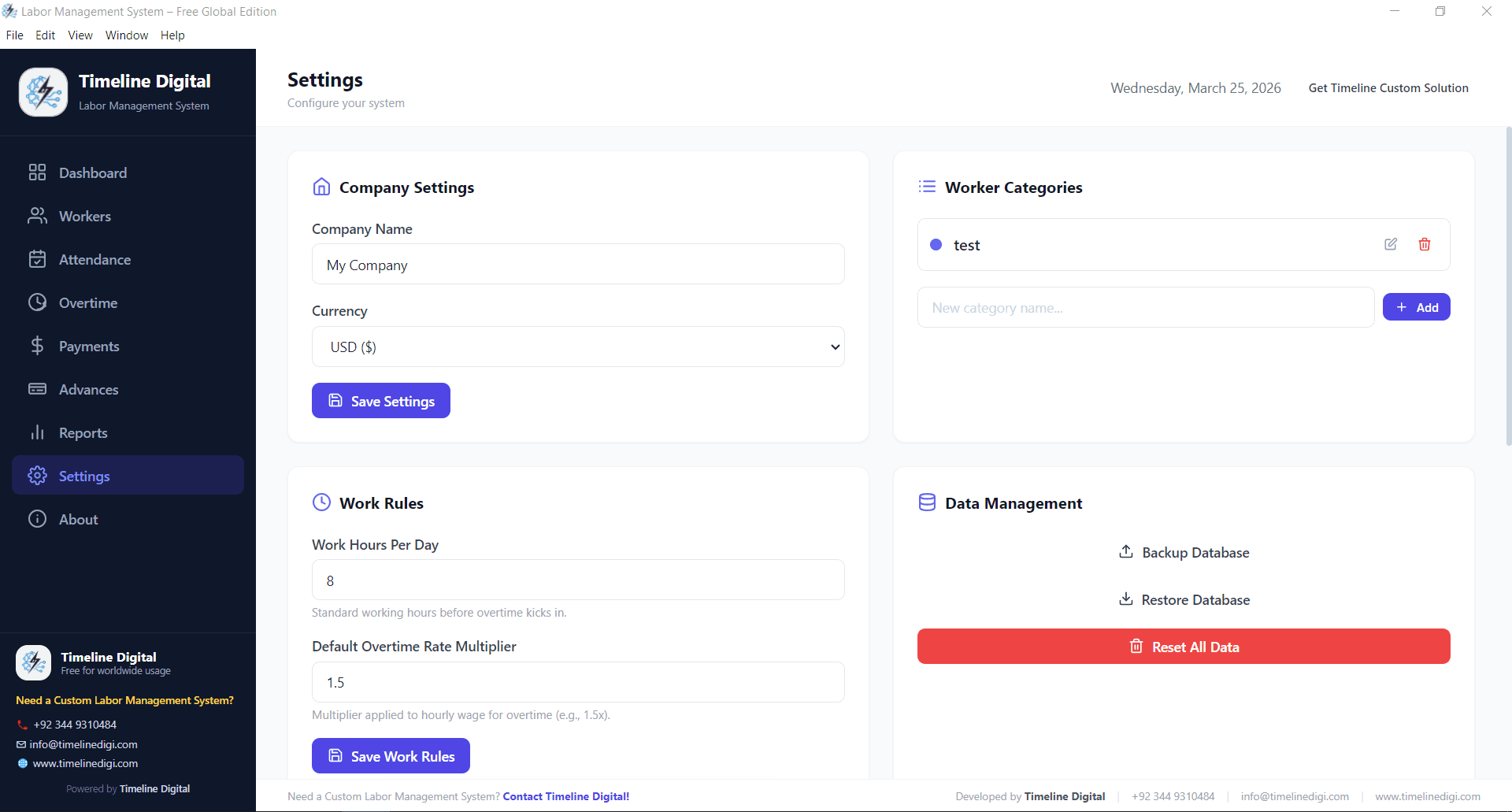
The free version includes configurable settings for overtime rates, working days, and company details. If you need deeper customization. Custom reports, API integrations, multi-site cloud sync, biometric attendance, mobile supervisor apps, or industry-specific modules. Timeline Digital can build a tailored version for your operations.
Does it handle UK, US, EU and AU labour rules?
Yes. Overtime rates, working days, weekly caps, currency, and pay-cycle length are all configurable in Settings. The system does not bake in the rules of any single country, so you can align it with US FLSA overtime, UK Working Time Regulations, Australian Fair Work awards, Canadian provincial rules, or German Arbeitszeitgesetz limits by adjusting a handful of fields.
How do I get help if I face any issue?
Email Timeline Digital at info@timelinedigi.com or message us on WhatsApp at +92 344 9310484. The team responds within 24 hours and helps with installation, configuration, and usage questions at no charge.
Will there be future updates?
Yes. Timeline Digital ships regular updates with new features, improvements, and bug fixes. Updates are free and available from this same page.