Buy here pay here (BHPH) works like this: the dealer sells the car and finances it — the customer buys the vehicle at the lot and comes back to the same lot to make weekly payments, with no bank or outside lender in the deal. The dealer is the lender, which means the dealer keeps the finance income, sets the terms, and carries all the collection and default risk on their own books.
This guide walks through the real unit economics with a worked example, the records every BHPH lot must keep, the collection cadence that keeps loss rates down, and how to run all of it without paying for dealer management software.
What Does "Buy Here Pay Here" Actually Mean?
At a traditional dealership, three parties touch the deal: the dealer sells the car, a bank or finance company lends the money, and the customer pays the bank. At a BHPH lot, two of those parties are the same person. You sell the car, you carry the note, and the customer pays you — often literally walking into your office every Friday with cash.
That changes the whole business:
- Your customer is different. BHPH buyers typically can't get bank financing — thin credit, past repossession, cash income. You're serving people the banks won't, which is both the opportunity and the risk.
- Your profit is different. A traditional dealer makes money on the metal — the spread between what they paid and what they sold for. A BHPH dealer makes money on the metal and on the note. The note is usually the bigger number.
- Your risk is different. When a bank's borrower defaults, the bank eats it. When your borrower defaults, you eat it — and you're the one arranging the repossession.
In plain terms: you're running two businesses on one lot — a used car dealership and a small finance company. Dealers who fail at BHPH usually fail at the second business, not the first. The finance side lives or dies on records, collections, and consistent terms — the same discipline covered in our in-house financing software guide, applied to cars.
What Do the Numbers Look Like on One BHPH Deal?
Let's walk one car all the way through. These are illustrative round numbers — plug in your own.
The deal: You acquire a used sedan for $4,800 all-in (auction price plus transport, reconditioning, and detail). You sell it BHPH at $6,500 with $1,500 down and 40 weekly payments of $140.
| Line item | Amount |
|---|---|
| Acquisition + reconditioning (all-in cost) | $4,800 |
| BHPH sale price | $6,500 |
| Down payment collected at delivery | $1,500 |
| Note carried (40 weekly payments × $140) | $5,600 |
| Total collected if the note pays in full | $7,100 |
| Gross profit if fully collected ($7,100 − $4,800) | $2,300 |
Now the honest version. Not every note pays in full. Suppose your losses run 15% of the note — payments that never arrive because of defaults, skips, and charge-offs:
| Scenario | Note collected | Total collected (incl. $1,500 down) | Gross profit vs $4,800 cost |
|---|---|---|---|
| Fully collected (0% loss) | $5,600 | $7,100 | $2,300 |
| 15% loss rate on the note | $4,760 | $6,260 | $1,460 |
| 25% loss rate on the note | $4,200 | $5,700 | $900 |
Read that table twice, because it's the whole BHPH business in three rows. Every point of loss rate on this deal costs you $56. The gap between a lot that collects well and one that doesn't isn't a rounding error — on this single car, the difference between a 15% and 25% loss rate is $560, and across a 40-car portfolio that's over $22,000 a year. That's why the rest of this guide is mostly about collections and records: the money is made at acquisition, but it's kept in collections.
(Two other levers matter and deserve their own math on your own numbers: the down payment, which is profit you can't lose to a default, and recovered vehicles, which you can recondition and resell — a partial offset to the loss rates above.)
Why Do BHPH Lots Collect Weekly Instead of Monthly?
Almost every experienced BHPH operator runs weekly (or biweekly) payments, and the reasons are practical, not traditional:
- Weekly matches how your customers get paid. Most BHPH buyers are paid weekly or biweekly. $140 out of this Friday's check is manageable. $600 saved up over a month usually isn't — the money gets spent.
- You find out about trouble in 7 days, not 30. A missed weekly payment is a small problem you catch early. A missed monthly payment means the customer is already a month behind and possibly three states away.
- Smaller amounts get paid. A customer $140 behind will catch up. A customer $600 behind often gives up — the hole looks too deep.
- Weekly visits keep the relationship alive. A customer who sees your office every Friday is harder to lose track of, easier to talk to, and more likely to buy their next car from you.
The tradeoff is administrative: 40 payment events per note instead of 10. That's not a reason to go monthly — it's a reason to use software that generates the schedule and posts payments in seconds, which we cover below.
What Are the 5 Records Every BHPH Lot Must Keep?
If a payment dispute, a repossession, or a regulator ever tests your paperwork, these five records are what save you. Keep every one, on every deal, from day one.
- The signed installment sale agreement. Vehicle, price, down payment, every payment amount and due date, late-fee terms, and default terms — signed by both parties. Our installment agreement format guide covers the fields line by line. No signed agreement, no enforceable note.
- Customer identity and contact file. A copy of the government ID, current address, all phone numbers, employer info, and references — the names and numbers of people who can find your customer when you can't. On a BHPH deal, references aren't a formality; they're a collection tool.
- The complete payment history. Every payment — date, amount, method, running balance — with a receipt issued for every single payment, including the down payment. Cash-heavy businesses live and die on receipts; "I paid that Friday" is unanswerable without one.
- Late-fee and adjustment log. Every late fee charged, every fee waived, every discount or settlement adjustment — dated and consistent with your written policy. Inconsistent fees are how disputes (and worse) start.
- The collection contact log. Every call, text, visit, and promise-to-pay, with dates. If a deal ends in repossession, this log plus the payment history is your evidence that the customer actually defaulted and that you followed your own stated process.
What's the Collection Cadence That Keeps Losses Low?
Loss rate is mostly a function of speed and consistency. The lots that collect well all run some version of this cadence:
| Days past due | Action |
|---|---|
| Day 1 | Call the customer — same day, friendly. Most misses are timing, not intent. Get a specific promise: "I'll be in Saturday with $140." Log it. |
| Day 3-5 | Promise broken or no contact? Call again, and text. Second miss on the account? Tighten the tone. |
| Day 7 | Call the references on file. You're not shaming anyone — you're saying "I can't reach Marcus, can you have him call the lot?" This resolves a surprising share of skips. |
| Day 10-14 | Visit — the home address or workplace on file. In-person contact recovers accounts phones can't. |
| Beyond that | Decide per your written default policy: catch-up plan, voluntary surrender, or repossession. |
Two rules that matter more than the exact day numbers: never skip day 1 (a customer who learns that missed payments go unnoticed will miss more), and log every contact (see record #5).
What Records Do You Need Before a Repossession?
Repossession law is state-specific and full of traps — what "breach of the peace" means, whether notice is required, how surplus and deficiency work. This section is awareness only, not legal advice: talk to a professional in your state before your first repo, not after.
From a record-keeping standpoint, before any repossession you should be able to print, on the spot:
- The full payment history — every payment received, every due date missed, current balance and days late. If your tracking system can't produce a clean payment history printout for one customer in under a minute, fix that before you ever need it.
- The signed agreement showing the default terms the customer agreed to.
- The collection log showing you tried to contact them and how.
That packet is what protects you if the customer claims they were current, and it's what your attorney will ask for first.
What Compliance Rules Should a BHPH Dealer Know About?
Awareness only — none of this is legal advice, and BHPH sits in one of the more regulated corners of small business. Budget for a consultation with a professional who knows your state; it's cheaper than one mistake.
Areas to have on your radar:
- State usury and finance-charge limits. States cap what you can charge on financed vehicle sales, and the caps and formulas vary widely. Know your state's number before you price a note.
- State UDAP laws (unfair and deceptive acts and practices). These cover how you advertise, what you tell customers, and how you collect. "Consistent, written, and honest" is the safe posture.
- The FTC Used Car Rule. Used vehicle dealers are generally required to display a Buyers Guide on vehicles offered for sale. Mentioned here purely for awareness — the details of who's covered and how belong in that professional consultation.
- Disclosure requirements on financed sales. Financed vehicle deals typically carry federal and state disclosure obligations about the cost of credit. Again: professional, before your first deal.
The pattern across all of it: regulators punish inconsistency and missing paper far more often than they punish honest dealers with complete files. The five records above are most of your defense.
How Do You Track 40 Weekly Notes Without Paying for a DMS?
Full dealer management systems charge real monthly money, and a small BHPH lot mostly needs the finance side: schedules, payments, receipts, overdue tracking, and reports.
Timeline Free Installment Manager (v1.6.0, by Timeline Digital) covers exactly that for $0 — it's 100% free forever, because Timeline Digital sells custom software and uses this tool as their introduction. For a BHPH lot specifically:
- Auto-generated weekly schedules with a live preview — enter the note once and all 40 due dates are built, shown to the customer before signing.
- The down payment is auto-recorded as payment #1 with a printed receipt at delivery.
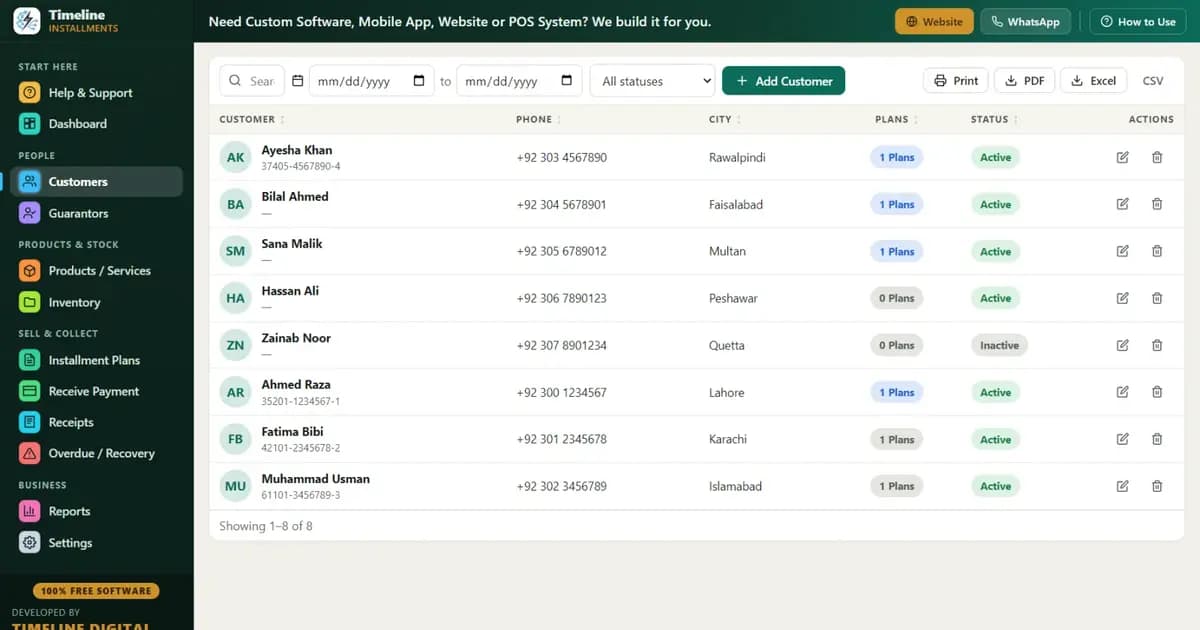
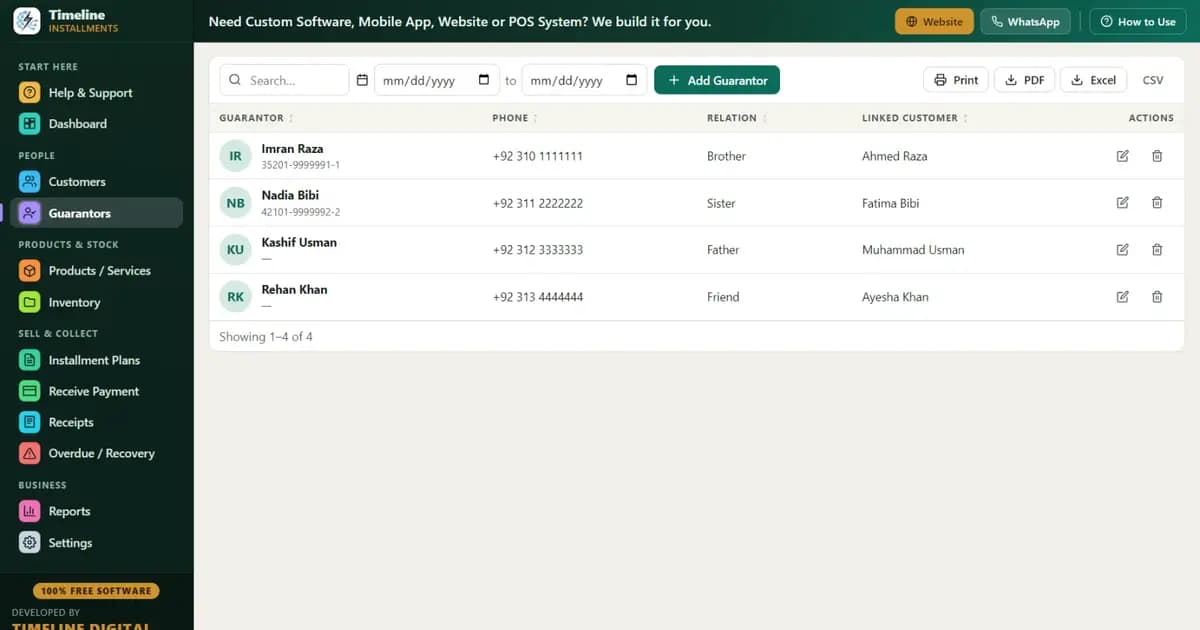
- Customer files hold ID and references (guarantors), linked to their plans — your record #2, structured.
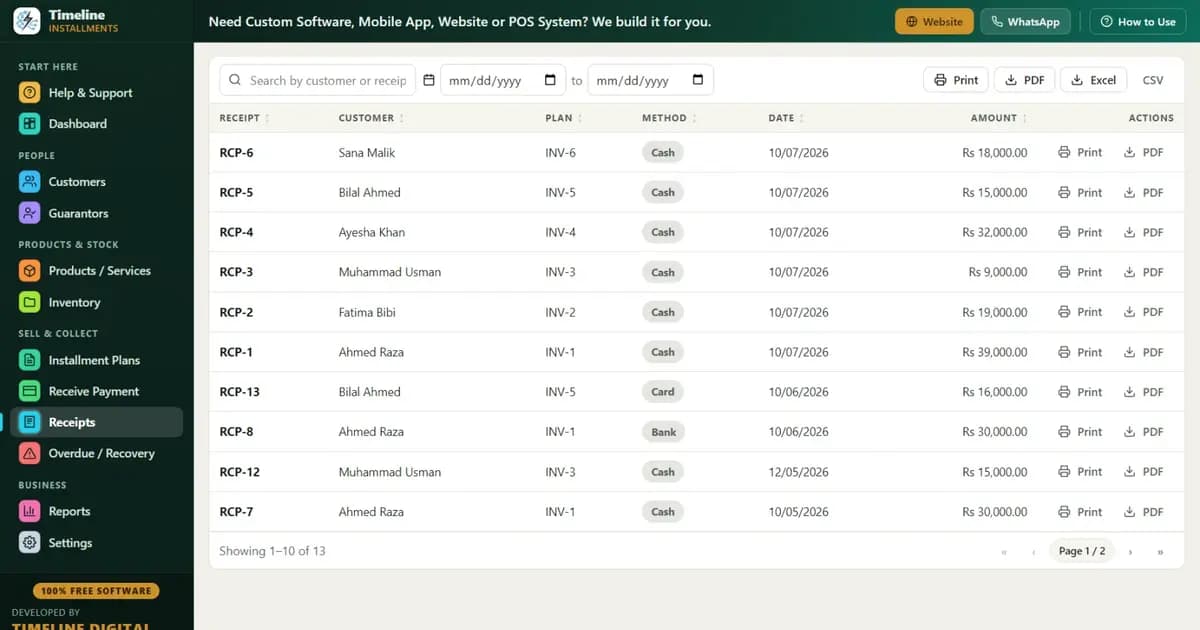
- A receipt for every payment, branded print or PDF, with your logo, "Installments Paid X of Y," the remaining balance, signature lines, and an editable terms footer where you can put your payment and default policy.
- Late fees as a fixed amount or % of the remaining balance; partial payments post oldest-first; discounts count toward settlement — matching how BHPH payments actually arrive.
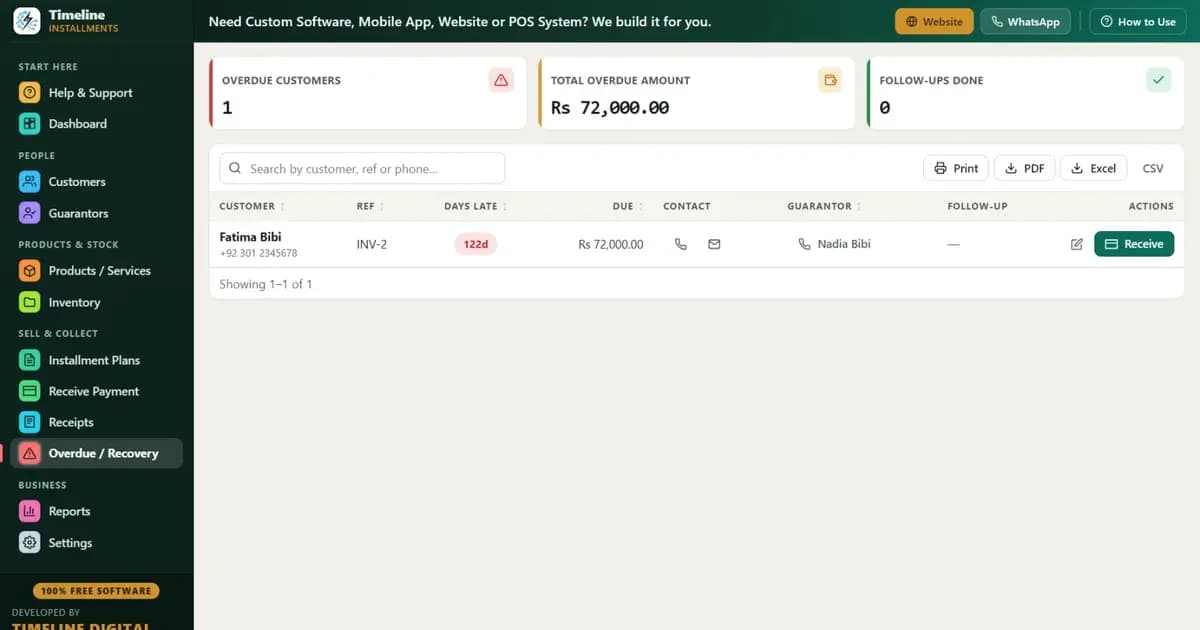
- The Overdue screen shows every late account with days late and phone numbers — your day-1 call list, generated for you each morning.
- 11 reports including Next 30 Days Recovery (this month's expected cash), Customer Statement (your payment-history printout for the repo packet), and Daily Collection — all exportable to Print/PDF/Excel/CSV.
- Fully offline, local database, no account — customer data never leaves the lot. Windows 10/11 x64, about a 90 MB install, USD auto-set for the US with MM/DD/YYYY dates, one-click Backup & Restore, and a Sample Data practice mode to train your office manager on fake deals first.
More on the BHPH-specific setup in our buy here pay here software guide, and when accounts slip, our installment recovery tips cover the follow-up playbook in depth.
---
Running notes on paper or spreadsheets? Download Timeline Free Installment Manager — free forever, fully offline — load a few practice deals in Sample Data mode, and see your whole portfolio's overdue list and Next 30 Days Recovery before you open tomorrow. Also compare the model with BNPL vs in-house installments if you sell smaller-ticket goods too.