How to offer customer financing in Canada comes down to three routes: sign up with a third-party lender, plug in a BNPL provider, or run in-house installment plans yourself. This small business guide to how to offer customer financing in Canada compares all three honestly, shows a worked $2,400 CAD example, and gives you a setup checklist so a tire shop, powersports dealer, furniture store, or appliance retailer can start this month.
Financing isn't a big-city luxury anymore. When a family in Timmins needs four winter tires in October, or a farmer near Brandon needs a quad before seeding, the difference between "that's $2,400" and "that's $480 down and $240 a month" is often the difference between a sale and an empty parking lot.
What Are Your Three Financing Options as a Canadian Small Business?
Every financing route answers the same customer question — "can I pay over time?" — but the economics for you are very different:
| Factor | Third-party financing (lender/leasing co.) | BNPL (app-based) | In-house financing (you carry it) |
|---|---|---|---|
| You get paid | Upfront, minus fees (typically 3–10% of the sale) | Upfront, minus merchant fees (typically 2–8%) | Over time, as the customer pays |
| Credit risk | Lender's | Provider's | Yours |
| Approval decision | Lender's algorithm/underwriter | App's algorithm | Your judgement |
| Customers with thin or bruised credit | Often declined or charged high rates | Often declined | You decide — you know them |
| Rural/older customers without app habits | Okay | Poor fit | Excellent fit |
| Ticket size sweet spot | $1,000–$50,000+ | $50–$1,000 | $300–$10,000 |
| Margin on the financing | None — you pay for it | None — you pay for it | You keep any financing markup |
| Customer relationship | Lender's | App's | Yours — monthly contact |
| Admin burden | Low | Very low | Yours — needs records and discipline |
| Setup time | Days to weeks (dealer agreements) | Days | One afternoon with the right tools |
The honest summary: third-party and BNPL buy you convenience with a slice of every sale. In-house financing keeps the margin and the relationship, but you become the bank — which only works if your paperwork and payment tracking are airtight.
When Does In-House Financing Actually Win for Canadian Dealers?
In-house isn't for everyone. It shines in four very Canadian situations:
1. Seasonal tire and powersports businesses. Winter tires, snowmobiles, ATVs, and boats all cluster into short buying windows. A tire shop that lets regulars pay $200 down and the rest over three months sells four tires in October instead of two in October and a prayer in December. Powersports dealers use the same logic on used sleds and quads where third-party lenders won't touch older units.
2. Rural customers. In small-town Ontario, the Prairies, or the Maritimes, the local shop often knows the customer, their family, and their employer. A big-city algorithm doesn't. In-house financing turns that local knowledge into approvals a lender would never make — usually safely, because reputation matters in a town of 3,000.
3. Regulars and repeat customers. If someone has bought from you for eight years and never missed a bill, why send them to a lender that charges them 29.9% or declines them for a thin file? Financing your regulars deepens loyalty and brings them back into the store every month.
4. Tickets too small for lenders, too big for BNPL. A $1,800 appliance package or a $2,400 tire-and-rim set sits awkwardly between BNPL's comfort zone and a lender's minimums. That gap is in-house territory.
What Does a Real In-House Deal Look Like in Canadian Dollars?
Let's work a realistic example: a $2,400 purchase — say a set of winter tires with rims and installation, or a used snowblower and a small trailer.
The structure:
- Purchase price: $2,400 CAD
- Down payment: $480 (20%)
- Balance: $1,920
- Term: 8 monthly payments of $240
- Total paid: $480 + (8 × $240) = $2,400
That's a 0% plan — a strong promotion for regulars. Many dealers add a financing markup instead. Here's the comparison, including what the same sale nets you through a third party:
| Line item | In-house 0% | In-house with 10% markup | Third-party (typical fees) |
|---|---|---|---|
| Sticker price | $2,400 | $2,400 | $2,400 |
| Customer pays in total | $2,400 | $2,592 | $2,400 + lender's interest |
| Down payment to you (day one) | $480 | $480 | — |
| Monthly payment (8 months) | $240.00 | $264.00 | Set by lender |
| Fees you pay | $0 | $0 | Typically 3–10% ($72–$240) |
| You net | $2,400 | $2,592 | Roughly $2,160–$2,328 upfront |
| Your risk | Balance of $1,920 | Balance of $2,112 | None |
Look at the spread: between a 10% in-house markup and a third-party deal at the high end of typical fees, the same $2,400 sale can differ by over $400 in what lands in your pocket. That's your compensation for carrying the risk and doing the admin. To build your own pricing, use the method in /blog/calculate-installment-price.
Cash-flow note: with a 20% down payment, if your cost on the goods is $1,600, you've recovered it by the end of month 5 ($480 + 4 × $240 = $1,440; month 5 takes you to $1,680). Everything after that is profit collection.
What's on the Setup Checklist Before Your First Financed Sale?
Do these five things before the first customer, not after the first missed payment:
1. Write a one-page financing policy. Who qualifies (e.g., repeat customers, local address, employed or verifiable income), minimum down payment (20% is a solid Canadian default), maximum term (6–12 months for most retail goods), and your late-fee rule. Staff should be able to answer "can I get financing?" the same way every time.
2. Use a written agreement — every time, even for your brother-in-law. It should state the price, down payment, schedule, late fee, and what happens on default, with both signatures. A handshake is not a repayment plan. Grab a starting template at /blog/installment-agreement-format.
3. Take ID. Record a government ID number (driver's licence or other) with the customer file. Timeline Free Installment Manager has an ID field on every customer record for exactly this.
4. Take references — or a co-signer for bigger tickets. One or two local references for standard deals; for a $5,000+ powersports unit, consider a guarantor. Timeline links guarantors/co-makers directly to plans so their phone number shows up on the overdue screen when you need it.
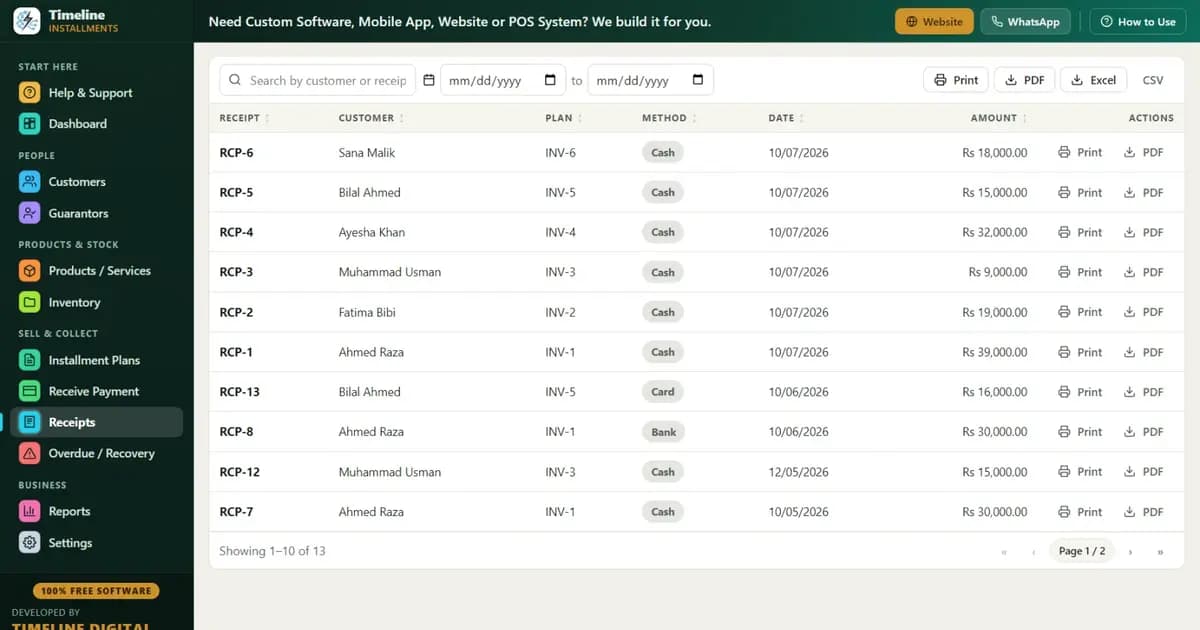
5. Give a receipt for every dollar. Every down payment and every monthly payment gets a printed or PDF receipt showing the amount, the plan progress, and the remaining balance. Receipts prevent 90% of "I already paid that" disputes. Timeline records the down payment automatically as the first payment and prints a branded receipt on the spot.
A word on privacy (PIPEDA awareness): Canadian businesses that collect customer personal information are generally subject to privacy law such as PIPEDA, so handle IDs, references, and payment histories with care — and consult a professional if you're unsure of your obligations. One practical advantage of offline software like Timeline: the database lives entirely on your shop computer, so customer data stays in-store rather than on a third-party cloud. That's a helpful posture, not legal advice.
How Do You Handle Canada's Winter Seasonality?
Canadian instalment retail breathes with the seasons, and your financing terms should too:
- September–November (winter tire rush): Shorten terms so plans finish before spring — a tire plan that runs into July collects poorly. The 8-month example above, started in October, wraps up in May. Better yet, offer 4–6 month terms in tire season.
- December: Expect a wobble. Christmas competes with your payment. Send friendly reminders in the first week of December and offer a "half now, half January 15" catch-up rather than letting January become a two-month hole.
- January–March (powersports season): Sleds and ice-fishing gear sell now; structure plans to finish by early summer while the purchase still feels worth paying for. A depreciating, out-of-season toy is the hardest balance to collect in August.
- April–June (spring): Quads, mowers, boats, patio sets. This is also your cleanup window — use a "Next 30 Days Recovery" style report to see what's due and clear stragglers from winter plans before the summer lull.
- Tax-refund season (March–May): Many customers get refunds. It's the single best time of year to invite lump-sum settlements — Timeline counts discounts toward settlement, so "clear your $720 balance for $650 this week" is easy to record cleanly.
For more on matching payment frequency to your trade, see /blog/daily-weekly-monthly-installments, and for chasing late accounts without burning relationships, /blog/installment-recovery-tips.
What Software Should a Canadian Shop Use to Track It All?
You can start in a notebook, but the failure mode is predictable: missed follow-ups, disputed balances, and no idea how much is owed to you in total. Timeline Free Installment Manager (v1.6.0, from Timeline Digital at timelinedigi.com) is a purpose-built option that's 100% free forever — they sell custom software, and the free app is their introduction.
What matters for a Canadian dealer:
- Windows 10/11 app, about 90 MB, no account or login. Install it on the shop PC and go.
- Fully offline local database — customer data stays in-store, which pairs well with a careful PIPEDA posture.
- Currency auto-sets to CAD $ based on your country.
- Auto monthly/weekly/daily schedules with a live preview — the $2,400 example takes a minute to set up, and the customer sees every due date before signing.
- Down payment recorded automatically as payment #1, with a printed receipt.
- Late fees as a fixed amount or % of remaining balance; partial payments applied oldest-first.
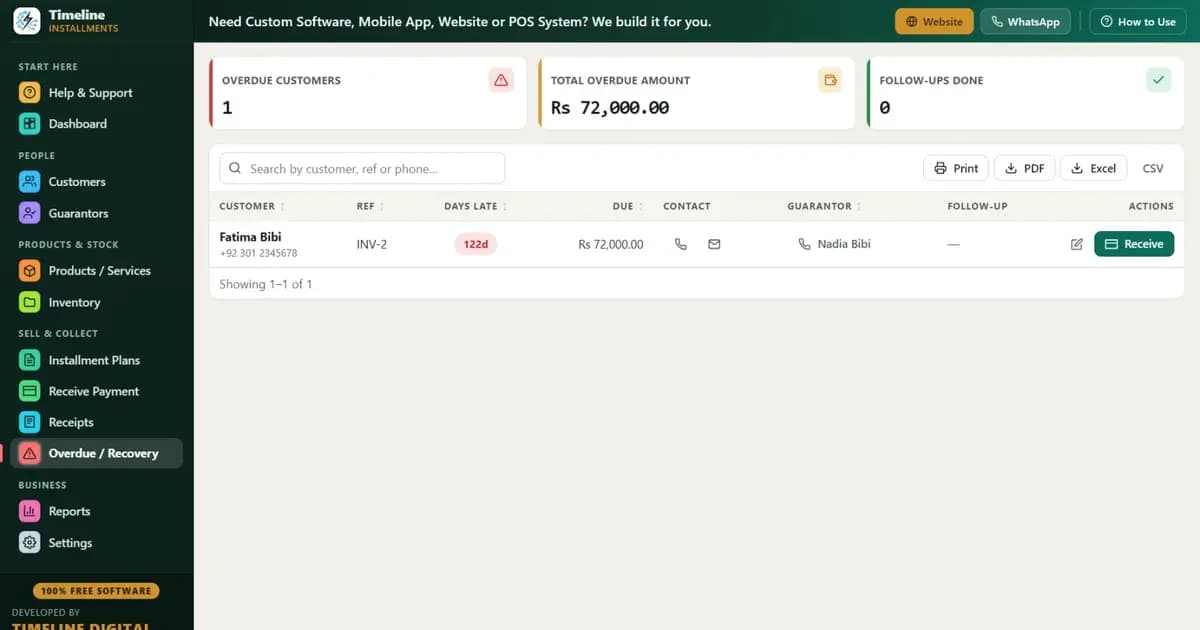
- Guarantors/co-makers linked to plans, and an Overdue screen showing days late, amounts, and phone numbers including the guarantor's.
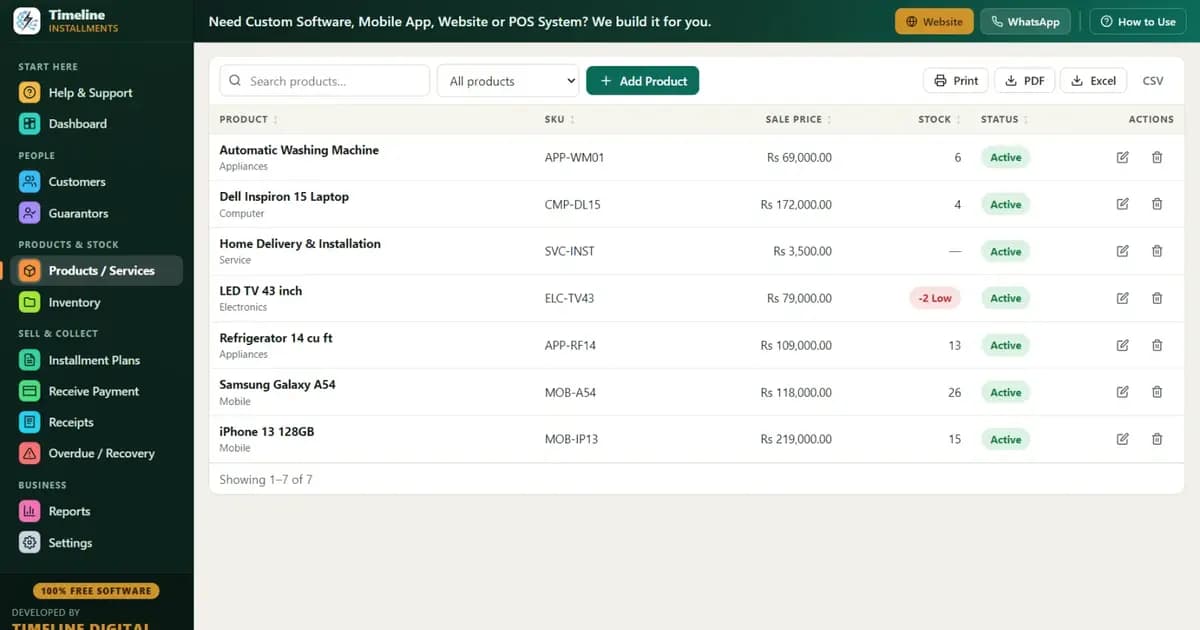
- Stock auto-reduces when you sell on a plan — your tire count stays honest.
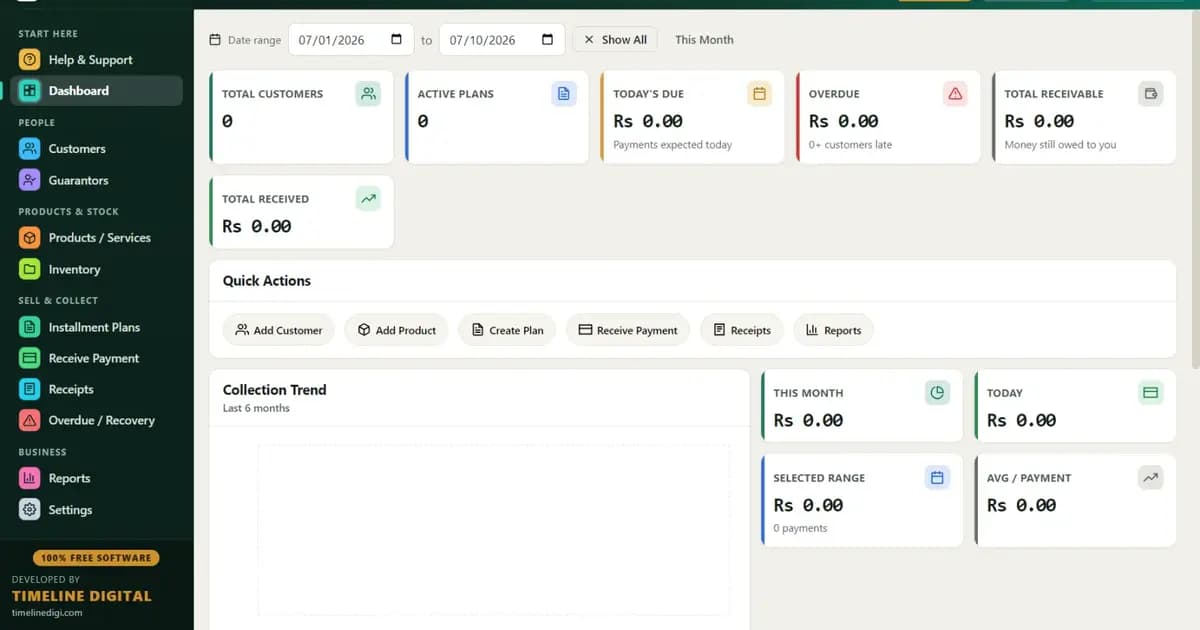
- 11 reports including Next 30 Days Recovery, Daily Collection, Customer Statement, and Area Wise — exportable to Print, PDF, Excel, or CSV for your accountant.
- One-click Backup & Restore and a Sample Data practice mode.
Details for Canadian shops at /installment-software-canada, or the general overview at /free-installment-management-software.
---
Ready to finance your first customer? Download Timeline Free Installment Manager — free forever, fully offline, CAD-ready out of the box. Practice with Sample Data first, then set up your first real plan in minutes: /free-installment-management-software.