How to run an installment (hire purchase) business in Africa comes down to five disciplines: price the credit properly, take a real deposit, secure every deal with a guarantor, record every payment (including M-Pesa and momo), and chase arrears within days, not weeks. This guide to running an installment business in Africa covers Nigeria, Kenya, and Ghana, with worked examples in ₦ and KSh — including full boda-boda financing math — plus the tools that make it manageable even where internet is unreliable.
Whether you call it hire purchase in Lagos, lipa mdogo mdogo ("pay little by little") in Nairobi, or simply "installment" in Accra, the model is the same: the customer pays a deposit, takes the item, pays little by little, and owns it fully when the last payment lands.
Why Is Hire Purchase Booming Across Nigeria, Kenya, and Ghana?
Three forces are pushing installment selling from a side hustle into a mainstream business model across the continent:
1. Big-ticket essentials, small-ticket incomes. A smartphone, a fridge, a TV, or a motorcycle is not a luxury — it's a work tool and a family upgrade. But most customers earn daily or weekly, not monthly, and few have savings equal to a phone's full price. Installments match the payment to the income pattern. That's why phone shops in Lagos, appliance dealers in Kumasi, and boda-boda financiers in Kisumu all run on the same engine.
2. Motorcycles are income-generating assets. An okada in Nigeria or a boda-boda in Kenya earns its own repayments. A rider who clears KSh 800–1,200 a day after fuel can comfortably pay KSh 3,500 a week. Financing a machine that pays for itself is the strongest installment business there is — the asset works off its own debt.
3. Formal credit doesn't reach these customers. Banks want payslips and collateral; most riders, traders, and market sellers have neither. What they do have is community reputation and a guarantor who will vouch for them. Installment sellers who understand guarantor culture can lend where banks can't — profitably.
What Do the Unit Economics Look Like in ₦ and KSh?
Let's work two real-world examples.
Example 1: Boda-boda financing in Kenya (KSh)
- Cash price of the motorcycle: KSh 180,000
- Deposit: KSh 40,000
- Balance financed: KSh 140,000
- Weekly installment: KSh 3,500
- Weeks to clear: 140,000 ÷ 3,500 = 40 weeks (about 9 months)
- Total paid: KSh 40,000 + KSh 140,000 = KSh 180,000 (a par deal)
Most financiers add a hire-purchase uplift on the balance. Here's how the same deal looks at three pricing levels:
| Line item | Par (0% uplift) | 15% uplift | 25% uplift |
|---|---|---|---|
| Cash price | KSh 180,000 | KSh 180,000 | KSh 180,000 |
| Deposit | KSh 40,000 | KSh 40,000 | KSh 40,000 |
| Balance + uplift | KSh 140,000 | KSh 161,000 | KSh 175,000 |
| Weekly payment (KSh 3,500) | 40 weeks | 46 weeks | 50 weeks |
| Your gross uplift per bike | 0 | KSh 21,000 | KSh 35,000 |
| Rider's daily net income (typical range) | KSh 800–1,200 | KSh 800–1,200 | KSh 800–1,200 |
| Payment as share of ~KSh 6,000/week income | ~58% | ~58% | ~58% |
The affordability check is the key line: KSh 3,500 a week against typical rider earnings is demanding but workable — which is exactly why deposits and guarantors matter (below). If your dealer cost on the bike is KSh 150,000, the deposit plus the first 32 weeks (KSh 40,000 + KSh 112,000) recovers your cost; everything after that is margin.
Example 2: Smartphone shop in Nigeria (₦)
- Cash price of the phone: ₦180,000
- Installment price: ₦210,000 (a typical uplift)
- Deposit: ₦60,000 (about 29%)
- Balance: ₦150,000
- Weekly payment: ₦12,500 for 12 weeks
If your landed cost on the phone is ₦150,000, the deposit plus eight weeks of payments (₦60,000 + ₦100,000 = ₦160,000) puts you past cost by week 8, with ₦50,000 of collections still to come. A shop running 20 such plans at a time is collecting ₦250,000 a week — which is precisely why written records beat memory. Learn the general pricing method at /blog/calculate-installment-price.
Why Are Guarantors the Real Security — Not the Contract?
In much of Africa, the guarantor is not a formality. The guarantor is the credit check, the collateral, and the collections department rolled into one respected person.
Here's why it works. A customer might disappear from your shop, but they cannot easily disappear from their church elder, their chama, their market association chairlady, or their uncle who signed for them. Social reputation is the collateral. A deal secured by a well-chosen guarantor outperforms a deal secured by paperwork alone, every time.
Practical guarantor rules used by experienced sellers:
- The guarantor must be findable independently of the customer — different address, own phone, known workplace or stall.
- Take the guarantor's ID details and photo of their ID alongside the customer's.
- The guarantor should sign the agreement and understand, in plain words, that they pay if the customer doesn't. See a template at /blog/installment-agreement-format.
- Call the guarantor once before approving the deal. How they answer that call tells you everything.
- For motorcycles, many financiers require two guarantors, at least one with a fixed business location.
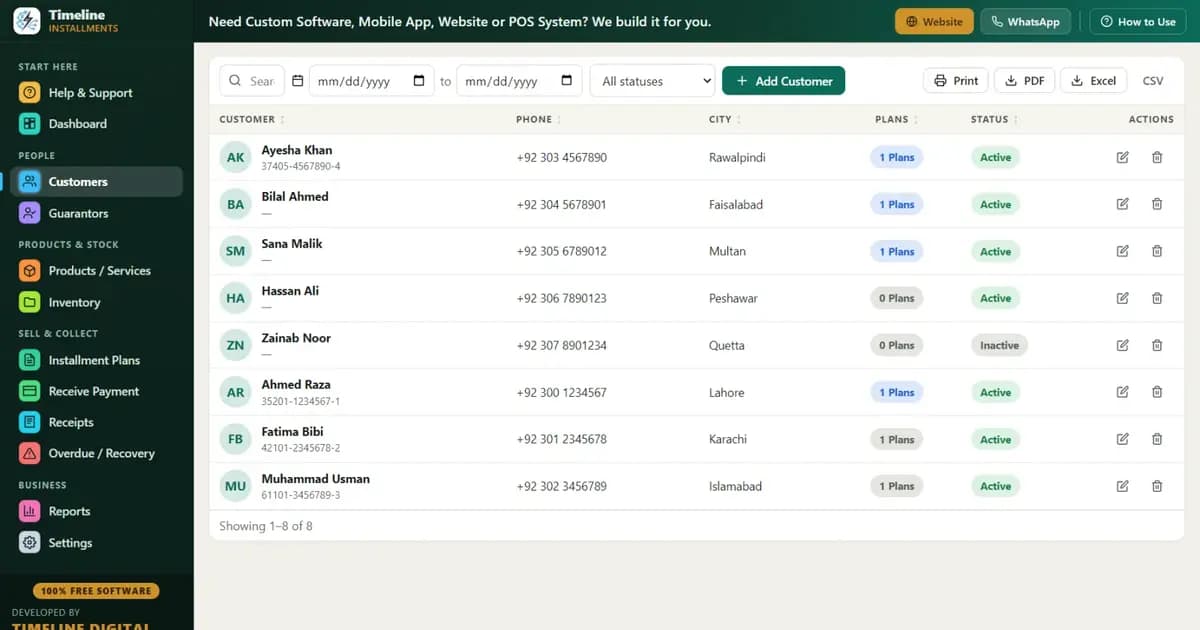
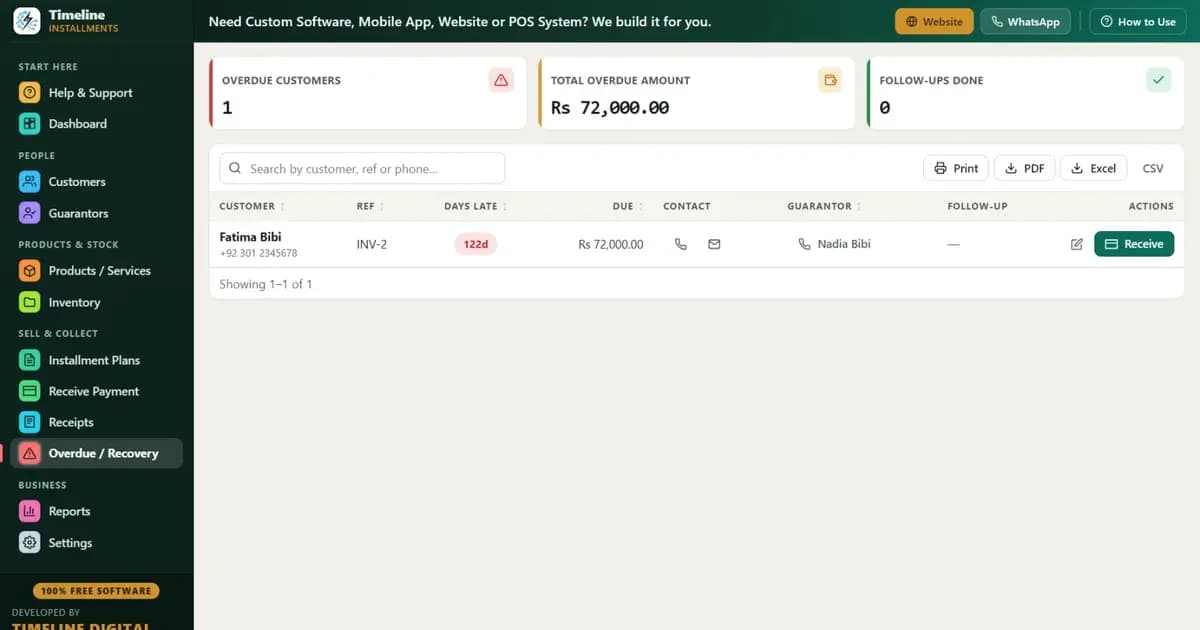
Timeline Free Installment Manager treats guarantors as first-class records: every customer has an ID field (national ID or passport), and guarantors/co-makers are linked directly to plans — so when a payment is late, the Overdue screen shows the guarantor's phone number right next to the customer's.
How Do You Record M-Pesa, MoMo, and Bank Payments Properly?
Most of your collections won't be cash. In Kenya it's M-Pesa; in Ghana it's MTN MoMo; in Nigeria it's bank transfer and USSD. That's good news — mobile money leaves a trail — but only if your records match it.
The working rule: record every mobile-money payment in your installment system with method "online", together with the date and amount, the moment the confirmation SMS arrives. In Timeline, payment methods are cash, bank, card, online, and other — M-Pesa, MoMo, and transfer payments all go under online. Then hand or send the customer a receipt showing "Installments Paid X of Y" and the remaining balance.
Why this discipline matters:
- The mobile-money statement proves money arrived; only your installment record proves which plan and which week it paid for.
- Customers often pay odd amounts — KSh 2,000 today, KSh 1,500 Friday. Timeline applies partial payments oldest-first, so the books stay clean without mental arithmetic.
- When a customer says "I finished paying long ago," you settle it in ten seconds with a Customer Statement instead of an hour of scrolling through SMS.
What Should Your Recovery Cadence Be?
Speed is everything. A payment chased on day 2 is a payment; a payment ignored for three weeks is a loss forming. A cadence that works across Lagos, Nairobi, and Accra:
| Days late | Action |
|---|---|
| 1–2 | SMS/WhatsApp reminder: amount due, balance, and how to pay. Friendly tone. |
| 3–4 | Phone call to the customer. Ask what happened; agree a specific day. |
| 5–7 | Call the guarantor — politely, as an alert, not an attack: "We haven't reached Daniel; his payment is behind." Guarantor pressure resolves most cases here. |
| 8–14 | Visit (shop, stall, or home) or a formal notice. Apply the late fee your agreement states. Offer a restructure if the problem is real. |
| 14+ | Follow the remedies in your signed agreement. For motorcycles, this is where repossession clauses come in — act per the contract and local law, and take professional advice. |
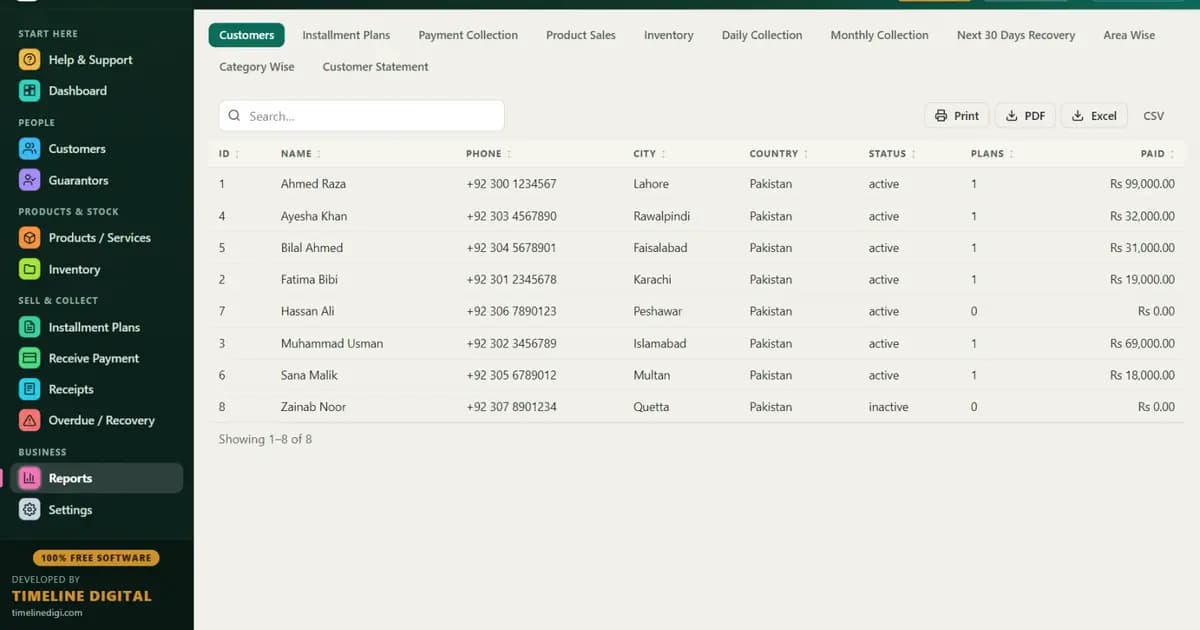
Run this from a list, not from memory. Timeline's Overdue screen shows every late plan with days late, amount owed, and both customer and guarantor phone numbers; the Next 30 Days Recovery report tells you what should be collected this month, and the Area Wise report groups customers by location so a field visit day covers one neighbourhood at a time. More tactics: /blog/installment-recovery-tips.
How Do You Run This Where Internet Is Unreliable?
Cloud software has a hidden assumption: always-on internet. In a shop in Kisii, a market in Onitsha, or a roadside dealership outside Tamale, that assumption fails weekly. The fix is offline-first software.
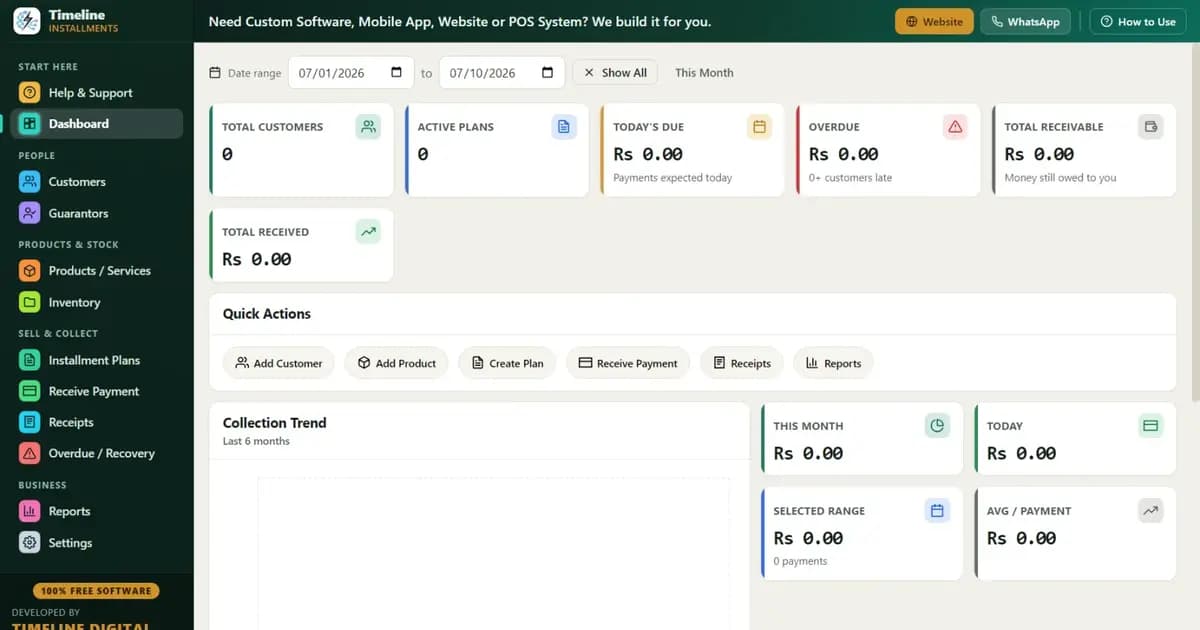
Timeline Free Installment Manager (v1.6.0, by Timeline Digital — timelinedigi.com) is built exactly this way, and it's 100% free forever (Timeline Digital sells custom software; the free app is their lead generator, so there's no catch and no trial clock):
- Fully offline local database — no internet needed to sell, record payments, or print receipts. Your data lives on your shop PC, not on someone's server.
- Windows 10/11, about 90 MB, no account or login. It installs and runs on a modest shop laptop.
- Currency auto-detects from your country — ₦, KSh, or ₵ appear automatically (150+ currencies supported).
- Daily, weekly, or monthly schedules generated automatically with a live preview — daily plans for market traders, weekly for riders, monthly for salaried customers. See /blog/daily-weekly-monthly-installments for choosing.
- Deposit auto-recorded as the first payment with a printed receipt.
- Branded print/PDF receipts with your logo, "Installments Paid X of Y", the remaining balance, signature lines, and an editable terms footer.
- Late fees as fixed or % of remaining balance; discounts count toward settlement for negotiated early payoffs.
- Stock auto-reduces when a phone or bike is sold on a plan.
- 11 reports — Daily Collection for end-of-day reconciliation against M-Pesa, Customer Statement for disputes, Area Wise for field visits — exportable to Print, PDF, Excel, or CSV.
- One-click Backup & Restore (keep a copy on a flash drive) and a Sample Data practice mode to train staff safely.
Africa-specific details at /hire-purchase-software-africa, or the overview at /free-installment-management-software.
One awareness note: consumer credit and hire purchase are regulated differently in Nigeria, Kenya, and Ghana. This guide is business practice, not legal advice — consult a professional about licensing, agreements, and repossession rules in your country before scaling up.
---
Ready to grow beyond the notebook? Download Timeline Free Installment Manager — free forever, fully offline, with your currency set automatically. Load the Sample Data, practice a boda-boda plan, and you'll be running real plans the same afternoon: /free-installment-management-software.