Most installment businesses don't fail because of bad customers — they fail because of ten avoidable mistakes in how the owner runs credit. The good news: every one of them has a simple, cheap fix, and most fixes take less than a day to put in place.
Below are the ten mistakes we see most often, each with what actually happens, a quick numeric example, the fix, and the software feature that makes the fix automatic.
Mistake 1 — Why is selling with no (or tiny) down payment so dangerous?
What happens: With nothing invested, the customer has nothing to lose by walking away. Zero-down sales attract exactly the buyers who never intended to finish paying, and they leave you carrying the full item cost.
The numbers: A phone costs you 160,000. Sold at 225,000 with zero down, a default in month one loses you the full 160,000. With a 20% down payment (45,000), the same default loses you 115,000 — and, more importantly, that customer probably never buys, because non-payers avoid down payments.
The fix: Set a floor — 20% minimum, 30–40% for new customers — and never negotiate below it. A customer who fights the down payment is showing you their next six months.
Software help: In Timeline Free Installment Manager, the down payment is auto-recorded as the first payment when the plan is created, so it's captured on paper and in the balance from day one.
Mistake 2 — What goes wrong when you skip guarantor verification?
What happens: A guarantor whose phone number is wrong, whose ID was never copied, or who lives in the buyer's own house is decoration, not security. When the buyer disappears, you discover your "guarantee" can't be found or has no independent money.
The numbers: Say 5 accounts go seriously late in a year, averaging 30,000 outstanding each. Shops with real, reachable guarantors typically recover most of these with a single call each; with fake or unverified guarantors, all 150,000 is in the wind.
The fix: Guarantor from a different household, ID photocopied, phone verified by calling it once while they're standing in your shop, and a signed one-line promise on the agreement (template in our agreement format guide).
Software help: Timeline stores guarantors with ID and contact details linked to each plan, and shows the guarantor's contact right on the Overdue screen next to the late customer.
Mistake 3 — Why do hand-written schedules cost real money?
What happens: A smudged digit, a skipped date, or a totals column that doesn't add up. Six months later the customer's paper says one thing, yours says another — and in a dispute over your own math, you lose.
The numbers: One arithmetic slip of 2,000 per plan across 50 plans a year is 100,000 gone — before counting the hours spent arguing.
The fix: Never hand-write a schedule. Generate it, print it, staple it to the agreement, and give the customer an identical copy.
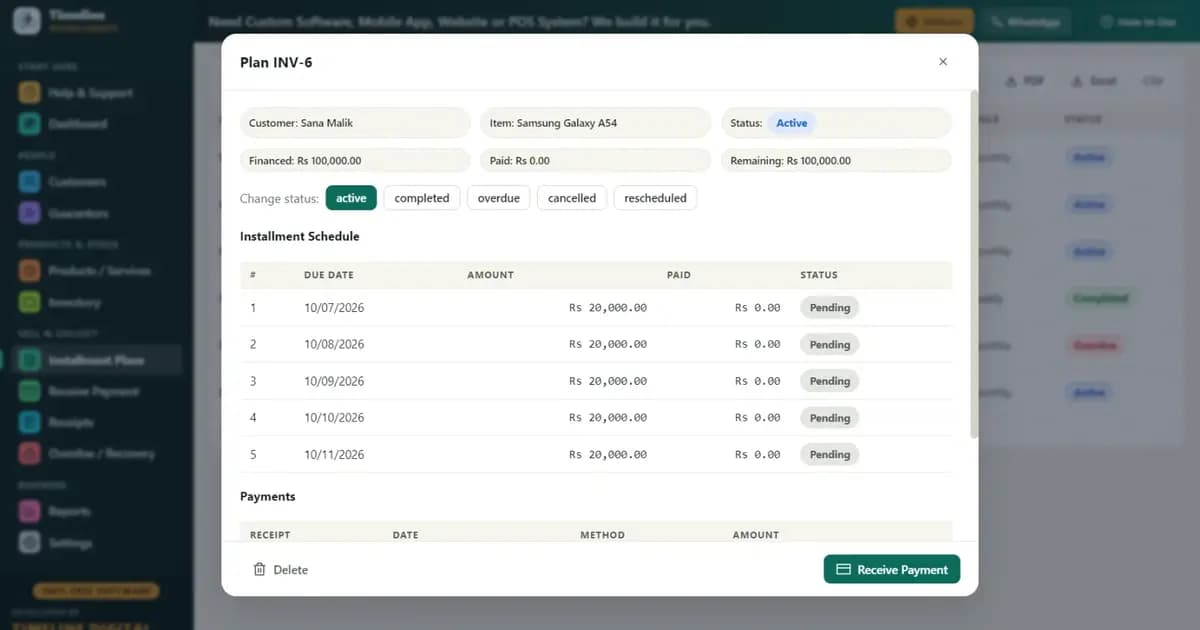
Software help: Timeline auto-generates daily, weekly, or monthly schedules with a live preview, so both copies come from the same math. (See which schedule type fits your customers.)
Mistake 4 — What happens when payments have no receipts?
What happens: "I paid your brother 10,000 last month." Without receipts you can't prove otherwise, and every undocumented payment becomes the customer's word against yours. Worse, staff-level leakage becomes invisible.
The numbers: If just 2 disputed payments a month average 8,000 each and you split the difference to keep the peace, that's 96,000 a year in quiet losses.
The fix: A printed receipt for every payment, no exceptions, and a clause in the agreement that payments count only with a receipt.
Software help: Timeline prints branded receipts — your logo, "Installments Paid X of Y," remaining balance, signature lines — on any Windows printer, including Microsoft Print to PDF for sending a copy by WhatsApp.
Mistake 5 — Why does a late first reminder call cost so much?
What happens: The owner waits "a week or two, to be polite." By then the customer's spare cash is spent, the missed installment has a friend, and the account has learned that missing payments brings no consequence.
The numbers: One missed 30,000 installment is recoverable. Let it sit 45 days and it's usually two missed installments — 60,000 — and a customer who now avoids your calls. Recovery odds drop sharply with every silent week.
The fix: A friendly call on day one late. Not a threat — a reminder. "Salaam, just checking — your installment was due yesterday, everything okay?" Early and polite beats late and angry every time (full routine in our recovery tips).
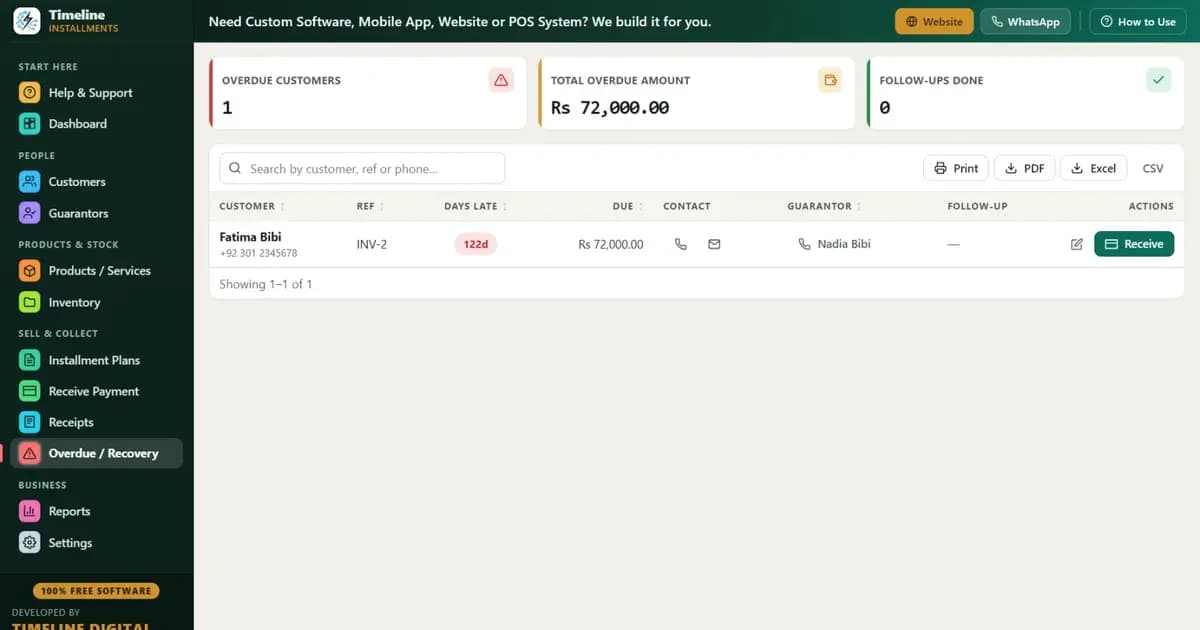
Software help: Timeline's Overdue screen shows every late account with days late, the customer's phone number, and the guarantor's contact — your morning call list, ready-made.
Mistake 6 — Should you ever sell again to a late payer?
What happens: A customer three installments behind asks for a new item "and I'll clear both together." The owner, hoping to keep the relationship, agrees — and converts one bad debt into two bigger ones.
The numbers: Customer owes 40,000 overdue. You add a new 90,000 plan. If they were failing at 40,000, they will certainly fail at 130,000 — you've tripled the loss to avoid one awkward conversation.
The fix: Hard rule: no new plan while any installment is overdue. Frame it kindly: "Clear the current plan and I'll happily set up the next one the same day."
Software help: Timeline's Customer Statement report shows the full history and live balance for any customer in seconds — check it before every repeat sale.
Mistake 7 — What is area concentration risk?
What happens: All your credit sits in one neighborhood or one employer's workforce. Then the factory cuts shifts, or a local event hits that area's income, and half your book goes late in the same month.
The numbers: If 70% of a 2,000,000 receivable book sits in one area and that area has a bad quarter, even a 25% slippage there means 350,000 late at once — enough to stop you restocking.
The fix: Watch the geographic spread of your outstanding balance and deliberately grow in a second and third area before deepening the first.
Software help: Timeline's Area Wise report (one of 11 built-in reports, all exportable to Print/PDF/Excel/CSV) shows exactly where your money is concentrated.
Mistake 8 — Why does mixing business and personal cash sink shops?
What happens: Installment income arrives daily in small amounts, so it feels like pocket money. Owners spend collections as they come in, and when a supplier invoice lands, the "profitable" shop has no cash — because the profit was eaten in fragments.
The numbers: Collecting 15,000 a day and skimming 4,000 for household spending feels harmless, but that's 120,000 a month — often more than the shop's true profit — leaking out untracked.
The fix: Pay yourself a fixed weekly amount, keep collections in the business, and judge the shop by its receivable and received totals, not by the cash drawer's mood.
Software help: Timeline's dashboard and Daily Collection report show exactly what came in and what's still owed, so the shop's real position is never a guess.
Mistake 9 — What does having no backups risk?
What happens: All records on one computer, and one hard-disk failure, theft, or spilled tea erases who owes what. Your receivables are only as real as your records — customers do not volunteer to remember their balances for you.
The numbers: If your book is 1,500,000 in outstanding balances and records vanish, honest customers keep paying, but even losing track of 10–15% means 150,000–225,000 gone — plus every dispute now defaults in the customer's favor.
The fix: Back up on a schedule, keep a copy off the machine (USB drive stored at home), and test a restore once so you know it works.
Software help: Timeline has one-click Backup & Restore with built-in reminders, and because the database is fully local and offline, the backup file is yours — no cloud account to lose access to.
Mistake 10 — What's wrong with pricing that ignores default math?
What happens: The owner sees a 40,000 markup per sale and thinks that's the profit. But some customers won't finish paying, and that expected loss must come out of the markup. Shops that skip this math grow busily and go broke slowly.
The numbers: Markup 43,200 on 180,000 financed. At a 3% default rate the real profit is ~37,800; at 15% it's ~16,200 — the same "profitable" sale earning barely a third. One total default (180,000) wipes out the real profit of four or five good deals.
The fix: Use Real Profit = Markup − (Default Rate × Amount Financed) on every pricing decision, and actually measure your default rate. The full method with tables is in our pricing guide.
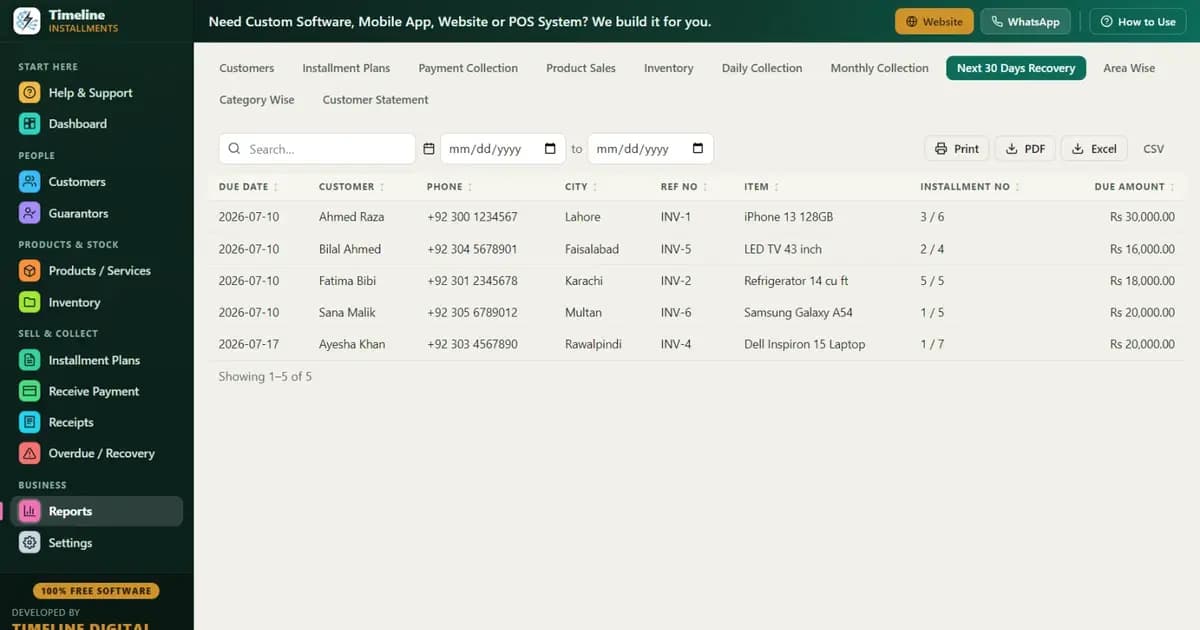
Software help: Timeline shows Total Receivable vs Total Received on its dashboard, and the Next 30 Days Recovery report projects what should arrive — so your default rate becomes a number, not a feeling.
The ten mistakes at a glance
| # | Mistake | Typical cost | The fix | Timeline feature |
|---|---|---|---|---|
| 1 | No/low down payment | Full item cost per default | 20% floor, 30–40% for new customers | Down payment auto-recorded |
| 2 | Unverified guarantor | Whole overdue book unrecoverable | Different household, ID + verified phone | Guarantors linked to plans |
| 3 | Hand-written schedules | Disputes + math losses | Print every schedule | Auto schedules, live preview |
| 4 | No receipts | Quiet leakage, lost disputes | Receipt for every payment | Branded print/PDF receipts |
| 5 | Late first reminder | Recovery odds collapse | Friendly call on day one late | Overdue screen with contacts |
| 6 | Selling to late payers | Doubles the bad debt | No new plan while overdue | Customer Statement report |
| 7 | Area concentration | Half the book late at once | Spread across areas | Area Wise report |
| 8 | Mixed cash | Profit eaten in fragments | Fixed owner salary | Daily Collection report |
| 9 | No backups | Entire receivable book at risk | Scheduled off-machine backups | One-click Backup & Restore |
| 10 | Ignoring default math | "Profitable" shop goes broke | Price with the real-profit formula | Receivable vs Received dashboard |
Fix the tooling half today, free
Half of these mistakes are rules you set; the other half are solved by proper tracking. Timeline Free Installment Manager — 100% free forever, fully offline, no account, Windows 10/11 — covers the tracking half: auto schedules, branded receipts, guarantor-linked plans, the Overdue screen, 11 reports, and one-click backups. Install it, switch on Sample Data mode, and practice the routine before your next sale.
Related: Recovery Tips · Calculate Installment Price & Profit · Start an Installment Business