To offer payment plans to customers, a small business has three routes: sign up with a BNPL provider, partner with a consumer financing company, or run in-house payment plans where the customer pays you directly over weeks or months. In-house plans usually win for stores with repeat local customers and big-ticket items, because you keep the fee a provider would take and you control the terms — but you take on the collection work, so you need a written policy, a signed agreement, and a system that tracks every payment.
This guide compares all three routes honestly, shows you a worked dollar example, and gives you the exact checklist to launch in-house plans this week.
Why Should a Small Business Offer Payment Plans at All?
Because a lot of your customers can afford your product — just not all at once on the same day. A $900 appliance is a hard "today" purchase for a family living paycheck to paycheck. Split it into a down payment plus six manageable installments and the same family says yes at the register.
Payment plans do three things for a small store:
- They rescue sales that would walk out the door. The customer who says "I'll come back next month" usually doesn't. A plan closes them today.
- They raise average ticket size. Shoppers who pay over time tend to pick the better model, not the cheapest one.
- They build repeat relationships. A customer who comes in weekly to make a payment is a customer who sees your new inventory weekly.
The question isn't really whether to offer plans. It's which route costs you the least and fits your customer base.
What Are the 3 Ways to Offer Payment Plans?
There are three routes, and they are very different businesses under the hood.
| BNPL providers (Affirm, Klarna, Afterpay, etc.) | Financing partners (consumer lenders, lease-to-own companies) | In-house payment plans (you carry the balance) | |
|---|---|---|---|
| Who gets paid up front | You — provider pays you, minus their fee | You — lender pays you, often minus a discount | Nobody — you collect over time |
| Who takes the default risk | The provider | The lender | You |
| Typical cost to the merchant | Typically a per-transaction fee noticeably higher than card processing | Typically a merchant discount or program fee; varies widely by program | $0 in fees — your cost is your own risk and collection effort |
| Customer approval | Provider's credit decision — some customers get declined | Lender's underwriting — declines happen | You decide; you can approve customers no lender would |
| Setup effort | Low — mostly online sign-up and checkout integration | Medium — application, contract, staff training | Medium — policy, agreement template, tracking system |
| Works offline / in-person | Best for e-commerce; in-store options vary | Yes, common in furniture and appliance retail | Yes — built for counter sales |
| Control over terms | None — provider sets everything | Little | Total — deposit, schedule, late fees, all yours |
| Best for | Online stores, smaller tickets, one-time buyers | Large tickets where you want zero risk | Regulars, big-ticket goods, thin margins, no-credit customers |
Honest summary: BNPL and financing partners sell you certainty — cash now, no chasing payments — and they charge for it. In-house plans keep every dollar in your pocket, but only if you run them with discipline. We compare the first two routes in more depth in BNPL vs in-house installments.
When Do In-House Payment Plans Beat BNPL and Financing Partners?
In-house wins in three specific situations:
1. You serve regulars. If you know your customers by name — a neighborhood furniture store, an appliance shop, a jewelry counter with repeat buyers — your default risk is far lower than a lender's model assumes. You're paying a provider to protect you from a risk you barely have.
2. You sell big-ticket items. On a $1,500 sale, a provider's per-transaction fee is real money. Carry the plan yourself and that fee stays in your margin. Across a year of installment sales, the difference can fund a part-time employee.
3. Your margins are thin. If you net 8-12% on a sale, handing several points to a BNPL provider can erase a third of your profit or more. In-house plans cost you effort, not percentage points.
In-house also wins when your customers can't get approved elsewhere. A customer with thin or damaged credit who has shopped with you for five years is exactly the person a lender declines and you shouldn't. That's the whole logic behind in-house financing — the store knows things the credit bureau doesn't.
When does in-house lose? When you sell mostly to strangers online, when you can't spare anyone to track payments, or when a single default would genuinely hurt your cash flow. Be honest with yourself about that last one.
What Do You Need to Set Up In-House Payment Plans? (Exact Checklist)
Don't start taking installment sales until every box below is checked. Verbal plans and memory-based tracking are how stores lose money.
Write a one-page policy that fixes:
- [ ] Deposit percentage. Typically 10-20% down. A customer with money down is a customer with skin in the game — deposits are your single best default filter.
- [ ] Term lengths you'll offer. Pick two or three (for example: 6 weekly, 12 weekly, 6 monthly) and stick to them. Custom terms for every customer become impossible to track.
- [ ] Payment cadence. Weekly or biweekly beats monthly for most retail plans — smaller amounts are easier for customers, and you spot a missed payment in 7 days instead of 30.
- [ ] Late-fee policy. A flat fee or a percentage of the remaining balance, stated in writing, applied consistently. Fee amounts and caps can be regulated in some states — this is awareness, not legal advice; confirm your numbers with a local professional.
- [ ] What happens on default. After how many missed payments do you cancel the plan? Does the customer forfeit the deposit? Write it down.
Build your paperwork:
- [ ] A signed installment agreement for every plan — item, total price, deposit, each payment amount and due date, late-fee terms, default terms, and signature lines for both parties. See our installment agreement format for a field-by-field template.
- [ ] A copy of the customer's government ID attached to the file.
- [ ] At least one reference — a name and phone number of someone who can reach the customer. For larger plans, consider a guarantor who co-signs.
- [ ] A printed receipt for every single payment, starting with the deposit. The receipt should show what was paid, the date, and the remaining balance. Receipts protect you and the customer from "I already paid that" disputes.
Set up tracking before your first plan — more on the free way to do that below.
What Does a Real Payment Plan Look Like in Dollars?
Here's a worked example you can copy for your own price points.
The sale: A customer wants a $900 appliance. You offer 20% down and 6 monthly payments.
| Line item | Amount |
|---|---|
| Cash price of appliance | $900 |
| Down payment at the register (20%) | $180 |
| Balance to finance | $720 |
| Monthly payment (6 payments) | $120 |
| Total paid by customer | $900 |
| Fees paid to any provider | $0 |
Compare that with the provider routes on the same sale: a BNPL provider or financing partner pays you up front but typically keeps a slice of the $900 as their fee — and on a thin-margin appliance, that slice comes straight out of your profit. In-house, the customer pays $900, you keep $900. Your "cost" is six months of waiting and the small chance of a default — which the $180 deposit, the signed agreement, and the reference on file all work to shrink.
One more practical note: record the $180 down payment as payment #1 on the plan, and hand the customer a receipt for it on the spot. It sets the tone that this plan is documented from dollar one.
How Do You Advertise Payment Plans Without Getting in Trouble?
This section is awareness, not legal advice — advertising credit terms is a regulated area in the United States, so run your signage and ad copy past a professional before you print it.
With that said, the safe habits are simple:
- Advertise the plan, not just the payment. A sign that says only "$120/month!" without the full picture can be a problem under federal and state advertising rules. Safer framing: "Payment plans available — ask at checkout" or "$900 total: $180 down + 6 monthly payments of $120."
- If you state one term, be ready to state them all. Rules on credit advertising often work on a "trigger" basis: mention a specific payment amount or term, and you may need to disclose the rest of the deal. Vague-but-honest ("Flexible payment plans available") avoids the trigger entirely.
- Never advertise "no credit check" as "guaranteed approval" unless it truly is. Say what you actually do.
- Match the sign to the paperwork. If your window says 10% down and your agreement says 20%, fix one of them today.
- Skip interest, skip most of the headache. Many small stores charge the same price paid over time — no interest, no finance charge. That keeps the plan simple and keeps you out of much of the credit-cost disclosure territory. If you do want to charge for financing, that's exactly when to consult a professional first, because state usury and disclosure rules apply.
How Do You Track Payment Plans Without Spreadsheets or Fees?
Paper ledgers fail the day you have 15 active plans. Spreadsheets fail the day an employee overwrites a formula. What you actually need is software that generates the schedule, records payments against it, prints receipts, and shows you who's late — and you don't need to pay for it.
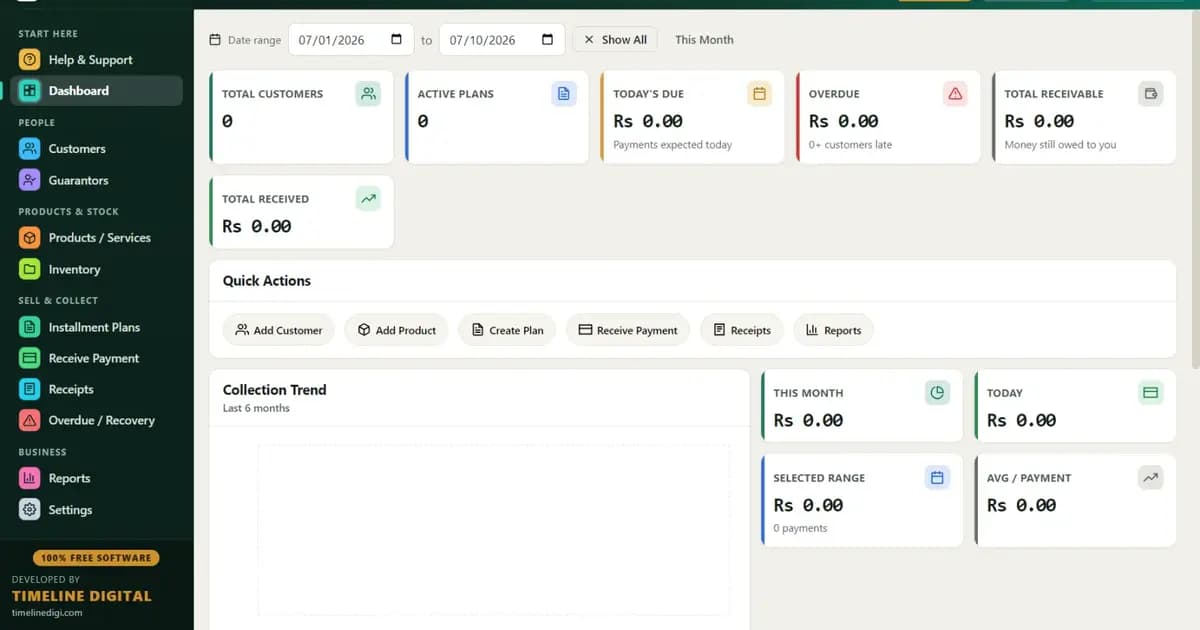
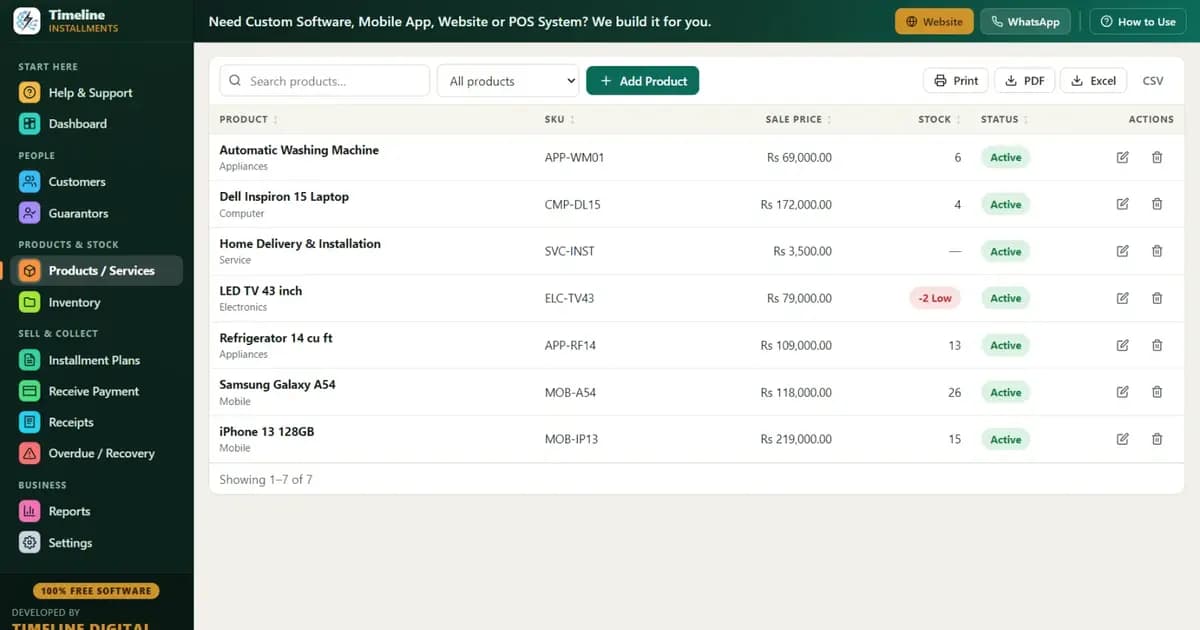
Timeline Free Installment Manager (v1.6.0, by Timeline Digital) is a Windows 10/11 desktop app that's 100% free forever — the company sells custom software, and this free tool is how they introduce themselves. For a payment-plan operation it covers the whole checklist above:
- Auto-generated schedules — daily, weekly, or monthly — with a live preview before you confirm, so you and the customer see every due date at the counter.
- The deposit is auto-recorded as the first payment, with a printed receipt on the spot.
- Customer files with ID and references (guarantors) linked directly to their plans.
- Late fees as a fixed amount or a % of the remaining balance, matching whatever your written policy says.
- Partial payments applied oldest-first, and discounts count toward settlement — real-life payment behavior handled cleanly.
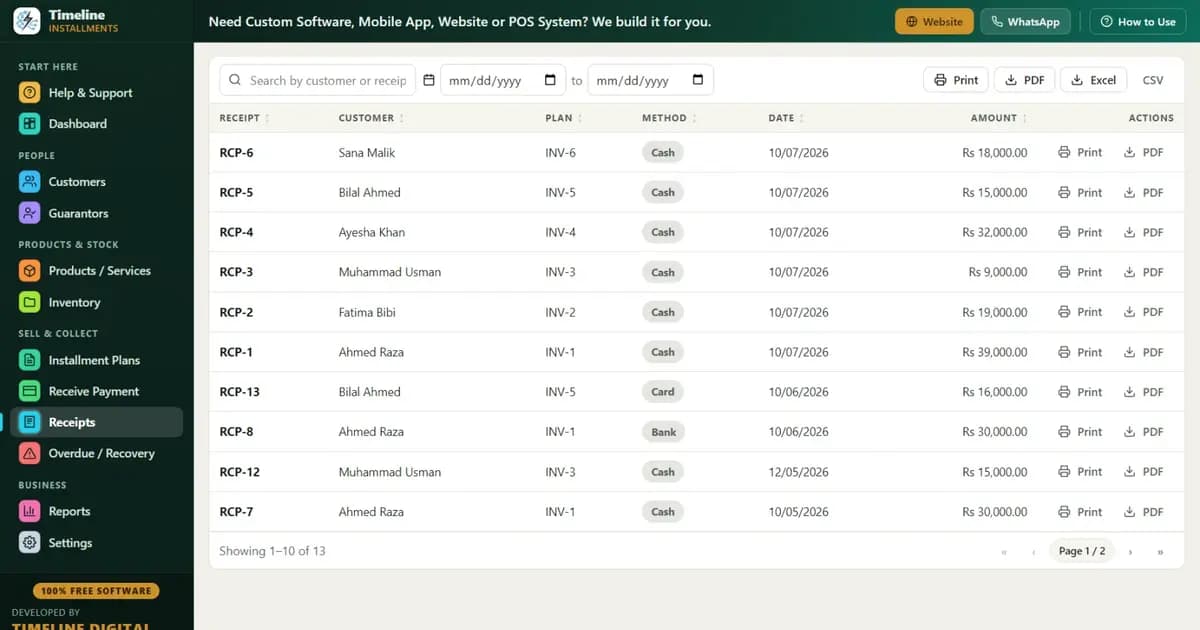
- Branded print/PDF receipts with your logo, "Installments Paid X of Y," the remaining balance, signature lines, and an editable terms footer — paste your plan policy right into the footer so every receipt restates the rules.
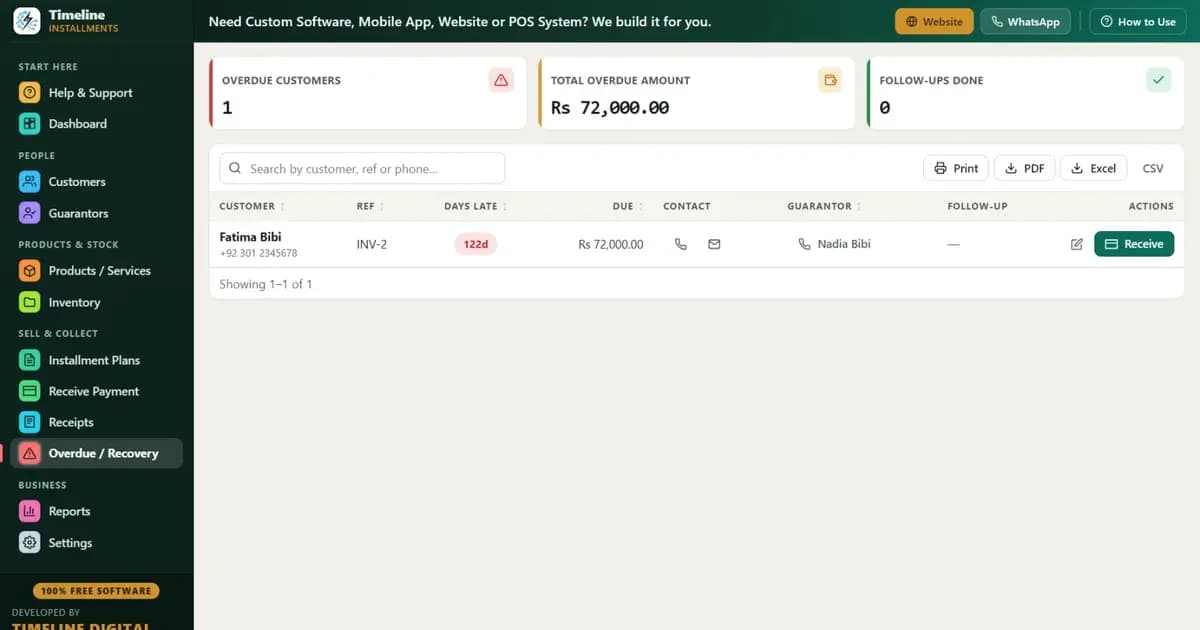
- An Overdue screen showing days late with phone numbers, plus 11 reports including Next 30 Days Recovery, Customer Statement, and Daily Collection — exportable to Print/PDF/Excel/CSV.
- Fully offline with a local database — no account, customer data never leaves your store — around a 90 MB install, USD auto-set for the United States with an MM/DD/YYYY date option, one-click Backup & Restore, and a Sample Data practice mode so staff can learn on fake plans first.
If plans slip anyway, our installment recovery tips cover the follow-up routine that gets late payers back on schedule.
Ready to offer your first payment plan? Download Timeline Free Installment Manager — free forever, offline, no account needed — set up a practice plan with the Sample Data mode tonight, and offer your first real plan at the register tomorrow. Also see our guides to layaway software and rent-to-own payment tracking if those models fit your store better.