Knowledge hub

Software development blog and guides

This is the Timeline Digital software development blog: straight answers on architecture, SEO, and product delivery, written in plain language for the people who have to make the decision, not for search engines.

Articles
253
Topics
15
Latest article
Nov 14, 2026

Latest articles

New articles on custom software, process design, and the technology decisions that move the needle.

Enterprise Systems

Software Testing for ERP and Enterprise Programs: Beyond UAT

ERP and enterprise programs need testing in layers: configuration and unit checks, integration testing across modules and systems, regression, data migration reconciliation, period-end and volume tests, access testing and finally user acceptance. This guide covers the program around UAT.

Oct 27, 202612 min readRead
ERP

ERP RFP Scoring Matrix and Vendor Evaluation Scorecard (With Worked Example)

An ERP RFP scoring matrix turns vendor responses into comparable numbers: pass or fail gates first, then weighted criteria scored on a fixed 0 to 5 scale by several evaluators. This guide gives a copyable scorecard, a worked example with illustrative numbers, and the checks that stop the spreadsheet from deciding for you.

Oct 27, 202611 min readRead

ERP

How to Write ERP Requirements That Vendors Can Actually Price

ERP requirements that vendors can price describe processes, volumes, users, integrations and data in testable sentences, ranked by priority. This guide shows how to gather them, a format that works, before and after examples, and the mistakes that make quotes impossible to compare.

Oct 27, 202610 min readRead

ERP

Food and Beverage ERP: Lot Traceability, Recall Readiness and Build vs Buy

Lot traceability in a food and beverage ERP means every receipt, production run and shipment carries a lot, linked in both directions so a recall can be scoped in minutes. This guide covers the genealogy data model, a recall-readiness scorecard, the gaps packaged food ERPs leave, and when a custom build is justified.

Oct 27, 202611 min readRead

ERP

ERP for NGOs and Nonprofits: Fund Accounting, Grant and Donor Tracking, and When Custom Makes Sense

An NGO ERP must track money by fund, grant and project at the same time, allocate shared costs fairly and report to each donor in its own format. This guide covers the accounting dimensions, grant lifecycle, cost allocation and donor reporting, and gives a test for when a custom build beats a packaged nonprofit system.

Oct 27, 202611 min readRead

ERP

Distribution ERP Implementation: 10 Steps and a Feature Checklist

A distribution ERP implementation runs in ten steps: map the flows, clean the item and customer data, design pricing and stock rules, build and integrate, migrate, test with real orders, train, cut over and stabilise. This guide gives each step, the cutover traps specific to wholesalers, and a feature checklist you can use in demos.

Oct 27, 202611 min readRead

ERP

Construction ERP: Job Costing, Retention, Subcontract Valuation and Progress Billing (Custom vs Package)

Construction ERP differs from standard ERP in four places: job costing against a cost code structure, retention held on both sides, subcontract valuations, and progress billing against a schedule of values. This guide explains each with a worked example and shows when a custom build is better than a packaged construction system.

Oct 27, 202612 min readRead

Custom Software

Custom POS Software Requirements Checklist for Retailers and Restaurants

A custom POS requirements document lists what happens at the counter, how prices and taxes are worked out, how stock moves, which hardware is used, what must work offline, which systems the till feeds, and who may do what. This checklist covers retail and restaurant needs, section by section.

Oct 27, 20269 min readRead

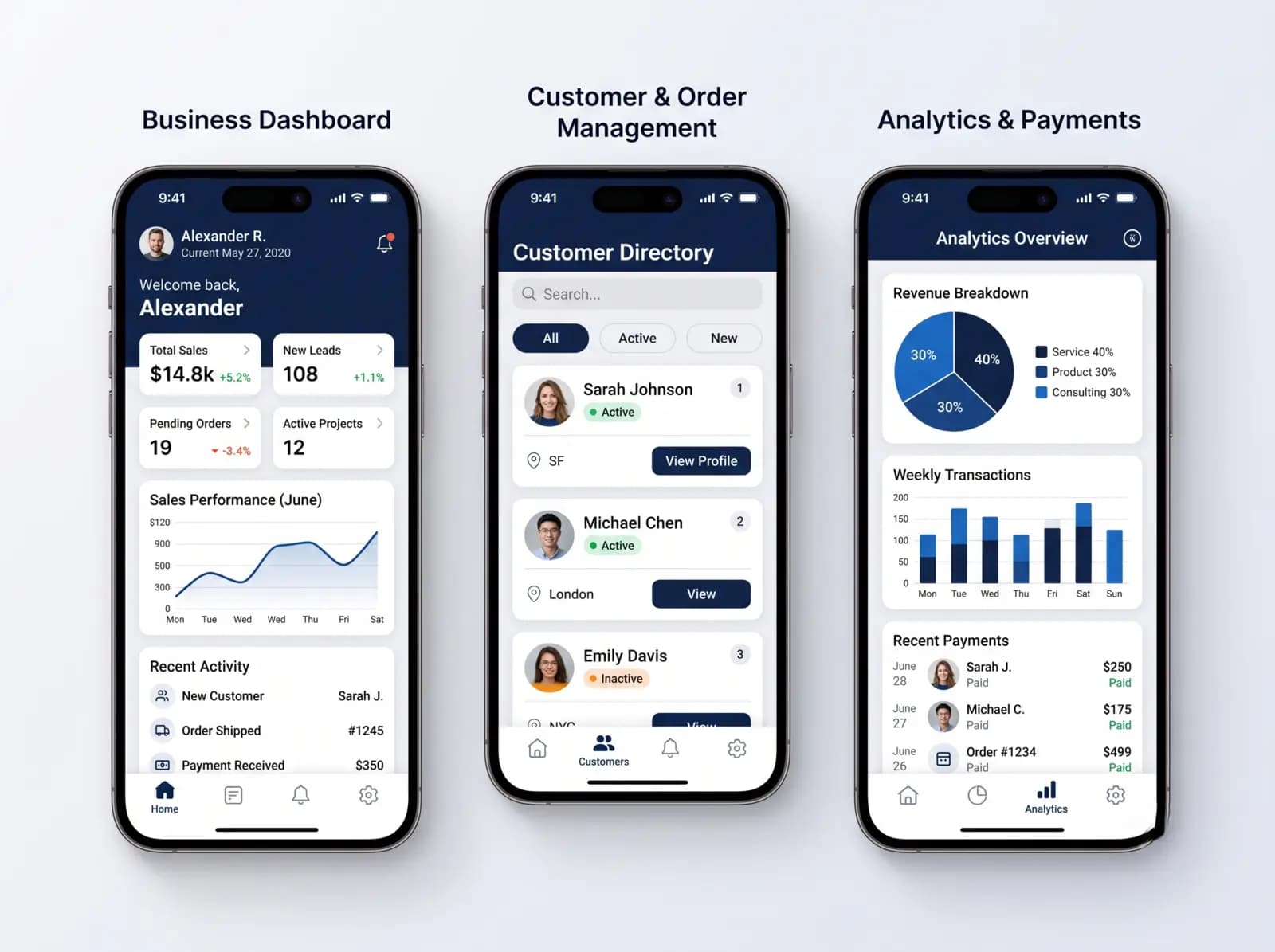
Illustrative UI mockup of mobile and tablet screens, representing an offline-capable point-of-sale application

Custom Software

Offline-First POS Architecture: Sync, Conflict Handling and Hardware

An offline-first POS treats the counter device as the place where a sale is completed, and the server as a place to reconcile. It stores sales locally, queues them in an outbox, syncs with idempotent writes, keeps stock as a ledger of movements, and agrees conflict rules in advance.

Oct 27, 202610 min readRead

Custom Software

Custom POS Software Cost: What Drives the Price and the Hidden Costs

The cost of custom POS software is driven by branches and counters, how unusual your pricing and tax rules are, the hardware, offline operation and the integrations. Hidden costs sit outside the build: payment fees, hardware replacement, hosting, integration upkeep, training and support.

Oct 27, 20269 min readRead

Custom Software

Custom CRM Requirements Checklist: Fields, Pipelines, Permissions and Automation

A custom CRM requirements document defines the data you store (objects and fields), the pipeline stages and their exit rules, who may see and change what, which tasks are automated, the integrations, the reports and the migration plan. This checklist walks through each area with examples.

Oct 27, 202610 min readRead

Custom Software

CRM Data Migration: From Spreadsheets, HubSpot or Zoho to a Custom CRM

Migrating to a custom CRM means inventorying what you have, mapping old fields and stages to the new model, cleaning and de-duplicating, loading into staging, reconciling counts, rehearsing, and cutting over with a rollback plan. The main risks are duplicates, lost history and broken relationships.

Oct 27, 202611 min readRead

Showing 62–73 of 253 articles

Start a conversation

Tell us how your business works.

Describe what is slowing your team down. We will help you work out what to build, and how a free pilot lets you judge our work before the full project.

Prefer WhatsApp? Start a chat

What happens next

  1. You send a short brief

    The problem, the people involved and any target date. A senior engineer replies within 4 business hours.

  2. We understand your workflow

    A first call about how your business works today. An NDA can be signed before you share details.

  3. You test a free pilot

    You choose 2 to 3 key modules and we build them first, so you judge real software before the full project.