Warehouse labor management is the practice of measuring, planning, and controlling the hours your warehouse staff spend on picking, packing, receiving, and shipping. A warehouse labor management system, or warehouse LMS, records who did what and how long it took, compares that against a fair expected time, and turns the gap into cost and productivity reports managers can act on.
Labor is usually the largest controllable cost in a warehouse, and it moves every day with volume, staffing, and overtime. Most operations still reconcile it in a spreadsheet after the fact, which tells you what happened last month but never in time to fix it. A warehouse LMS closes that gap. Here is how these systems work, what engineered standards actually measure, and how to choose the right level for your operation.
If you are here to choose and deploy a system rather than study the mechanics, start with the warehouse labor management system page, which compares the options and covers deployment. This article is the deep dive behind it.
What is a warehouse labor management system?
A warehouse labor management system is software that captures the time workers spend on each task, measures it against an expected standard, and reports the difference as productivity and cost. It sits between the warehouse management system that tells people what to do and the payroll system that pays them, turning raw hours into numbers a supervisor can manage against.
This is a specialized branch of the wider category covered in what a labor management system is. A general labor management system tracks attendance, overtime, and pay for any workforce. A warehouse-specific system adds task-level detail: it knows the difference between picking a full pallet and picking a single unit, and it holds a separate expected time for each.
How do engineered labor standards work?
Engineered labor standards are the core of any serious warehouse LMS, and they are what separate labor standards software from a simple time clock. A standard is the fair time a task should take, built from the physical steps involved: travel distance to the pick location, the number of cases handled, the weight, and fixed setup time. When a worker finishes the task, the system compares real time against the standard and reports the result as a percentage.
Not every warehouse needs standards built to that depth. The difference between the two common approaches matters when you budget the setup effort.
| Discrete standards | Engineered standards | |
|---|---|---|
| How it is built | Averages of past performance | Measured from the physical steps of each task |
| Accuracy | Rough, good enough for planning | Precise and defensible per task |
| Setup effort | Low | High, needs industrial engineering input |
| Best fit | Mid-size warehouses starting out | Large distribution centers with high volume |
Goals vs actuals: how does a warehouse LMS score performance?
Every warehouse LMS runs on the same loop: set a goal, capture the actual, report the variance. The goal is the standard time for the task. The actual is what the worker recorded through a scanner, a terminal, or the warehouse management system. The variance is performance to standard, usually shown as a percentage where 100 percent means the task was done in exactly the expected time.
Managers use that percentage to see where a shift is running ahead or behind while the shift is still on the floor, not after payroll closes. The same data separates direct labor, the hours spent moving product, from indirect labor such as cleaning, meetings, and waiting, which is often where quiet cost hides.
What is 3PL labor management software?
Third-party logistics providers have a sharper reason to measure labor than most warehouses: they bill clients for it. 3PL labor management software attributes every hour to the client whose goods were handled, which is what makes accurate cost-to-serve possible. Without per-client labor data, a 3PL cannot tell which contracts are profitable and which are quietly losing money against a fixed rate.
Cost-to-serve is simply the true cost of handling one client's volume, labor included. When a warehouse LMS tags each task with a client, the provider can compare the rate charged against the labor actually consumed, then renegotiate or redesign the contracts that do not cover their own cost.
Which warehouse labor management system is right for you?
That buying question deserves its own page, and this deep dive deliberately does not answer it. Our warehouse labor management system page compares the system tiers, enterprise WMS modules, standalone warehouse LMS tools, cloud workforce apps, and the free desktop route, against team size and volume, and is kept current as the commercial overview. Whichever tier you land in, the mechanics in this article are what to test for: task-level standards you can tune to your own layout, a live in-shift view of performance to standard, clean separation of direct and indirect labor, and a clean export into payroll.
How does labor optimization and compliance work?
Labor optimization software goes one step past measurement. Once you know the standard and the actual for every task, you can rebalance staff toward the work that is behind, flatten overtime by moving hours across shifts, and stop paying premium rates for work a standard shift could absorb. The measurement is the input; the optimization is what you do with it.
Compliance runs on the same data. In markets with strict working-time and break rules, labour optimisation and compliance software enforces the limits automatically, flagging a shift that would breach a maximum-hours or mandatory-rest rule before it is worked rather than after. That turns compliance from a monthly audit into a control that runs in real time.
Should you build custom or use free warehouse labor management software?
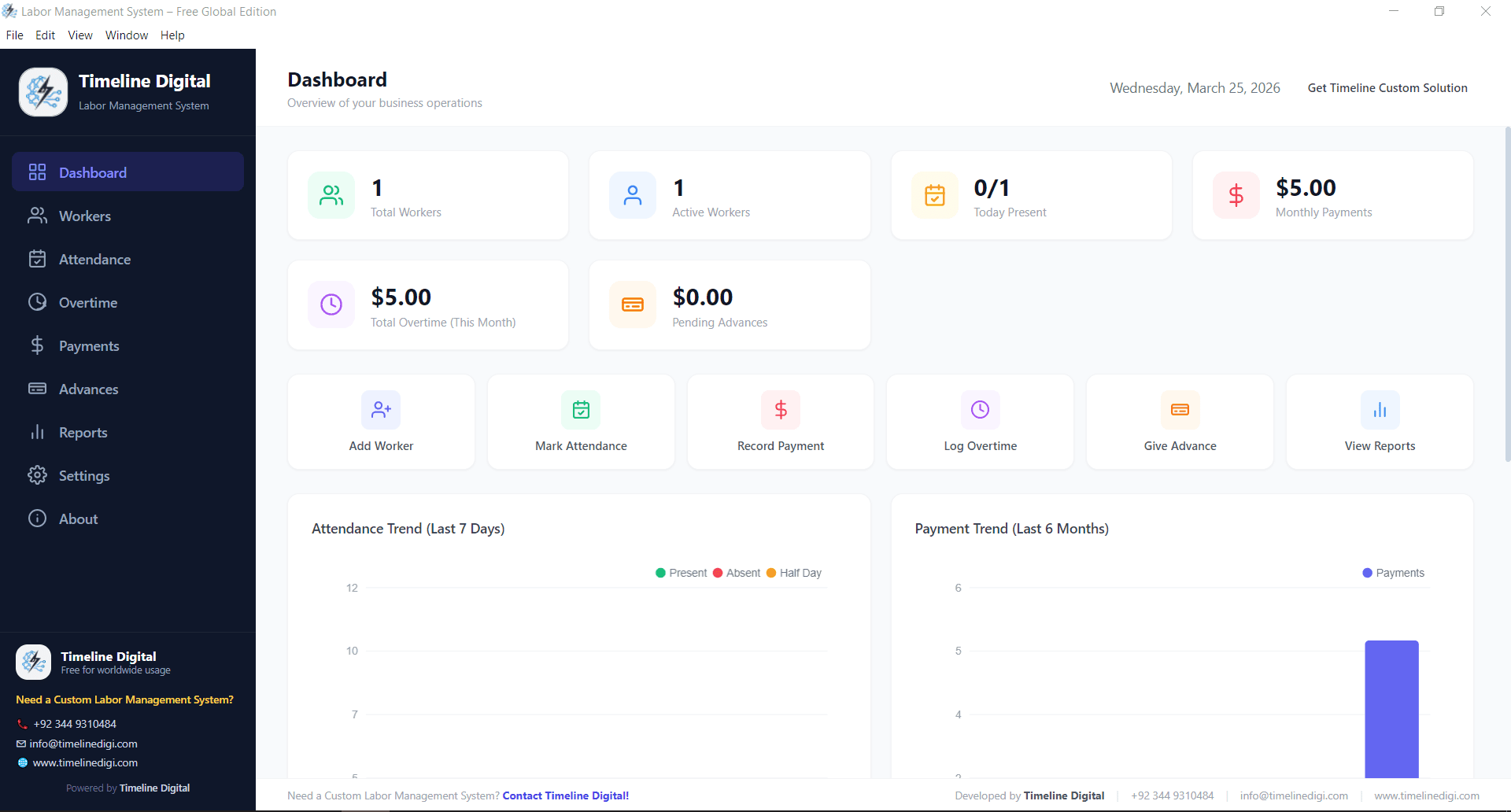
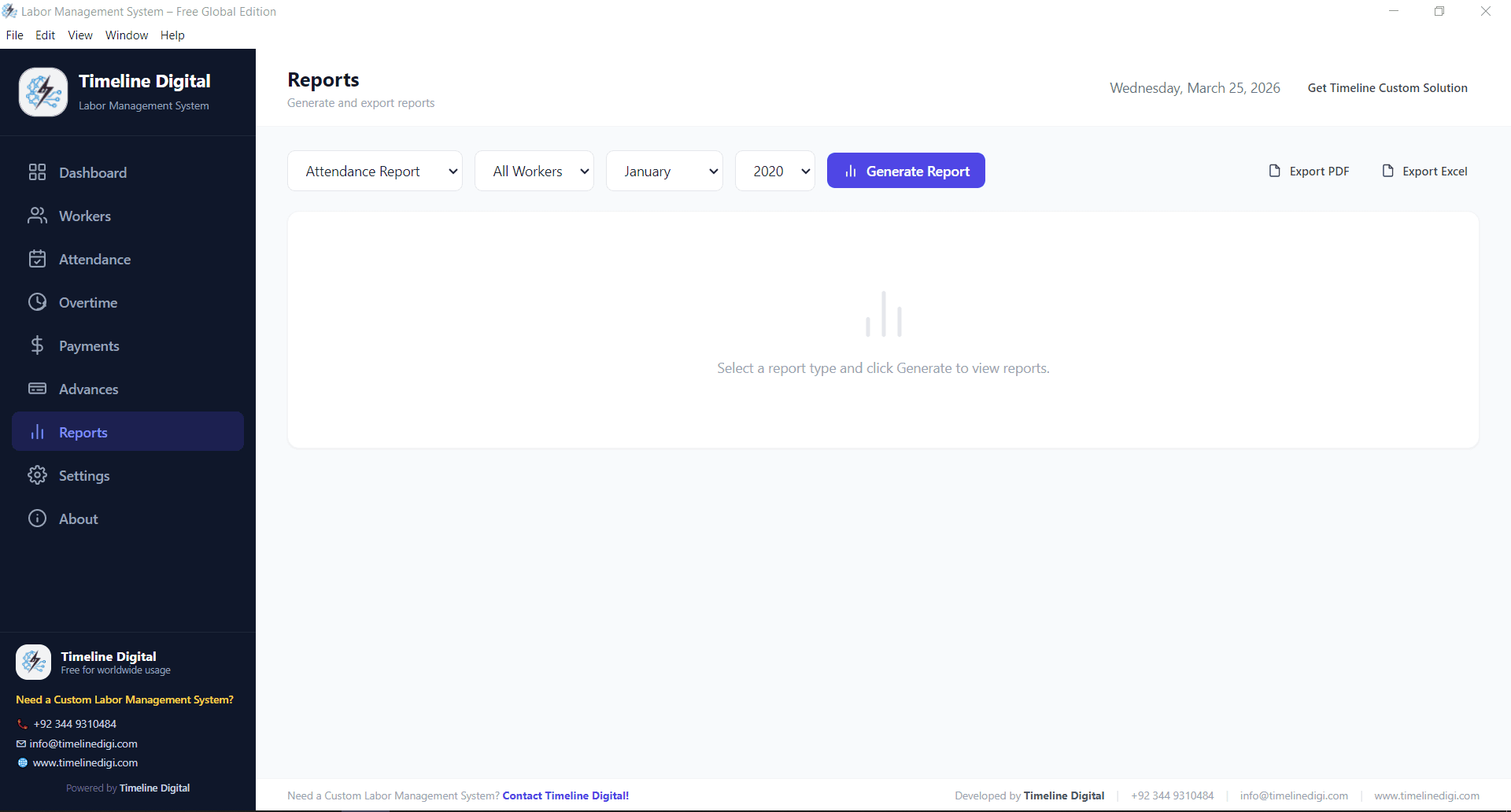
For a small warehouse or a single-site team, the honest starting point is free warehouse labor management software. Timeline's free labor management system runs offline on Windows and covers worker records, attendance, shifts, overtime, advances, and payroll at no cost, with no per-user fee and no account to create. It does not carry engineered standards, and for a team of this size it does not need to.
Custom becomes the right call when your rules do not fit a package: task-level standards tuned to your own layout, per-client cost-to-serve for a 3PL operation, or labor data feeding straight into job costing. Timeline Digital has built operations software since 2013 and develops custom labor and warehouse systems through our enterprise systems development team, sized to your floor rather than a generic template.
Where to start
Start with the problem that costs you the most. If hours and overtime are your pain, move attendance off paper first with free software, because every productivity number depends on accurate hours underneath it. If you already have reliable hours and need to measure output per task, that is the point where engineered standards and a full warehouse LMS earn their cost.
Want a warehouse labor management system built around how your floor actually runs? Talk to Timeline Digital's enterprise systems development team, or download the free labor management system and start tracking hours today.