Engineered labor standards and task benchmarking
Free app for hours, custom builds for standards
Warehouse Labor Management System
Warehouse labor management is the practice of measuring, planning, and controlling the hours your warehouse staff spend on picking, packing, receiving, and shipping. A warehouse labor management system records who did what and how long it took, compares that against a fair expected time, and turns the gap into cost and productivity reports managers can act on.
Labor is usually the largest controllable cost in a warehouse, and it moves every day with volume, staffing, and overtime. Most operations still reconcile it in a spreadsheet after the fact, which tells you what happened last month but never in time to fix it. A warehouse LMS closes that gap.
What Is a Warehouse Labor Management System?
A warehouse labor management system is software that captures the time workers spend on each task, measures it against an expected standard, and reports the difference as productivity and cost. It sits between the warehouse management system that tells people what to do and the payroll system that pays them, turning raw hours into numbers a supervisor can manage against.
This is a specialized branch of the wider category explained in what a labor management system is. A general labor management system tracks attendance, overtime, and pay for any workforce. A warehouse-specific system adds task-level detail: it knows the difference between picking a full pallet and picking a single unit, and it holds a separate expected time for each.
What a Warehouse LMS Tracks on the Floor
Warehouse leaders need labor visibility by zone, task, shift, and wave instead of end-of-day spreadsheets. Shift planning, training levels, and dock throughput are rarely aligned in one system, and generic workforce tools do not model warehouse work well. A proper warehouse labor platform covers:
Zone, wave, and dock-level staffing visibility
Productivity scorecards by worker, shift, and process
Cross-training, certifications, and role readiness tracking
WMS integrations for operational context and throughput analysis
Executive dashboards for cost per order and labor efficiency
Larger operations add incentive-pay and performance-exception workflows plus mobile supervisor tools for reallocating labor mid-shift. Smaller sites usually need the first honest layer, accurate hours by worker and shift, before any of the above earns its cost.
Engineered vs Discrete Labor Standards
Engineered labor standards are the core of any serious warehouse LMS, and they are what separate labor standards software from a simple time clock. A standard is the fair time a task should take, built from the physical steps involved: travel distance to the pick location, the number of cases handled, the weight, and fixed setup time. When a worker finishes the task, the system compares real time against the standard and reports the result as a percentage, where 100 percent means the task took exactly the expected time.
Not every warehouse needs standards built to that depth. The difference between the two common approaches matters when you budget the setup effort:
| Discrete standards | Engineered standards | |
|---|---|---|
| How it is built | Averages of past performance | Measured from the physical steps of each task |
| Accuracy | Rough, good enough for planning | Precise and defensible per task |
| Setup effort | Low | High, needs industrial engineering input |
| Best fit | Mid-size warehouses starting out | Large distribution centers with high volume |
Whichever type you use, every warehouse LMS runs on the same loop: set a goal, capture the actual, report the variance. Managers use that performance-to-standard number to see where a shift is running ahead or behind while the shift is still on the floor, not after payroll closes. The same data separates direct labor, the hours spent moving product, from indirect labor such as cleaning, meetings, and waiting, which is often where quiet cost hides. For third-party logistics providers there is a sharper use again: tagging every hour to the client whose goods were handled is what makes accurate cost-to-serve possible. The full mechanics, including 3PL cost-to-serve and labor optimization, are in our warehouse labor management systems deep dive.
The Four Tiers of Warehouse Labor Management Systems
There is no single best system, because the top warehouse labor management systems for a 500-person distribution center are overkill for a 20-person stockroom. Most systems fall into one of four tiers, and the right tier follows your scale rather than the marketing.
| Tier | What it is | Best for |
|---|---|---|
| Enterprise WMS-bundled labor module | Labor management built into a large warehouse suite | High-volume distribution centers |
| Standalone warehouse LMS | Dedicated labor standards software that connects to your WMS | Single large sites wanting depth without a full suite |
| Workforce time and attendance tool | Per-user subscription for time and scheduling | Teams that need hours and rosters, not standards |
| Custom-built system | Purpose-built software written around your own rules | Operations with standards, costing or rules a package cannot fit |
A free desktop tier sits underneath all four for small sites starting out. Comparing labor software beyond the warehouse? See the best labor management systems compared by category.
Start free. Version 1.0.0
Start With the Free Windows Labor App
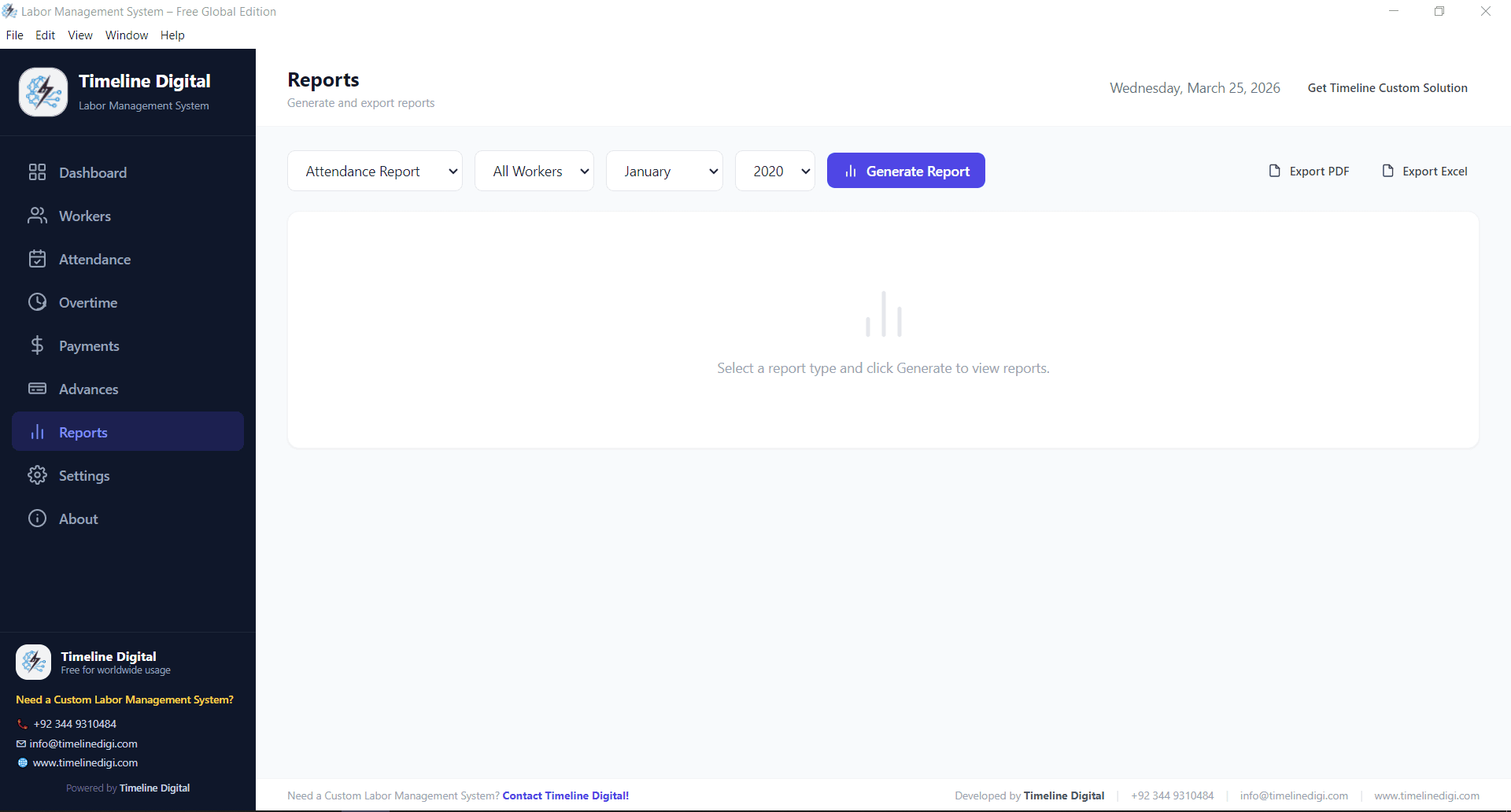
For a small warehouse or a single-site team, the honest starting point is free software. Timeline’s free labor management system runs offline on Windows and covers worker records, attendance, shifts, overtime, advances, and payroll at no cost, with no per-user fee and no account to create. Every productivity number depends on accurate hours underneath it, so moving attendance off paper is the first fix that pays.
It does not carry engineered standards, and for a team of this size it does not need to. A high-volume distribution center measuring output per pick will outgrow it; a 20-person stockroom will not.
- Track pickers, loaders, and drivers alongside salaried staff
- Attendance, overtime, and advances feed payroll automatically
- Runs fully offline, so it works on docks with no reliable Wi-Fi
- Sits alongside any existing WMS without forcing a data migration
Need Engineered Standards or Per-Client Costing? Build Custom
Custom becomes the right call when your rules do not fit a package: task-level standards tuned to your own layout, per-client cost-to-serve for a 3PL operation, incentive pay tied to performance-to-standard, or labor data feeding straight into job costing. A custom warehouse labor platform is a one-time build you own, not a per-user subscription, and Timeline Digital has built operations software since 2013, sized to your floor rather than a generic template.
Tell us how your floor runs
Zones, waves, standards, incentive rules, WMS integration, payroll handoff: we scope the build around your operation and you see working software early.
Keep Reading
The warehouse deep dive
Engineered standards in detail, goals-vs-actuals scoring, 3PL cost-to-serve, and labor optimization and compliance.
Read the guideThe broader comparison
Enterprise WMS-bundled, standalone, time and attendance, custom-built and free labor systems, compared by who each one fits.
Compare all categoriesWarehouse Labor Management FAQs
Straight answers to the questions warehouse operators ask before choosing a system.
What is a warehouse labor management system?
A warehouse labor management system is software that records the time workers spend on warehouse tasks such as picking, packing, receiving, and shipping, then measures that time against an expected standard and reports the result as productivity and cost. It sits between the warehouse management system, which directs the work, and payroll, which pays for it. Smaller sites use it mainly for accurate hours, overtime, and cost by shift, while large distribution centers add engineered standards to score each task.
What are engineered labor standards in a warehouse?
Engineered labor standards are the fair time a warehouse task should take, calculated from its physical steps: travel distance to the location, the number of cases handled, the weight, and fixed setup time. When a worker completes the task, the system compares the real time against the standard and shows performance as a percentage. They are more precise than discrete standards, which are simple averages of past performance, but they take more effort to build and usually need industrial engineering input to set up correctly.
What is the difference between a warehouse LMS and a WMS?
A warehouse management system, or WMS, directs the physical work: where to store stock, which items to pick, and how to route a shipment. A warehouse LMS measures the labor that work consumes and scores it against a standard. The WMS answers what to do and the LMS answers how efficiently it was done and what it cost. They are complementary, and a labor management system usually reads task data from the WMS so it can attach a time and a cost to every movement.
How much does a warehouse labor management system cost?
Cost depends on the tier. Free desktop software covers attendance, overtime, and payroll at no charge and suits small single-site teams. Cloud workforce tools bill per user per month, which grows with headcount. Enterprise labor modules inside a warehouse suite are quoted per project, and the implementation, including building engineered standards, often costs more than the licenses. A custom build is a one-time project fee with no per-user charge, and it makes sense when your labor rules do not fit any packaged product.
Is there free warehouse labor management software?
Yes. Timeline’s free labor management system runs offline on Windows and covers worker records, attendance, shifts, overtime, advances, and payroll with no subscription and no per-user fee. It is a practical starting point for a small warehouse that needs accurate hours and cost before investing in engineered standards. It does not include task-level productivity standards, so a high-volume distribution center measuring performance per pick will eventually outgrow it, but most smaller operations get accurate labor cost without paying anything to begin.